Agriculture: when people stopped being nomadic and the first villages arose
Executive Briefing
Synthesized and verified with gemini-2.0-flash-thinking-exp
“For most of human history, people lived in small groups, moving seasonally to hunt and gather.”
Key Takeaways
- 1.For most of human history, people lived in small groups, moving seasonally to hunt and gather.
- 2.Then after the end of the last Ice Age, in many parts of the world, different groups of people almost independently began to sow seeds, raise livestock and stay in one place.
- 3.Gordon Childe called this transition the "Neolithic Revolution" in his 1936 book *Man Makes Himself*.
For most of human history, people lived in small groups, moving seasonally to hunt and gather. Then after the end of the last Ice Age, in many parts of the world, different groups of people almost independently began to sow seeds, raise livestock and stay in one place. Archaeologist V. Gordon Childe called this transition the "Neolithic Revolution" in his 1936 book Man Makes Himself. Although it was called a revolution, it lasted thousands of years.
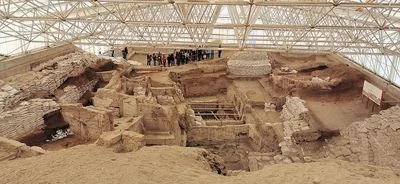
Çatalhöyük excavation site in Konya (Türkiye), where Neolithic people lived continuously from about 7400 to 6200 BC in houses built next to each other
Start in the Fertile Crescent
The Holocene, the warmer climate period in which we live, began about 11,700 years ago. According to Britannica, the first evidence of farming and animal domestication in Southwest Asia dates to about 9500 BC, and by about 7000 BC village farming lifestyles were well established in the Tigris and Euphrates river basins and in what is now Syria, Israel, Lebanon and Jordan. Wikipedia states a slightly different time frame, from 10,000 to 8,000 BC, suggesting that these dates are still being adjusted according to new findings.
This region was the site of domestication of three cereals including einkorn wheat, emmer wheat and barley, four legumes including lentils, peas, bitter beans and chickpeas, and flax. Sheep, goats, then cows and pigs were also domesticated in West Asia.
Einkorn wheat (Triticum monococcum), one of the first cereals domesticated in West Asia, specimen kept at Toulouse Museum of Natural History (France)
Domestication was not a one-day invention. Wild wheat has flowers that easily drop their seeds when ripe, and the seeds fall to the ground before people can harvest them. The plants that keep their seeds on the flower for a long time are the ones that are harvested, stored and re-sown the following season. Repeatedly over many seasons, people accidentally select seed-keeping varieties. Experiments by Gordon Hillman and Stuart Davies show that selection may take as little as 20 to 200 years, although in reality domestication often takes longer and involves centuries of previous cultivation of wild plants.
Not just a cradle
- China: the Yangtze River basin is where rice was domesticated, according to Wikipedia, between 13,500 and 8,200 years ago. The Yellow River Basin domesticated millet with evidence about 8,000 years ago. Britannica believes that millet and rice farming villages in the Yellow River and Southeast Asia appeared much later, around 3500 BC.
- Mexico: corn was domesticated from a wild grass called teosinte. The team of archaeobotanist Dolores Piperno (Smithsonian) announced that the earliest traces of corn in the Balsas River valley are about 8,700 years old, Britannica records its domestication around 8,000 BC.
- New Guinea: highlanders grow bananas, taro and yams. Wikipedia mentions the Kuk site possibly from about 8,000 BC, while Britannica identifies the independent Neolithic period here at about 5,000 years ago.
Illustrative diagram: earliest agricultural milestones in several independent centers, measured in years before present day
From tent to village
When there is surplus food, people need a place to store it, and the granary needs someone to guard it. The population increased rapidly, a phenomenon researchers call the Neolithic demographic transition. Included were what is commonly referred to as the "Neolithic package": livestock, pottery, polished stone tools, and rectangular houses.
Çatalhöyük in the Anatolian plateau is an example recognized by UNESCO. The eastern mound has 18 levels of residence from about 7400 to 6200 BC. The houses are built back to back, there are no paths between the houses, people enter and exit through the roof paths. The houses are roughly the same size, which UNESCO considers a sign of a fairly egalitarian community. This 37-hectare site was included in the World Heritage list in 2012.
Advertisement
Stone tower at Jericho (West Bank), one of the oldest known structures, built in the pre-ceramic Neolithic period
The price of settlement
Agriculture feeds more people, but it doesn't necessarily make them healthier. Wikipedia summarizes that the menu of the first farmers was less diverse than that of hunter-gatherers, with reduced nutritional quality. Dependence on a few staple crops can cause deficiencies, for example corn lacks the two essential amino acids lysine and tryptophan and is poor in iron. Crowded living next to waste, livestock and grain warehouses also creates conditions for parasites, rats and pathogens.
Still, surplus food allows some people to avoid having to forage directly. Craftsmen, merchants, administrators and writing appeared one after another on that platform. The earliest known civilization arose in Sumer, southern Mesopotamia, about 6,500 years ago. The order in which these steps occurred and why people chose to stay remains a subject of debate, and the answer probably differs from region to region.
Source:
Wikipedia
,
Britannica
,
UNESCO
,
PNAS (Piperno et al., 2009)