Airbnb manages coding agents on Amazon Bedrock using cost per task
Executive Briefing
“Airbnb uses cost per task evaluations and internal metrics to select foundation models for...”
Key Takeaways
- 1.Engineers and engineering-adjacent staff at Airbnb use AirChat, their internal tool for running coding agents, which routes requests through Amazon Bedrock.
- 2.Cost per task represents the list-price cost of all the tokens an agent consumes to finish a single task.
- 3.Before a rollout, the team runs evaluations on representative tasks to measure each model's performance score and cost per task.
Airbnb uses cost per task evaluations and internal metrics to select foundation models for coding agents through Amazon Bedrock. This approach helps the engineering team balance task performance, token usage, and production spend.
Key Developments & Primary Facts
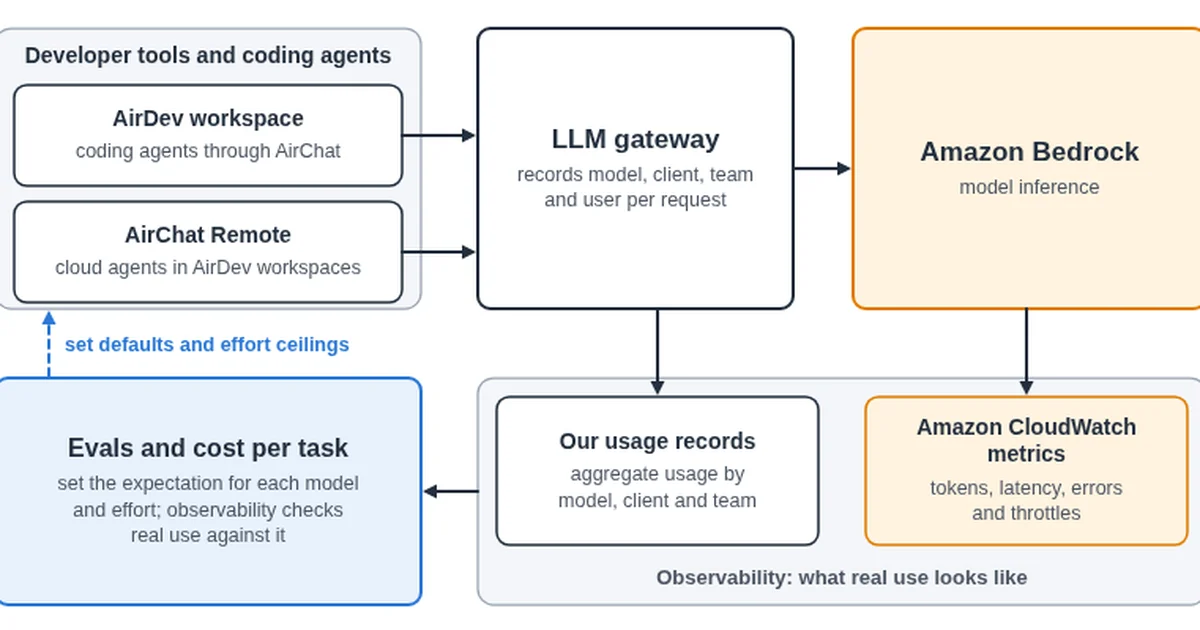
Engineers and engineering-adjacent staff at Airbnb use AirChat, their internal tool for running coding agents, which routes requests through Amazon Bedrock.
Cost per task represents the list-price cost of all the tokens an agent consumes to finish a single task.
Before a rollout, the team runs evaluations on representative tasks to measure each model's performance score and cost per task.
Strategic Analysis & Implications
Combining pre-rollout evaluations with production observability allows engineering teams to detect divergences between benchmark predictions and actual developer workflows.
Managing token quotas, caching behaviors, and max token limits prevents throttling bottlenecks during extended, self-directed coding sessions.
Outlook & Factors to Watch
The source does not disclose performance benchmarks for specific third-party model providers outside of Airbnb's internal task suites.
The exact overhead introduced by custom IAM role assumption caching mechanisms on high-frequency requests remains unquantified.