Wireless charging: two copper coils, a magnetic field and why the phone must be centered
Executive Briefing
Synthesized and verified with gemini-2.0-flash-thinking-exp
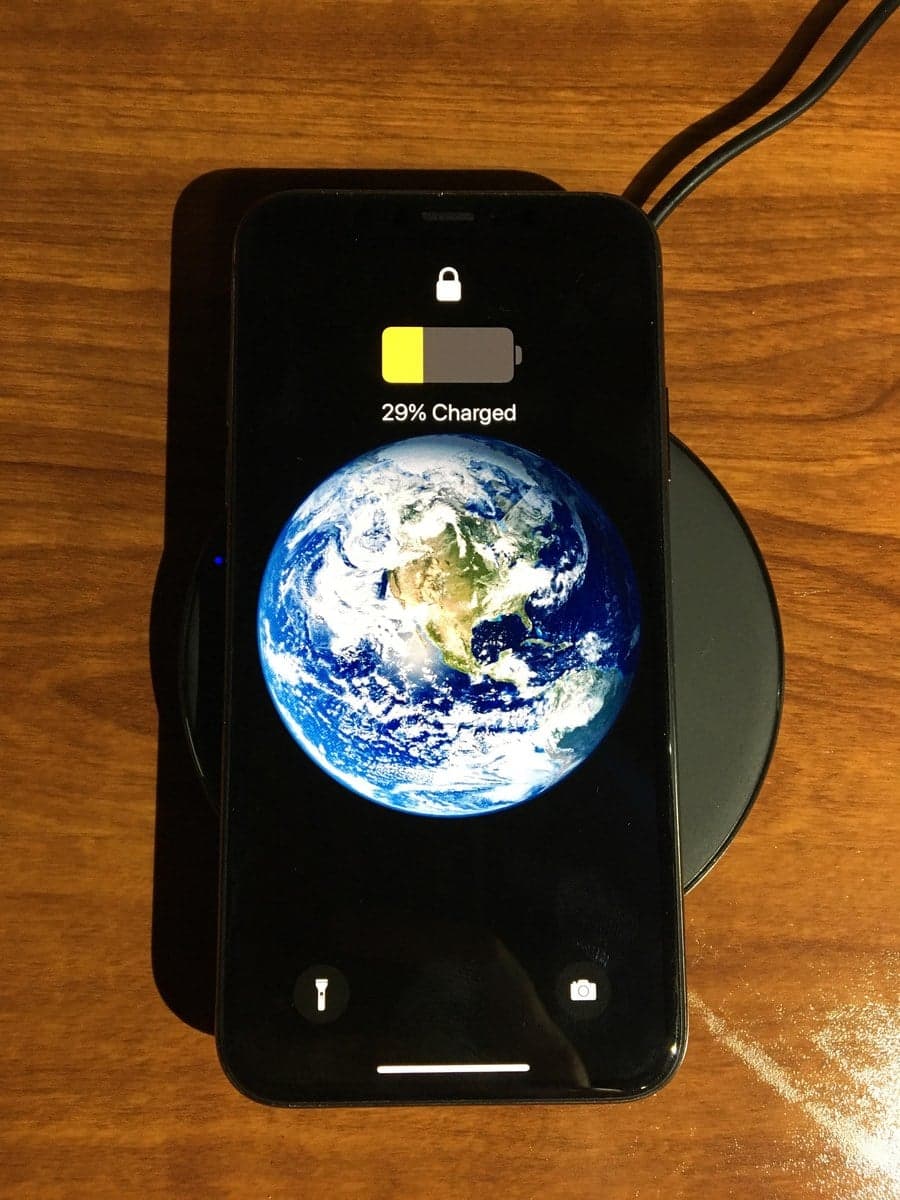
“Place the phone on a round base, the screen shows that it is charging even though there is no cable”
Key Takeaways
- 1.Place the phone on a round base, the screen shows that it is charging even though there is no cable plugged into the device.
- 2.Electricity does not fly through the air like Wi-Fi waves, but is transferred through a gap of a few millimeters thanks to two copper coils: one coil is in the charging base, one coil is located on the back of the phone.
- 3.This working phenomenon was described by scientist Michael Faraday in 1831, called electromagnetic induction.
Place the phone on a round base, the screen shows that it is charging even though there is no cable plugged into the device. Electricity does not fly through the air like Wi-Fi waves, but is transferred through a gap of a few millimeters thanks to two copper coils: one coil is in the charging base, one coil is located on the back of the phone. This working phenomenon was described by scientist Michael Faraday in 1831, called electromagnetic induction.
Two coils and a changing magnetic field
According to Wikipedia, the transmitter and receiver coils, when placed close together, act like two halves of a transformer. The alternating current flowing in the generator coil creates a magnetic field that continuously changes direction. This magnetic field passes through the receiver coil and, according to Faraday's law of induction, generates an alternating voltage in the receiver coil. The rectifier circuit in the phone turns that current into direct current to charge the battery.
An iPhone charging on a wireless charging pad. Place the device on it and the base automatically recognizes it and begins transmitting energy, no need to plug a cable into the device
The phone charging dock does not use 50 Hz mains electricity. An internal oscillator circuit generates much higher frequency alternating current, because transmission efficiency increases with frequency. For Qi standard devices, Wikipedia records that the frequency is usually in the range of 87 to 205 kHz, meaning the current changes direction hundreds of thousands of times per second. This type of charging existed long before phones, on electric toothbrushes and shavers, so as not to expose metal contacts in wet places.
Why must you place the device in the right place
The amount of energy transmitted depends on how much of the transmitter coil's magnetic field actually passes through the receiver coil. Wikipedia explains that if two coils are on the same axis and close to each other, almost all of the magnetic field passes through the pickup coil and efficiency can approach 100%. When the two coils are farther apart or off axis, the magnetic field slips out more and efficiency drops very quickly, almost proportional to the square of the degree of coupling between the two coils.
The transmitter coil in the charging base creates a constantly changing magnetic field, the receiver coil in the phone catches that magnetic field to generate an electric current. If placed incorrectly, most of the magnetic field will slip
Therefore, the coil is flat and wide, and the distance between the two coils is very small. According to the Qi specification cited by Wikipedia, at low power levels, the two coils are usually about 5 mm apart and a maximum of about 40 mm. The sample generator coil in the Qi reference has 20 turns of wire, 40 mm outer diameter, placed on a magnetic shield so that the magnetic field does not spread downwards.
The energy that does not reach the battery does not disappear but becomes heat. Wikipedia cites a 2018 test showing that with the same power, wireless charging takes about 15% longer than wired charging. A 2020 amateur analysis of the Pixel 4 found that charging the wire from 0 to 100% costs 14.26 Wh, the wireless charging dock costs 19.8 Wh, and when placed sideways on a regular charging dock, it reaches 25.62 Wh, about 80% more.
Resonance: two tuning forks of the same frequency
Most current inductive charging systems use additional resonance. Each coil is connected to a capacitor to form a resonant circuit, and both are tuned to vibrate at the same frequency. Wikipedia compares this phenomenon to two tuning forks of the same pitch: when you strike one, the other vibrates as well. Thanks to that, the two coils bond stronger and transmit energy farther than conventional induction.
From Qi to MagSafe and Qi2
Qi is an open standard developed by the Wireless Power Consortium, the name taken from the Chinese word qi, meaning life energy. Version 1.0 was released in 2010. In 2012, the Nokia Lumia 920 was one of the first phones to use this standard, and since the iPhone 8 in 2017, all new iPhones support Qi.
Advertisement
Inside the Samsung EP-P1300 Qi charging dock: on the left is the control circuit board, on the right is a flat spiral wound copper coil, which is the transmitter coil
On October 13, 2020, Apple introduced MagSafe on iPhone 12: a magnetic ring surrounding the charging coil, which Apple describes as optimal for alignment and performance. The MagSafe charger provides up to 15 W of power, while regular Qi charging on the iPhone was then limited to 7.5 W. The magnet attracts the receiver coil to the exact center of the transmitter coil, so users no longer have to detect the location.
In January 2023, the Wireless Power Consortium announced the Qi2 standard with a Magnetic Power Profile based on Apple's MagSafe technology. The device that supports this part uses a magnetic ring to align itself with the charging base. The iPhone 15 launched in 2023 supports 15 W Qi2 charging, the Qi 2.2 version in 2025 raises the maximum level to 25 W, and the Google Pixel 10 series in August 2025 are the first major Android phones with built-in Qi2 magnets. The method of transmitting electricity is still Faraday's two coils, except now magnets hold them in place.
Source:
Wikipedia: Inductive charging
,
Wikipedia: Wireless power transfer
,
Wikipedia: Qi (standard)
,
Apple Newsroom: Apple announces iPhone 12 and iPhone 12 mini
,
MacRumors: Apple's New MagSafe Charger Offers 15W Charging
,
TechCrunch: Wireless Power Consortium is working with Apple to bring MagSafe-like capabilities to Android
Attribution & Original Source
Synthesized and verified from Tinhte.vn. All copyrights and intellectual property belong to the original publication.