2 days of bloodbath for US technology stocks: Alphabet lost 500 billion USD, Intel plunged nearly 30%
Executive Briefing
Synthesized and verified with gemini-2.0-flash-thinking-exp
“**The last two days of October became a disaster for US technology stocks as investors began to look”
Key Takeaways
- 1.**The last two days of October became a disaster for US technology stocks as investors began to look back at the business performance of trillions of dollars poured into building AI infrastructure.** In just two trading sessions on October 29 and 30, a series of US technology stocks simultaneously plummeted, with Intel losing more than 31%, ServiceNow falling 30% and Marvell Technology losing nearly 22%.
- 2.On Friday alone, the sell-off wiped out more than $1,000 billion in market value of technology businesses, according to Cboe Global Markets.
- 3.The wave of sell-offs took place on a large scale, from chip, memory, server and storage device manufacturers to cloud computing corporations, software and digital asset trading platforms.
The last two days of October became a disaster for US technology stocks as investors began to look back at the business performance of trillions of dollars poured into building AI infrastructure.
In just two trading sessions on October 29 and 30, a series of US technology stocks simultaneously plummeted, with Intel losing more than 31%, ServiceNow falling 30% and Marvell Technology losing nearly 22%. On Friday alone, the sell-off wiped out more than $1,000 billion in market value of technology businesses, according to Cboe Global Markets.
The wave of sell-offs took place on a large scale, from chip, memory, server and storage device manufacturers to cloud computing corporations, software and digital asset trading platforms. At the heart of the decline are concerns about the growing scale of AI spending, while the business results and prospects of some corporations do not meet expectations.
The first big shock appeared at Alphabet. On October 29, shares of parent company Google dropped 12.6%, to about 283 USD, marking the worst trading session in history. The decline blew away about $500 billion in market capitalization in just one day.
At the October 30 session, stocks continued to be under selling pressure as investors reassessed business prospects and the huge spending the corporation is spending on AI.
What worries investors is not Google's lack of users. In contrast, the number of queries on search engines in the third quarter increased at the fastest rate in 5 years. The problem is that the increase in queries does not mean a corresponding increase in advertising revenue.
During the meeting announcing business results, Philipp Schindler, Google's Chief Business Officer, admitted that the strong growth rate of queries on AI Mode has impacted search revenue because the ability to monetize these queries is currently lower than traditional search forms.
Meanwhile, although company revenue increased 25%, reaching 127.6 billion USD, profit per share was lower than expected. Notably, capital expenditures amounted to 51.36 billion USD, while free cash flow turned negative 9.07 billion USD.
Not only Alphabet, other big names also contributed to pushing the market into two volatile trading sessions.
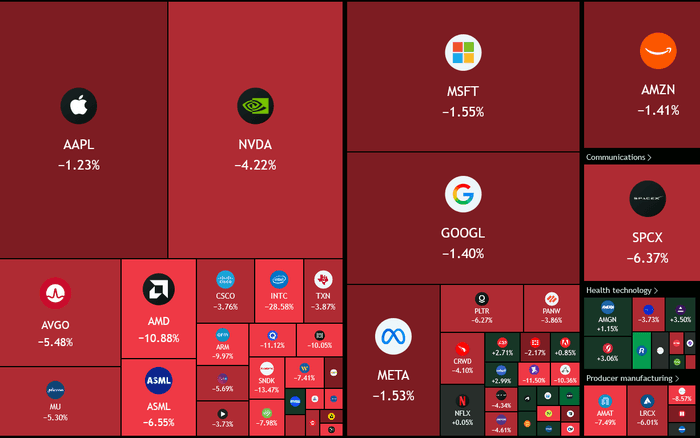
On October 30, Intel became the focus of the sell-off. This chip company's shares plunged 28.58%, marking the sharpest decline since 1974. The direct reason is that fourth quarter revenue forecast was only 15-16 billion USD, lower than the 17.07 billion USD expected by analysts.
Intel also warned that it does not expect to generate positive cash flow this year as demand for personal computers weakens, production problems are not resolved and the company must spend heavily to expand production capacity.
Not only Intel, a series of other semiconductor businesses were also strongly sold. AMD fell 10.9%, Nvidia lost 4.2%, while the Philadelphia Semiconductor Index fell 7.2% on Friday. SanDisk lost 13.47%, Marvell fell about 10% and Arm Holdings lost more than 10%.
Amazon also contributed to increased concerns about the cost of AI investment. Although AWS continues to grow, the company recorded negative free cash flow of $42.4 billion in the latest 12 months. Amazon plans to spend about $220 billion in 2026 and CEO Andy Jassy said next year's investment could be even higher.
The sell-off did not stop at large-cap corporations. ServiceNow dropped nearly 27% on October 29, marking the sharpest decline in the company's history, after business results and subscription revenue prospects did not meet the expectations of a portion of investors. Marvell Technology lost about 13%, while Fortinet fell more than 20%. These developments show that pressure has spread from the semiconductor group to software and cybersecurity businesses.
According to Reuters, in the last session of October, the Nasdaq Composite index fell 2.86%, the sharpest decline since June 5. The semiconductor index also lost 7.2%, with Intel down 28.6%, AMD down 10.9% and Nvidia down 4.2%.
The notable point is that this adjustment does not simply stem from a weak financial report or an individual enterprise. Successive earnings results are forcing the market to reassess the relationship between the pace of AI expansion and actual cash flow generation.
Over the past several quarters, large technology corporations have continuously raised their budgets to build data centers, buy chips and expand computing infrastructure. The scale of investment is increasingly large, but the time when these expenditures will be converted into profits is still unclear.
As Alphabet showed that AI Mode could generate more searches but monetize less effectively than traditional search, and Amazon and Intel signaled cash flow was under pressure, investors began to demand more of the promise of future growth.
Reuters said the Nasdaq 100 index fell more than 5.8% in October, putting more than $2,000 billion in market capitalization at risk of being wiped out as investors worry that huge AI investments cannot bring profits quickly enough.
After a period of strong market bets on AI prospects, Wall Street is turning to a more rigorous test: how long can businesses turn hundreds of billions of dollars in investments into revenue, profits and cash flow?
Attribution & Original Source
Synthesized and verified from GenK. All copyrights and intellectual property belong to the original publication.