AMD beats expectations as agentic AI sparks its data center revenue growth engines
Executive Briefing
Synthesized and verified with gemini-2.0-flash-thinking-exp
“### AMD beats expectations as agentic AI sparks its data center revenue growth engines Shares of th”
Key Takeaways
- 1.### AMD beats expectations as agentic AI sparks its data center revenue growth engines Shares of the chipmaker Advanced Micro Devices Inc.
- 2.were up more than 5% in late trading today after it delivered solid third-quarter earnings and revenue today, with data center sales almost doubling from a year ago.
- 3.The company reported earnings before certain costs such as stock compensation of $2.09 per share, easily beating Wall Street’s forecast of $1.95 per share.
AMD beats expectations as agentic AI sparks its data center revenue growth engines
Shares of the chipmaker Advanced Micro Devices Inc. were up more than 5% in late trading today after it delivered solid third-quarter earnings and revenue today, with data center sales almost doubling from a year ago.
The company reported earnings before certain costs such as stock compensation of $2.09 per share, easily beating Wall Street’s forecast of $1.95 per share. Revenue for the period jumped 45% from a year earlier to $13.38 billion, ahead of the $13.09 billion analyst consensus estimate. All told, the company’s net income for the quarter came to $3.47 billion, up 77% from the previous year when it posted a profit of just $1.96 billion.
The star performer in the quarter was AMD’s data center business unit, which accounted for 64% of its overall revenue, up from just 47% one year ago. After spending years trying to compete with Nvidia Corp.’s graphics processing units for artificial intelligence market share, the company’s traditional central processing units or CPUs are suddenly back in vogue thanks to the emergence of agentic AI applications such as Meta Platforms Inc.’s Muse. Autonomous AI agents can run much more efficiently on CPUs than they can on GPUs, boosting demand for the chips.
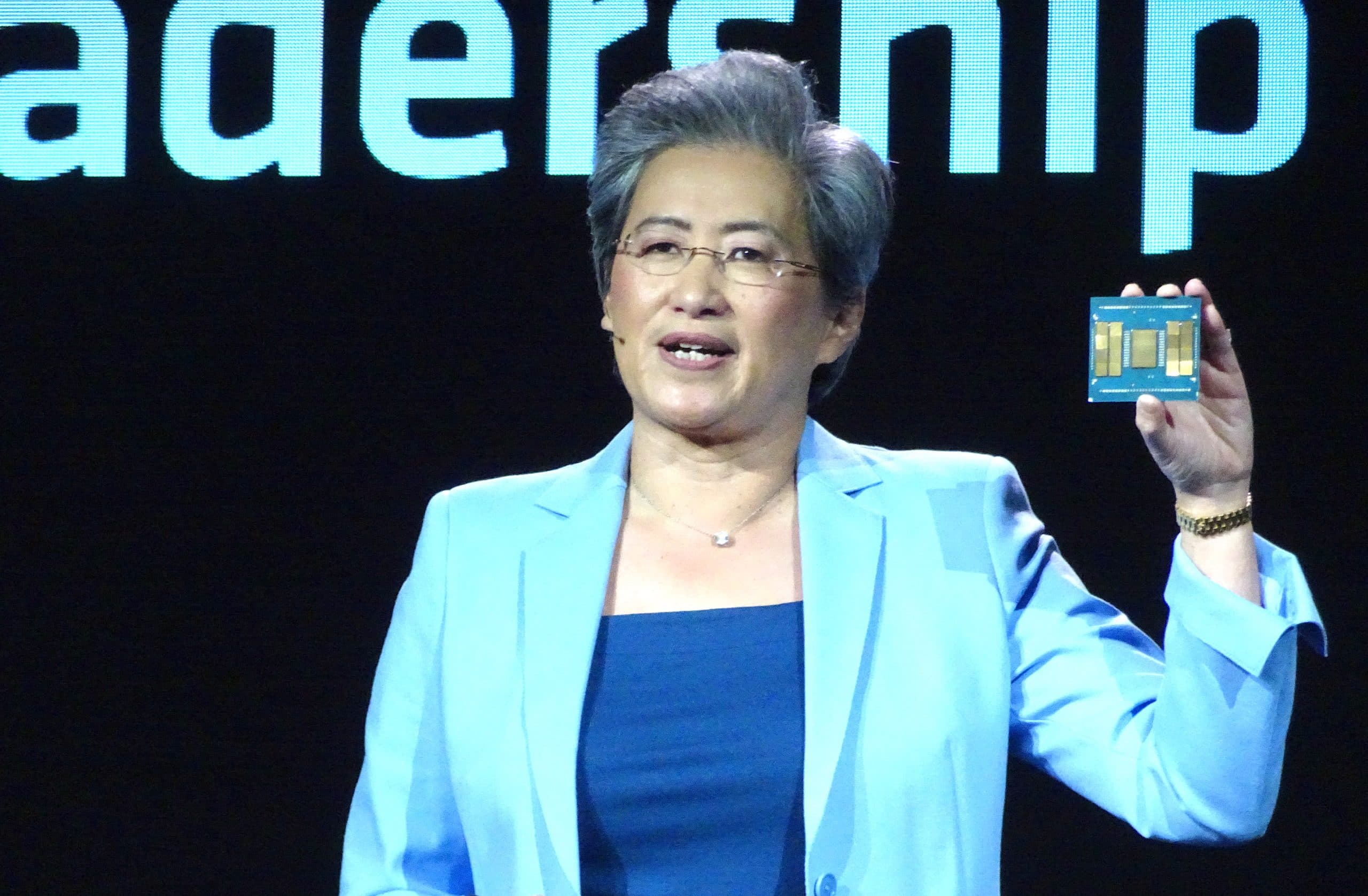
Looking ahead, AMD expects its server revenue to double year-over-year in fiscal 2027, with AI growth likely to accelerate even faster than the company projected just three months ago. “Adoption is just starting and we expect demand to grow sharply as agents are deployed more broadly and take on more complex work,” said AMD Chief Executive Lisa Su (pictured) on a conference call with analysts.
AMD’s data center story isn’t all about CPUs, though. The company also sells GPUs, including bundles of them shipped inside data center-ready rack-scale systems called Helios, and that system’s popularity is growing fast. Su said Anthropic PBC, OpenAI Group PBC, Microsoft Corp., Oracle Corp. and Meta are all using AMD Helios systems in their data centers. Last week, Meta said its first Helion racks are already up and running as it revealed that AMD invested $1 billion in its latest equity offering.
The chipmaker has also committed to a $5 billion investment in Anthropic, which last week revealed the long-awaited prospectus for its upcoming initial public offering.
AMD delivered its latest earnings report just days after its rival Intel Corp. did the same. Intel also posted strong data center revenue growth, but its stock fell more than 30% on Friday due to weak guidance and concerns over its ability to meet demand for its products. But Su said AMD had no such problems. She made a high-profile visit to Taiwan last month where she held meetings with Taiwan Semiconductor Manufacturing Co. and a number of supply chain partners, and said after the trip that the company plans to substantially increase its supply in the coming year. “We have worked across our supply chain to secure the wafers, substrates, advanced packaging, memory and other key components needed to support much higher growth next year,” Su added.
AMD’s results will go some way towards reassuring investors who have become increasingly nervous about the direction of the AI industry and whether or not the hundreds of billions of dollars being spent on it each year is actually going to generate a return on their investments, said Emarketer analyst Jacob Bourne. “The results are a test of AMD’s own performance and the broader AI trade, and its data center and revenue beats will encourage investors after the recent semiconductor selloff,” he added.
While AMD is far from immune to the recent volatility that has afflicted AI-related stocks, its future still looks increasingly rosy for now. “Demand for AI computing is not going to fall off a cliff, and AMD has the competitive products and major customer relationships to capitalize on that demand,” Bourne said.
Strength in the data center unit is helping AMD to ride out difficulties in its traditional market for personal computers, which is the reason for Intel’s poor outlook. During the second quarter, global PC shipments were down 4% from a year earlier, with buyers dissuaded by the rising cost of components such as memory chips, according to data from Counterpoint Research. Along with Intel, AMD is a leading manufacturer of the x86 CPUs that power most of the world’s computers and laptops. The company reports PC chip revenue within a segment that also includes its chips for games consoles, and that unit saw its revenue decline 8% from a year earlier to $3.7 billion. Gaming revenue was down 40% from the previous year.
For the current quarter, AMD is targeting revenue of around $17 billion at the midpoint of its guidance range, ahead of the Street’s $16.2 billion consensus estimate. The company also sees its gross margins coming in at 55%, just below the Street’s forecast of 55.3%.
AMD was busy on the acquisition front during the quarter. In September it revealed it’s going to buy World Labs Inc. for $8.2 billion in an all-stock deal. The San Francisco-based AI lab was founded by the AI industry luminary Fei-Fei Li, and has developed world models that can simulate 3D environments to support the training of intelligent robots and other physical AI applications.
The company also acquired a startup called Taalas Inc. that makes specialized model-specific integrated circuits, which are essentially chips that can be customized to run a specific AI model more efficiently. That acquisition should help to boost AMD’s position in AI inference. AMD also invested in the AI image generation model maker Stability AI Ltd., which raised $76 million in funding in August.
Photo: Robert Hof/SiliconANGLE
A message from John Furrier, co-founder of SiliconANGLE:
Support our mission to keep content open and free by engaging with theCUBE community. Join theCUBE’s Alumni Trust Network, where technology leaders connect, share intelligence and create opportunities.
- 15M+ viewers of theCUBE videos, powering conversations across AI, cloud, cybersecurity and more
- 11.4k+ theCUBE alumni — Connect with more than 11,400 tech and business leaders shaping the future through a unique trusted-based network
Are you an AWS customer? Support SiliconANGLE financially by buying your AWS services from our Marketplace portal page and links: https://siliconangle.com/aws-marketplace/
About SiliconANGLE Media
Founded by tech visionaries John Furrier and Dave Vellante, SiliconANGLE Media has built a dynamic ecosystem of industry-leading digital media brands that reach 15+ million elite tech professionals. Our new proprietary theCUBE AI Video Cloud is breaking ground in audience interaction, leveraging theCUBEai.com neural network to help technology companies make data-driven decisions and stay at the forefront of industry conversations.
Attribution & Original Source
Synthesized and verified from SiliconANGLE. All copyrights and intellectual property belong to the original publication.