What everyone talks about is quantum: when energy goes in steps rather than flowing seamlessly
Executive Briefing
Synthesized and verified with gemini-2.0-flash-thinking-exp
“Quantum computers, quantum encryption, quantum chips, even "quantum" water purifiers or cosmetics.”
Key Takeaways
- 1.Quantum computers, quantum encryption, quantum chips, even "quantum" water purifiers or cosmetics.
- 2.This word appears everywhere, so much so that the United Nations chose 2025 as the International Year of Quantum Science and Technology, marking 100 years of the birth of modern quantum mechanics.
- 3.But its core idea is quite easy to imagine: in a very small world, energy does not flow seamlessly like water but in certain small parts.
Quantum computers, quantum encryption, quantum chips, even "quantum" water purifiers or cosmetics. This word appears everywhere, so much so that the United Nations chose 2025 as the International Year of Quantum Science and Technology, marking 100 years of the birth of modern quantum mechanics. But its core idea is quite easy to imagine: in a very small world, energy does not flow seamlessly like water but in certain small parts. The word "quantum" in Latin also just means "how much".
1900: Planck divided energy into packets
At the end of the 19th century, physicists encountered a simple problem: what colors and how strongly does a hot object emit light? The formulas of that time did not exactly match the measured data. This problem is called black body radiation.
In 1900, German physicist Max Planck found a formula that matched experiment exactly, but to explain it, he had to assume that energy is only emitted and absorbed in discrete packets, called quanta. The energy of each packet is proportional to the light frequency, according to the formula E = hf. The constant h, now called Planck's constant, has a very small value, exactly equal to 6.62607015 × 10 to the minus 34 joules times seconds (J·s), and since 2019 is used to define the kilogram. Because h is very small, we cannot feel the energy levels in everyday life. Planck received the Nobel Prize in Physics in 1918 for this discovery.
Max Planck in 1938, photo by Hugo Erfurth. In 1900, he hypothesized that energy is emitted and absorbed in small packets, opening the door to quantum physics
Einstein, Bohr and the Energy Staircase
In 1905, Albert Einstein pushed Planck's ideas further. He believed that light itself consisted of packets of energy, later called photons. This way of thinking explains the photoelectric effect, the phenomenon in which light shining on a metal causes electrons to be ejected. With many metals, no matter how strong red light shines, electrons cannot be turned on, while higher frequency light, even weak, can, because what is decisive is the energy of each photon, not the total amount of light. Einstein received the Nobel Prize in Physics in 1921 for this work, not for the theory of relativity.
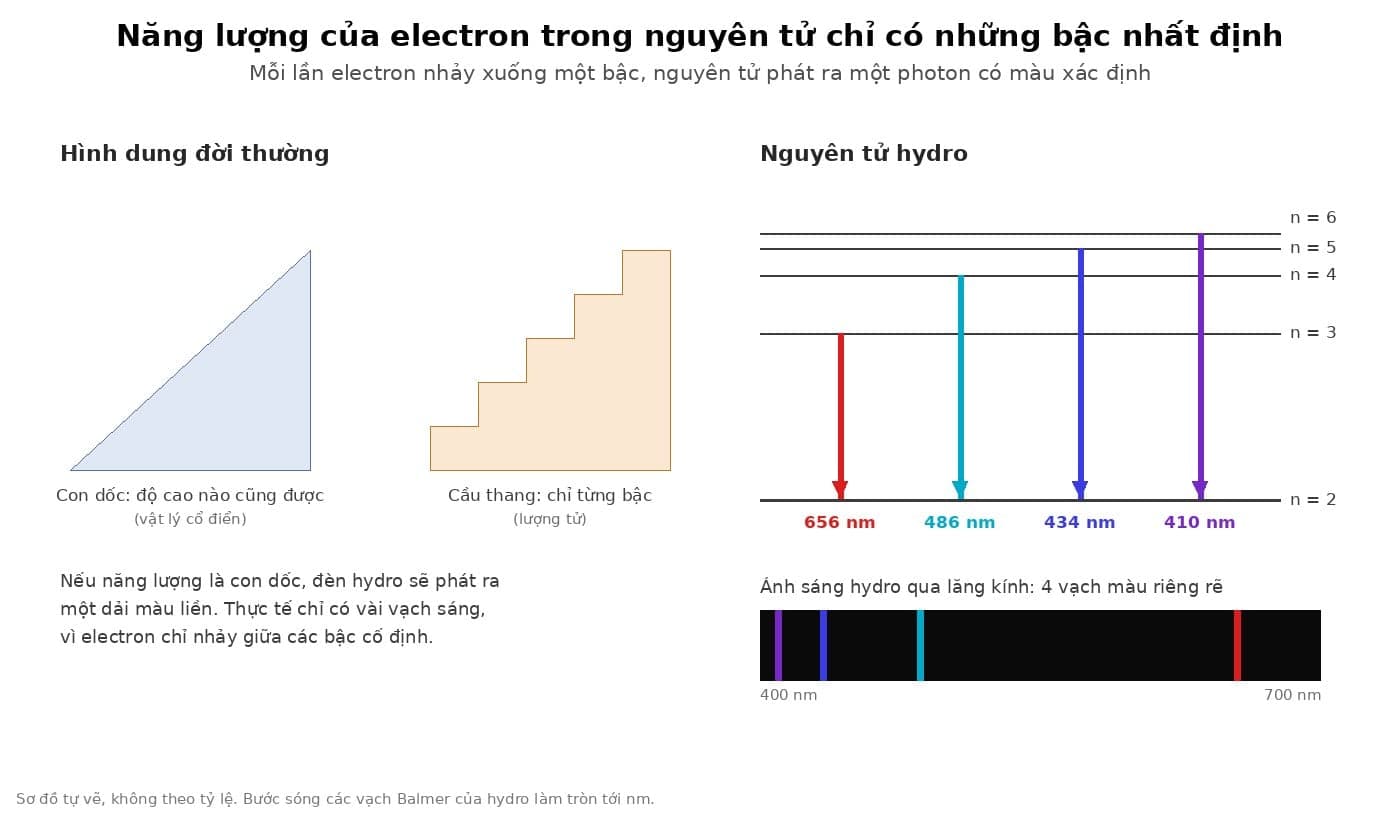
In 1913, Niels Bohr applied quantum ideas to the hydrogen atom. According to his model, electrons can only be in certain orbits with certain energy levels, like only being able to stand on stairs. When jumping from a high level to a low level, the electron emits a photon carrying exactly the difference in energy. That's why incandescent hydrogen gas does not produce a continuous rainbow, but only has a few separate color lines, such as the red line at 656 nm and the blue line at 486 nm.
Diagram illustration: the energy of an electron in an atom is more like a staircase than a slope. Each jump between two steps creates a distinct colored line in the hydrogen spectrum
Both a particle and a wave
In 1923, Louis de Broglie proposed the opposite: if light can behave like particles, then particles like electrons can also behave like waves. In 1925 and 1926, Werner Heisenberg, Max Born, Pascual Jordan and Erwin Schrödinger built the complete mathematics, giving birth to modern quantum mechanics.
The double slit experiment shows this most clearly. In 1989, Akira Tonomura's research group at Hitachi shot electrons into a device that split the path in half, only about 10 electrons per second, so there were never two electrons in the microscope at the same time. Each electron hits the screen as a particle, leaving a bright dot in a random position. But after about 20 minutes, tens of thousands of dots arranged into alternating light and dark fringes, a pattern that only appears when waves pass through both sides and then interfere with each other.
Experiment by Akira Tonomura (Hitachi) group in 1989: each electron is fired individually and hits the screen as random dots, but when accumulated enough, the dots form wave-like interference patterns
Advertisement
Quantum is right in your pocket
It may sound abstract, but quantum mechanics is the foundation of much of today's electronics. Familiar applications include:
- Transistors and semiconductor chips: the way electrons move in silicon can only be explained by quantum energy levels.
- Laser: based on the stimulated emission phenomenon that Einstein described in 1917.
- LED light: each electron falls to a lower energy level and emits a photon of a specified color.
- Magnetic resonance imaging (MRI) and electron microscope in medicine and research.
Quantum computers, the most talked about today, go one step further: instead of just taking advantage of energy levels, it directly controls the quantum state of each particle to calculate. The word "quantum" on water purifiers or cosmetics is mainly a marketing call, because quantum is how all matter operates at the atomic level, not an added feature.
Source:
Wikipedia: Quantum mechanics
,
Wikipedia: Max Planck
,
Wikipedia: Photoelectric effect
,
Wikipedia: Bohr model
,
Hitachi
,
American Journal of Physics
,
Wikipedia: International Year of Quantum Science and Technology
Attribution & Original Source
Synthesized and verified from Tinhte.vn. All copyrights and intellectual property belong to the original publication.