AIINEWS

AIINEWS

Global intelligence on artificial intelligence and computing

Search Intelligence

Query across our knowledge base of synthesized technology dispatches

Results for “malware”16 stories
FBI dismantles crypto social engineering scheme using deepfakes

FBI dismantles crypto social engineering scheme using deepfakes

The U.S. Federal Bureau of Investigation has established that North Korean threat actors stole over $400 million in cryptocurrency over the past 18 months via a social engineering scheme named FaceStealer. The campaign combines compromised communication accounts and AI-generated deepfake video calls to deceive victims into running malware.

1 min read4,042
Detecting sophisticated new malware attacking the Windows operating system

Detecting sophisticated new malware attacking the Windows operating system

A targeted cyber attack campaign targeting a version of Windows 10 customized specifically for government agencies in an Asian country has just been discovered. According to security firm Kaspersky on November 5, the attack uses a completely new malicious code framework that has never been recorded before, called NetamLoader. Notably, instead of directly attacking with strange files that are easily blocked by virus scanning software, bad guys have applied the tactic of "borrowing" legitimate components in the system to activate malicious code.

2 min read5,937
Binance says hackers who stole billions in crypto spent months planning heist
Gadgets13 days ago

Binance says hackers who stole billions in crypto spent months planning heist

The hackers who stole billions of dollars in cryptocurrency from the Binance exchange spent months working on the theft and used both social engineering and novel malware in the process, the company said Tuesday. The heist, which both the FBI and the TRM Security firm attributed to North Korean actors, initially targeted $6.34 billion in cryptocurrency from Binance wallets. The exchange has since frozen or intercepted $2.85 billion of that sum.

1 min read4,783
Binance says hackers used fake job interviews and an internal AI tool to pull off the $6.3 billion heist

Binance says hackers used fake job interviews and an internal AI tool to pull off the $6.3 billion heist

The largest crypto theft to date was pulled off by combining some well-known hacking techniques over the course of a few months, according to Binance. A postmortem from the company says the process that started with one developer downloading a tampered installer in June apparently spread by a malicious Google ad, exposing details about the engineers and how they work. Then, in September, another engineer was targeted by someone pretending to be interested in hiring them; that person set up a series of calls and multiple rounds of interviews, shared social media pages to build trust, and eventually prompted them to download a fake interview assignment that was actually malware.

3 min read8,128
UEFI bootkit infected fully patched Windows machines. Is Microsoft to blame?

UEFI bootkit infected fully patched Windows machines. Is Microsoft to blame?

In 2023, malware tracked as BlackLotus became the first publicly documented in-the-wild UEFI bootkit capable of bypassing Secure Boot on fully updated Windows 11 systems. With the industry-wide chain-of-trust mechanism subverted, the malware was able to run malicious code before Windows was fully loaded and many security defenses were operational. Microsoft had already patched the vulnerability that BlackLotus exploited in 2022.

1 min read4,737
One of Google’s Android partners turned 1.3 million set-top boxes into a botnet

One of Google’s Android partners turned 1.3 million set-top boxes into a botnet

Google says one of its Android manufacturing partners secretly built a backdoor in 1.3 million devices and turned them into a botnet. The company says it has now dismantled the backdoor and “cut ties” with the manufacturer, the Shenzhen, China-based Videostrong Technology Co., which has been banned from building or selling certified Android devices or supplying software for them. # One of Google’s Android partners turned 1.3 million set-top boxes into a botnet Google says a manufacturer ‘intentionally’ hijacked its devices with malware.

2 min read4,959
Spooky New Infostealer Malware Uses AI to ‘Autodox’ Victims

Spooky New Infostealer Malware Uses AI to ‘Autodox’ Victims

*Welcome to Kernel Panic, a weekly newsletter by Lily Hay Newman and Matt Burgess from inside the new world of privacy and digital security. To receive this newsletter in your inbox each week, sign up here.* New research shared exclusively with Kernel Panic shows that hackers have started adding AI functionality into a new strain of infostealer malware, making it possible for the system to automatically profile victims and quickly surface the highest value targets and their information. Dubbed “Volta-Autodoxer” because of how the malware refers to itself internally, the finding by Cisco Talos researchers sheds light on the ways that commercial LLMs are being used to augment and enhance the capabilities of established types of malware.

5 min read4,362
The Internet is in a period of becoming crazy dangerous Chrome has a dangerous security hole...
Gadgets17 days ago

The Internet is in a period of becoming crazy dangerous Chrome has a dangerous security hole...

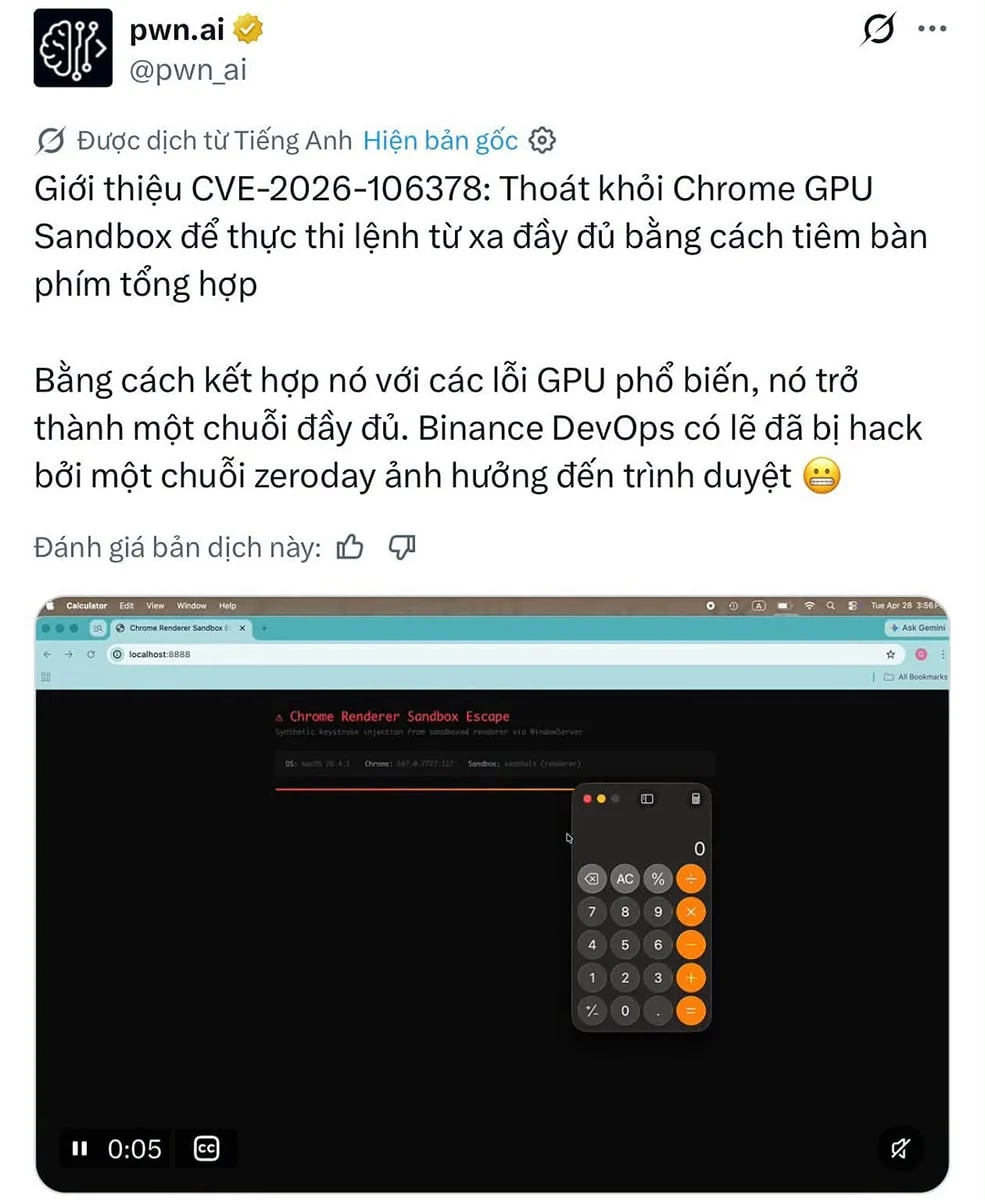
The Internet is in a period of becoming crazy dangerous 🙃 Chrome has the most dangerous security hole that allows hackers to exploit the Chrome web browser and run dozens of things on your computer simply because you went to a website containing the hacker's exploit code 🙃 I heard rumors that Binance's ill-fated Devops may have been hacked through this bug. PHP, NodeJS, the platforms that build most websites in the world, encounter bugs that can run malicious code remotely. Synology NAS, the world's second largest supplier of network drive equipment, also has the problem of running malware comfortably remotely.

4 min read4,529
A Hacker Targeted High-Stakes Poker Players With Malware That Exposed Their Cards

A Hacker Targeted High-Stakes Poker Players With Malware That Exposed Their Cards

In a fitting sign of the times, the hacker’s carefully laid plans were foiled by an AI agent. It was September 25, 2026, and Alex, a professional online poker player, was using his Claude AI agent to review some play statistics. (Alex only agreed to speak with WIRED under a pseudonym to avoid any risk of reprisals from threat actors.) After Alex’s SQL database crashed and needed to be reset, the Claude agent noticed something suspicious: A program called MeshAgent was operating in the background, where it seemed to be capable of capturing Alex’s screen and even controlling his entire machine.

13 min read4,139
Beware of the "AI movie mining" scam: Risk of losing money, revealing personal data and falling into the trap of online "missions"

Beware of the "AI movie mining" scam: Risk of losing money, revealing personal data and falling into the trap of online "missions"

**VTV.vn - Hanoi Police warn of AI movie watching applications lurking to make money to lure users to deposit money, install malicious code, steal data and appropriate property.** Illustrative photo: Hanoi City Police e-information portal Hanoi City Police said the explosion of short films created with artificial intelligence (AI) with sensational scenarios and intense climaxes is attracting a large number of viewers on digital platforms. However, taking advantage of this attraction, many bad actors have turned the AI ​​movie viewing application into a "bait" to lure users into a chain of fraudulent traps, forcing them to watch dense ads, install malware and appropriate property. According to the police, scam tactics are often built through sophisticated steps such as: \- Attractive bait: Applications heavily advertise the form of "watching AI movies and making money".

3 min read7,489