Images of the first security chip designed by Vietnam were officially revealed
Executive Briefing
Synthesized and verified with gemini-2.0-flash-thinking-exp
“**VGC chip v1.0 - breakthrough in security semiconductor technology "Make in Vietnam" officially lau”
Key Takeaways
- 1.**VGC chip v1.0 - breakthrough in security semiconductor technology "Make in Vietnam" officially launched.** Too small for the naked eye to see, too complex for the average person to imagine how it works, but it is controlling the whole world, that is the semiconductor chip.
- 2.Semiconductor chips are no longer just a story for the technology world, but have become a top priority for countries.
- 3.Autonomy in design and production, especially chips with high security requirements, is a key factor that countries aim for in their semiconductor industry strategies.
VGC chip v1.0 - breakthrough in security semiconductor technology "Make in Vietnam" officially launched.
Too small for the naked eye to see, too complex for the average person to imagine how it works, but it is controlling the whole world, that is the semiconductor chip. Semiconductor chips are no longer just a story for the technology world, but have become a top priority for countries. Autonomy in design and production, especially chips with high security requirements, is a key factor that countries aim for in their semiconductor industry strategies.
Vietnam is no exception to that trend. By building a secure semiconductor platform, many generations of semiconductor chips are born. VGC v1.0 - a microdigital chip branded "Make in Vietnam" was born. This is the result of the desire to master core technology and protect national digital sovereignty.
For many years, the world has witnessed serious incidents due to backdoor technology vulnerabilities - a secret code pre-installed into microchips right from the design stage. Hackers can take advantage of it to take control of the device and steal data without the user even knowing. But many Vietnamese security information storage devices still depend on imported control chips. That means a strategic gap, which cannot last forever.
With the Cipher industry, that requirement is even more urgent. For more than 80 years, Vietnam's Cipher Industry has completely mastered software cryptographic algorithms to protect state secrets. However, mastering the cryptographic algorithm is not enough, it is necessary to control where the algorithm is executed, where the key is generated, and ensure resistance to direct attacks on the hardware.
In another direction, Viettel pursues the desire to master core technology and start from the foundation of design. Accordingly, Viettel's team chose open instruction set architecture to proactively develop microprocessors. One side masters cryptography, the other side has the ability to design chips and industrialize products. Two aspirations, one destination, a technology foundation fully owned by Vietnam.
The Party, Government and Army are clearly aware of the importance of semiconductor technology. Resolution 57 of the Politburo determined: Developing science, technology, innovation and national digital transformation is the most important breakthrough, the main driving force for rapid development of modern production forces, and core technology is the key factor.
In early 2025, the Central Military Commission issued a resolution on breakthroughs in science and technology development, innovation and digital transformation in the military, assigning requirements to develop semiconductor chips, information security and safety products. To concretize those policies, the Minister of Defense assigned the task: the Government Cipher Committee and Viettel Group to jointly develop a security semiconductor platform with the first product being a security chip.
The parameters of Vietnam's first security chip are revealed
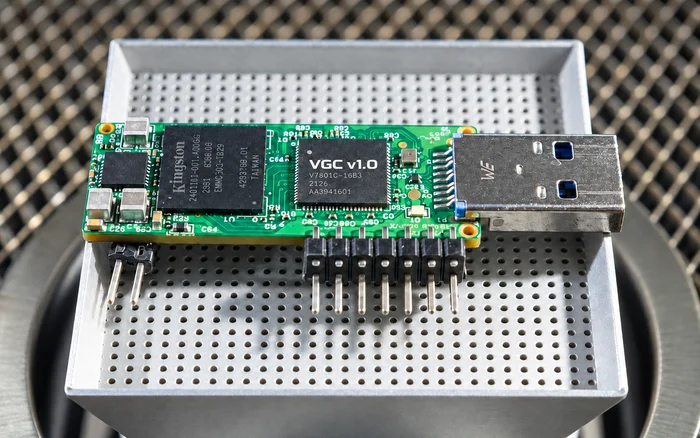
To meet the requirements of protecting information right on hardware, the Government Cipher Committee and Viettel Group jointly developed a secure semiconductor platform, with VGC v1.0 being the first product.
The chip has a packaging size of 10 × 10 mm, manufactured on a 28 nm CMOS process. Based on the RISC-V open instruction set architecture, the engineering team designs the processor and can proactively verify and adjust the design.
The MKV block cipher algorithm researched and developed by the Government Cipher Committee is realized into a specialized cryptographic processing block on VGC v1.0. According to the test results of the two sides, the encoding and decoding chip is about 10 times faster than pure software solutions in the same task. In addition to processing performance, the engineering team also applies technical measures to protect the design before sending it to the manufacturing plant, to limit the risk of leaks or reverse translation.
The birth of VGC v1.0 is a sharp demonstration of the effective cooperation model between State Management/Professional Agencies and National Technology Corporation. In particular, the Government Cipher Committee determines security requirements, develops algorithms and evaluation criteria; Viettel Group (hosted by Viettel Semiconductor Center - Viettel Semi) is responsible for designing the circuit and realizing the design into chips.
In the first quarter of 2026, the first batch of VGC v1.0 chips passed the technical testing items and was granted a certificate with the scope of socio-economic use according to the strict requirements of the Government Cipher Committee.
Around the world, many manufacturers integrate specialized security chips or hardware into digital devices to support cryptographic processing and data protection, such as Titan M on some Google Pixel devices or Secure Enclave on Apple platforms. VGC v1.0 is also developed with the orientation of bringing cryptographic and key protection functions to the hardware; Each solution has its own architecture, functionality and application scope.
In Vietnam, VGC v1.0 was initially applied in safe USB storage for Party, State and National Defense agencies. The next direction is to have the VGC v1.0 chip appear in the USB Token for digital signatures, the identification chip aims to serve the national digital signature authentication system, where there are more than 2 million digital certificates in circulation. Further, the design capacity accumulated through VGC v1.0 opens up the way to develop dual-use chip lines, serving to protect critical infrastructure such as electricity, water, oil and gas and telecommunications.
Security semiconductor platform - launching pad for generations of self-reliant chips in Vietnam
Besides the VGC v1.0 chip, the Announcement Ceremony especially emphasizes the significance of the secure semiconductor platform. With this platform, the Vietnamese team masters the design from the ground up and the verification process; Helps future products inherit existing achievements instead of starting from scratch. On that common foundation, each side will continue to deepen their strengths.
On the part of the Government Cipher Committee, the focus is on research and development of new generation cryptographic algorithms, meeting information security challenges in the coming period. These include post-quantum (quantum-resistant) cryptography for key exchange and digital signatures; lightweight cryptography for resource-constrained Internet of Things devices; and encryption algorithms with high-speed authentication for large data transmissions.
On Viettel's side, Viettel Semiconductor Center continues to delve into chip design technology: developing new generation high-performance RISC-V processing cores, building multi-core architecture and perfecting the design and verification process. This capacity is the basis for Viettel to develop chip lines for artificial intelligence, 6G telecommunications, smart cameras, Internet of Things, UAVs and robots, gradually reducing dependence on imported chips in key fields.
The results of the two research directions will converge on the same foundation. The new algorithm of the Government Cipher Committee, after being verified on the simulation system, will be realized into specialized cryptographic processing blocks and integrated into the multi-core architecture designed by Viettel. At the same time, Viettel's AI, camera, IoT, UAV, and robot chip lines can have built-in Vietnamese cryptographic blocks, so that security is set right from the design of each device.
Agreement to implement cooperation between the Government Cipher Committee and the Military Industry and Telecommunications Group on the production and development of security microchips and the development of human resources in the semiconductor industry
Together with the high-tech semiconductor chip manufacturing factory in Hoa Lac, this cooperation agreement is an affirmation of Vietnam's remarkable progress towards fully mastering the semiconductor value chain - design - production - packaging, contributing to ensuring supply security in the face of geopolitical fluctuations.
The launch of VGC Chip v1.0 and the security semiconductor platform marks Vietnam's historic transformation from the position of technology user to technology creator, affirming Vietnam's intelligence and bravery in proactively protecting national digital sovereignty.