The AI Cinema Era of 2026: The Truth About Hour-Long Movies and Their Production
Executive Briefing
Synthesized and verified with gemini-2.0-flash-thinking-exp
“**AI-generated movies no longer stop at short, meaningless videos.”
Key Takeaways
- 1.**AI-generated movies no longer stop at short, meaningless videos.
- 2.The year 2026 will see an explosion of hour-long cinematic productions, opening a new era for the entertainment industry with groundbreaking and challenging technological advances.** The concept of cinema has been completely redefined.
- 3.To understand the overall picture, experts divide AI products into three main groups.
AI-generated movies no longer stop at short, meaningless videos. The year 2026 will see an explosion of hour-long cinematic productions, opening a new era for the entertainment industry with groundbreaking and challenging technological advances.
The concept of cinema has been completely redefined. To understand the overall picture, experts divide AI products into three main groups. The first group, and the one growing at the fastest rate, are movies created entirely with AI. In this genre, every image and performance on screen is the product of generative models, although humans still hold a core role in scriptwriting, directing, editing and dubbing.
The second group is traditional AI-assisted cinema productions, where technology is used for specific VFX shots or acting recreations. Typically, recreating the late actor Val Kilmer in the movie As Deep as the Grave or the building collapse scene in the Netflix series El Eternauta.
Finally, there's the group of fan-made fake trailers. It is this third group that has created skepticism in public opinion, because creating a patchy two-minute trailer is very easy, but maintaining a coherent story throughout two hours is a huge challenge.
The appearance of long-length films has shattered previous prejudices. The most prominent is The Cully Hill Boys, a 110-minute action comedy film project produced by video company AI Higgsfield. With a budget of $2 million - half of which was spent on AI tokens - the film was completed in just four weeks.
Even though the script was written by a human and played the role of carrying the entire work, critics from Semafor still pointed out the fatal weaknesses of the AI's soulless acting and misleading commands.
At a completely different extreme in terms of budget, director Ash Koosha's 75-minute documentary Dreams of Violets made a big splash when it premiered at the Tribeca film festival in June 2026. This work depicting the repression in Tehran cost only $2,000, without needing actors, sets or physical cameras. Ash Koosha's decision to use AI comes from the harsh reality that filming in Iran is impossible and full of dangers for real people.
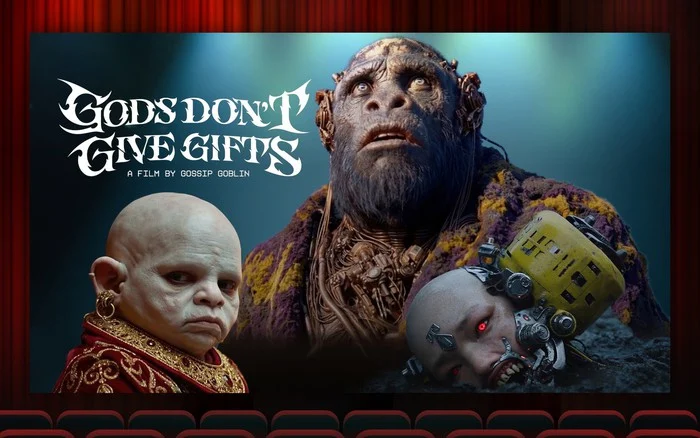
Not just stopping at film festivals, AI cinema is moving into commercial theaters and the Oscar race. Fable's anthology Gods Don't Give Gifts, which includes four short films made by YouTuber Gossip Goblin, is scheduled for limited release in the US and UK in early December 2026.
This work has been given an R rating by the cinema association and is aiming for the academy's best animated film category. Under current regulations, AI tools do not automatically enhance or hinder a film's chances of winning, but a panel of voters will evaluate based on the level of core human creative contributions.
However, the real battleground that attracts the largest audience is the YouTube platform. Independent creators are continuously releasing feature-length, story-centered AI films, especially in the mythological and fantasy areas.
Only as of October 2026, Pakistani creator Zahid Iqbal's masterpiece The Mother's Monster has garnered an unbelievable number of 74 million views for its 28-minute duration. The 38-minute work NAGIN also excellently reached 2.16 million views after only nine days of release.
Other names such as Naga Puspa (1 hour 44 minutes long) or the science fiction film End of Humanity also recorded millions of interactions. The secret to their success does not lie in technical perfection, but comes from the audience's desire to follow a complete story until the last moment.
Behind those achievements is an extraordinary effort to overcome the biggest technical barrier: the short lifespan of AI models. Up to now, the world's leading video creation machines such as ByteDance's Seedance 2.5, Alibaba's Wan 3.0 or Kling 4.0 are all limited to 30 seconds per image creation. Other models like the MiniMax H3 reach 15 seconds, while the Gemini Omni Flash 1.1 produces a base 10 seconds.
To complete a 38-minute film, producers have to shoot about 76 consecutive scenes without stopping, and for a 110-minute film, this number reaches 220. Each scene change is a big risk of deforming faces, costumes or lighting. Saurabh Pandey, CEO of Dolphin AI systems, once admitted that current tools struggle to maintain context beyond the 10-second threshold.
Therefore, instead of waiting for a super AI to automatically create an entire movie, professional filmmakers have built an extremely rigorous manual production process, closely combining technology and traditional cinema thinking. The first and most important step is always the script. A compelling story, clear character arcs, and detailed rhythm outline system must be locked in before any frames are created.
Once you have the script, the second step is to establish reusable references for the characters and settings. Consistency in AI movies cannot be achieved with general descriptive words alone. Directors must build original designs for each character and location, storing them as permanent reference files (like the Elements feature in CinemaDrop) to recall in every shot, ensuring that a character's appearance will not change in subsequent episodes.
The third step is to draw a storyboard for every shot. Each scene is broken down with clear numbering, along with descriptions of the action, camera angles and references. Creating 16:9 still frames before exporting video helps manufacturers check film continuity and correct errors at a low cost.
Once the storyboard is complete, the video rendering process officially begins. Filmmakers prefer to draft at low resolutions, such as 480p, to maximize resource budgets. On models like Seedance 2.5, they can set up a detailed timeline for every second, determining camera movements and character actions at each beat. Only when the draft is absolutely perfect will they spend the money to render it in high definition 1080p.
The post-production part of an AI movie is no less complicated than traditional cinema. Sound plays a great role in covering up AI's visual errors. Voices generated from platforms like ElevenLabs, combined with environmental sound effects and a soundtrack throughout help tie the entire piece together.
Finally, all individual clips are put into professional editing software such as CapCut, Premiere Pro or DaVinci Resolve to cut, adjust the tempo and complete the final mix. A 3-minute short film can cost from 12,350 to 23,150 credits depending on resolution, proving that serious AI filmmaking requires a significant investment.
Besides technical factors, this new era of cinema is also surrounded by strict legal regulations. Current copyright law requires that works must have human creative contributions to be protected.
Using images of real people requires explicit permission, just like how the As Deep as the Grave crew had to ask permission from Val Kilmer's family.
Furthermore, distribution platforms like YouTube have begun to tighten policies, requiring transparent labeling for all AI-generated content to protect audiences from the explosion of the automated content era.