The United States spends millions of dollars to destroy invasive green crabs
Executive Briefing
Synthesized and verified with gemini-2.0-flash-thinking-exp
“# The US spends millions of dollars to destroy invasive green crabs US authorities are looking for”
Key Takeaways
- 1.# The US spends millions of dollars to destroy invasive green crabs US authorities are looking for ways to control the number of invasive blue crabs that are causing tens of millions of dollars in economic damage in coastal areas.
- 2.*People* reported on October 15 that Washington state, USA, caught more than 2 million blue crabs in fiscal year 2026.
- 3.According to a recent report from the Washington Fish and Wildlife Service (WDFW), the state government destroyed more than 2.16 million European blue crabs from the waters from July 1, 2025 to June 30, 2026, of which the Coastal Zone Department eliminated 2,133,725 fish and the Salish Sea Branch removed 24,827 fish.
US authorities are looking for ways to control the number of invasive blue crabs that are causing tens of millions of dollars in economic damage in coastal areas.
People reported on October 15 that Washington state, USA, caught more than 2 million blue crabs in fiscal year 2026. According to a recent report from the Washington Fish and Wildlife Service (WDFW), the state government destroyed more than 2.16 million European blue crabs from the waters from July 1, 2025 to June 30, 2026, of which the Coastal Zone Department eliminated 2,133,725 fish and the Salish Sea Branch removed 24,827 fish. Catches have been at record highs for months, likely due to budget increases, weather changes and crab populations continuing to grow. However, Washington state has not yet been able to eradicate the invasive blue crab population.
According to Medium, female blue crabs can release hundreds of thousands of eggs in a single spawn. WDFW estimates that killing more than 2 million crabs could prevent tens to hundreds of billions of blue crab larvae from spreading throughout the waters around the state. In 2022, Jay Inslee, governor of Washington state, declared a state of emergency due to invasive blue crab populations. After that, the state government allocated more than 8 million USD to solve the problem.
Not only Washington state, the US state governments of Alaska and California, and the Canadian province of British Columbia, are making efforts to set traps to catch blue crabs to varying degrees. The Metlakatla tribe in Alaska cull tens of thousands of blue crabs each year. On Vancouver Island, the number of crabs destroyed annually reaches several hundred thousand.
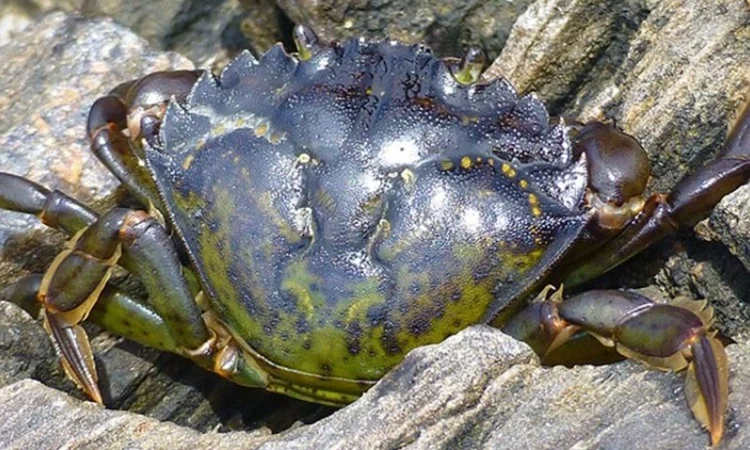
According to the New York Times, the European blue crab (Carcinus maenas) is one of the most destructive invasive species in the ocean. They followed ships to the East Coast of the United States in the 19th century, and have since become a nightmare for the seafood industry here. Blue crabs quickly took over, destroying seagrass beds and eating all kinds of shellfish such as mussels, clams, and even baby lobsters.
Washington's seafood industry generates nearly $400 million each year from aquaculture and exploitation, making it one of the state's most important marine economic sectors. The study results show that if left unchecked, invasive blue crabs could threaten 74 percent of the state's annual commercial harvest of clams, oysters and mussels in Puget Bay, which accounts for more than half of the industry's revenue. Fisheries industries on the East Coast suffer an estimated loss of $22.6 million per year due to predation by this species of crab.
On the West Coast of the United States, the first blue crabs were discovered in 1989, likely by larvae arriving on cargo ships. They took hold in San Francisco Bay and quickly spread to Vancouver Island. Today, they even thrive in Alaska. Climate change and warmer ocean waters create favorable conditions for blue crabs to thrive, making the problem more urgent.
Dr. Emily Grason, a marine ecologist and invasion biology researcher at the University of Washington in Seattle, said invasive blue crabs remain a problem. "It's not difficult to imagine things will get even worse. The invasion is still ongoing and shows no signs of cooling down or stopping," Grason said. This year, the number of crabs that researchers and trapping teams found around Willapa Bay in Washington state was three times greater than last year. According to Grason, this steady increase suggests the crab population may be increasing.
The blue crab monitoring team of the Washington Sea Grant organization (at the University of Washington) said this species may accidentally move to new habitats by ships and seafood distribution networks. Native to Europe, blue crabs are also an invasive species in South Africa and Australia. Due to their voracious nature, they can threaten other marine animals, causing ecological imbalance. Blue crabs are responsible for the decline in the number of soft-shelled clams in Europe.
According to WDFW, the best solution to control invasive crabs is early detection, quick response and population limitation. In addition to the typical green color, blue crabs also come in red, brown and orange, so the best way to identify them is through the 5 spines in each eye.
An Khang summary
