Vietnamese engineer builds rubber tapping robot to replace humans
Executive Briefing
Synthesized and verified with gemini-2.0-flash-thinking-exp
“# Vietnamese engineer builds rubber tapping robot to replace humans Rubber tapping robot created by”
Key Takeaways
- 1.# Vietnamese engineer builds rubber tapping robot to replace humans Rubber tapping robot created by engineer Do Minh Tam can take on hazardous work instead of humans, with 1.5 times the capacity of skilled workers, giving higher output.
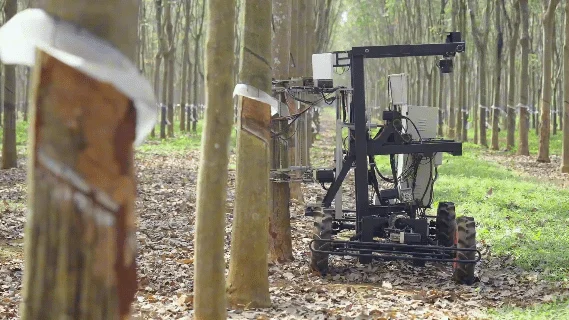
- 2.The more than two meter tall machine stopped close to a tree in the middle of a rubber garden in Dong Nai, stretched out its cylindrical arm to grip the tree trunk as a support for the razor head to move in an arc, then cut a long line on the wooden bark.
- 3.Engineer Do Minh Tam (Dong Nai), author of the machine, founder of Tan Y Robot and Rubber Company, said it is doing the job of a rubber tapper.
Rubber tapping robot created by engineer Do Minh Tam can take on hazardous work instead of humans, with 1.5 times the capacity of skilled workers, giving higher output.
The more than two meter tall machine stopped close to a tree in the middle of a rubber garden in Dong Nai, stretched out its cylindrical arm to grip the tree trunk as a support for the razor head to move in an arc, then cut a long line on the wooden bark. Engineer Do Minh Tam (Dong Nai), author of the machine, founder of Tan Y Robot and Rubber Company, said it is doing the job of a rubber tapper. This is the robot Mr. Tam spent four years developing. The robot - which weighs more than half a ton and resembles a large iron frame - has cutting power and precision superior to that of even the most skilled worker.
Mr. Tam said, the robot makes cuts that are often seamless - something that workers cannot do due to weak hand strength. Normally, workers have to "shave", pull the knife 2-3 cm, step back to gain momentum and then continue. This action helps prevent the knife path from going too deep - affecting the wood core, or too shallow - reducing output. In turn, the broken rhythm crushes the mouths of the latex tubes running along the bark, making it impossible to produce as much output as straight shaved sugar.
This is also the reason why in a test at Dong Nai Rubber Corporation, on a plot of 51 trees, the robot collected more than one and a half times more rubber than the worker's reference level. "Tapping rubber latex is a much more suitable operation for robots than for humans," Mr. Tam said.
More than four years of tool adjustment
The idea came to Mr. Tam in 2022, while working with a rubber business on automation needs. Rubber exploitation requires working from 2-5 a.m. when the tree can produce the most latex, in a slippery, wet, low-light, high-CO2 mountainous environment. Workers often suffer from blue skin diseases, anemia, latex allergies, and respiratory diseases. Therefore, rubber tapping is classified as a particularly heavy and hazardous job and has an earlier retirement age than usual.
Meanwhile, available automation solutions are ineffective. Most of the equipment is individually attached to each tree trunk, leading to high costs. To replace one worker, more than 2,000 machines are needed with a total cost of many billions of dong. Due to their small size and low power, these devices must use vibrating blades to cut through the tree's bark, crushing the latex tubes and reducing output.
With many years of experience in the field of precision mechanical engineering, Mr. Tam and his colleagues want to create an automation solution to solve the industry's serious labor shortage.
At the end of 2022, the first time they brought the robot to the garden, the team encountered a series of problems: the machine reached the tree in the wrong position, the shaving path was inaccurate, and they encountered a tree that was tilted and could not be shaved. The test shows the gap between a moving machine and the tapper's manipulative alternative. The robot must find the right tree, put the manipulator in the right place, and control the blade on tree trunks with different tilts, shapes and bark surfaces.
According to Mr. Tam, the most complicated thing is determining and keeping the knife path stable. By the middle of this year, the robot's shaving operation was completed. The requirement is that the blade must shave about 1-1.3 mm from the wood layer of the tree, enough to maximally open the pus tube in the bark but not damage the core layer. Only one slice of bark with a specified thickness is removed each time, to achieve maximum output while still ensuring the tree's exploitation life cycle.
This operation is difficult even for skilled workers. Normally, workers have their wages deducted, or their rank is demoted when scraping the core of the wood, so they tend to shave shallowly to avoid errors, leading to suboptimal output.
The team solved the problem with a mechanism that helps the knife follow the surface of the wood bark, combined with saving a separate shaving depth for each tree. Currently, the surface determination detail cluster has an error of only about 0.3 mm. The mechanical assembly and shaving technique are also protected by exclusive patents.
The next special point lies in strength. Taking advantage of the precision of the knife path, the Tan Y group built a robot with enough force to continuously pull the knife to "sweetly cut" all the latex tubes along the tree trunk, allowing the latex to flow more smoothly and yield higher yields.
Besides technical operations, navigation ability, which is simple for humans, is also a challenge for autonomous robots. Mr. Tam said the system uses a lidar, a device that measures distances and angles using a laser, does not require GPS and only has a position error of about 3 cm. When the robot stops at the tree, the mechanisms bring the shaving head into position to execute the knife path.
Ability to operate in real environments
Robots provide outstanding output, but require time to position, move and assemble operations. Therefore, the solution is still slower than humans, currently taking about 45 seconds for a shaving cycle. The advantages the group pursues are accuracy, stability, speed and the ability to work continuously for many hours, thereby contributing to overcoming the current serious shortage of tappers in the industry.
Tan Y representative continued, the group continues to improve the robot's operating speed, aiming for a goal of 20 seconds per cycle, equivalent to a human.
In the current operating plan, the robot works from 8:00 p.m. to 6:00 a.m. the next morning, longer than the worker's work shift to compensate for operating speed. Need one employee to monitor 10 machines to handle in case of problems. During the day, workers collect pus scraped by the robot from the night shift, rechecking the scraping path while the robot is maintained and the battery is charged.
According to Mr. Tam, the price of the robot is currently 420 million VND. With the plan to organize a team of 10 robots and support workers, the team calculates a payback period of about 2.7 years.
At the final of the 2026 Scientific Innovation Contest, the solution was assessed as having high commercialization potential in the context of a rubber mining labor force in Vietnam of about 300,000 people and still a shortage. Worldwide, this number is 2.5 million people. According to the jury, the product also shows the strengths of robots and automation, replacing humans in hazardous or dangerous jobs. The product was selected in the top 5 excellent business initiatives in the competition.
After the 2026 Science Initiative, the inventor wants to have more investment to expand production and deploy test models on rubber plantations of 100 hectares or more. "This is a potential solution to completely change the rubber exploitation process to create an output of 150% or more," Mr. Tam affirmed, but it takes time to convince customers to switch from the traditional exploitation process that has lasted hundreds of years.
Nam Nguyen
- Vietnamese research team makes metal bones from titanium