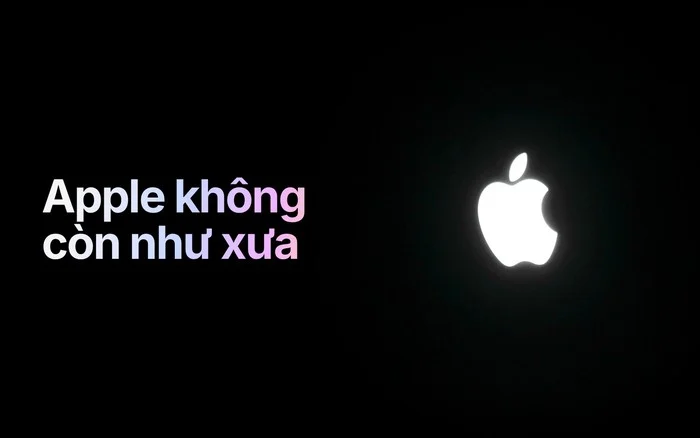
It's never too late and Apple is no longer the same
Executive Briefing
Synthesized and verified with gemini-2.0-flash-thinking-exp
“There's a question I bring into the post-event interview, and I'm guessing a lot of people do too.”
Key Takeaways
- 1.There's a question I bring into the post-event interview, and I'm guessing a lot of people do too.
- 2.If the touch screen on the laptop is so good, and the glowing logo is so attractive, why did Apple let them be absent for decades?
- 3.I used to be the person who shrugged every time someone mentioned the touch screen on the Mac.
There's a question I bring into the post-event interview, and I'm guessing a lot of people do too. If the touch screen on the laptop is so good, and the glowing logo is so attractive, why did Apple let them be absent for decades? I used to be the person who shrugged every time someone mentioned the touch screen on the Mac. Apple's answer over the years has been almost constant, that a Mac is a Mac, an iPad is an iPad, and if you want to touch, pick up the iPad. I nodded along in that vein and never found it to be a problem.
But after listening to Greg Joswiak and Tom Boger explain, I realized I was asking the wrong question in the first place. “Why is it slow” is actually not the problem. What's more worth asking is why Apple waited and why this time they sat down to explain to the press instead of letting the product speak for itself.
Those two answers say a lot about a changed Apple.
The glowing Apple logo used to be a symbol of waste
I still remember, the detail that made the whole auditorium cheer that morning was not the chip or the panel, but the reappearance of the glowing apple. This icon has been absent from MacBooks for more than ten years, since Apple quietly removed it in the mid-2010s without explanation. Users then only know that one day the logo no longer lights up. The way Apple behaves with these types of changes used to be quite familiar, that is, doing it first, and the reason is anyone's guess.
When I asked directly why I was bringing it back now, the first answer from Greg Joswiak - Apple's big boss - was only three words, "Because it's cool!" made the whole chat room laugh that day.
But then he continued,
The previous glowing logo was actually a hole cut into the back cover to let the LCD backlight leak light out. In other words, part of the light that should have gone towards the user's eyes to display the image was "exhausted" back, just to create an icon. For a company that prides itself on energy efficiency, that's a waste that's hard to justify. Apple chose to put all the light on the front and leave the logo off. The decision was technically sound, but in the past it had only been made in silence.
And then everything changed when the screen now switched to OLED. Without the backlight, each pixel glows on its own and the structural layer is significantly thinner. In that thin space, engineers placed a separate lighting system for the logo, which operates independently and consumes almost no electricity. What I like most is Greg's point that the magic sometimes lies in the moment the logo goes off. The surface is now a true reflective mirror, different from the matte plastic layer when it was not bright in the past. If it doesn't turn on, it's hard to know if it's the previous logo or not.
There is one small detail that always sticks out in my mind. When asked if there is a way to turn the logo on or off in macOS, the answer is no, there is no button, and Apple believes that users will find a way. (And it's true that I found it, but when you turn it off, the screen also goes black). That's a very Apple type of confidence and it shows that this logo was made more for emotion than for function. It took people a decade to remember it, and Apple is smart enough to understand that something remembered shouldn't be turned into an item in Settings.
Apple could have brought it back a long time ago if it were willing to waste power and thickness. But they chose not to do it, and waited until there was a way to do it that was both beautiful and effective. A little slow but correct, in my opinion is a more difficult way to make a product than fast but unfinished.
The touch screen on the MacBook Pro is not "ordinary"
What Mr. Tom emphasized in the conversation is that the touch screen on this device is not an additional layer on top of the screen. Apple integrates directly into the panel. Therefore, according to him, it is smooth, intuitive and exactly the way users expect Apple to make touch.
That background is also what makes me stop to listen carefully. This is the first tandem OLED screen on Mac to use oxide technology, with a brightness of 2,000 nits for both SDR and HDR, something Mr. Tom confirmed that no other laptop can do.
The contrast ratio reaches 10,000,000:1, five times the 2,000,000:1 level of iPad Pro. The color range supports both P3 and Adobe RGB in the same preset, and when viewed off-axis there is almost no color change. He believes that this quality is equal to or better than a reference monitor that weighs about 40 pounds (more than 18kg) and costs tens of thousands of dollars.
Apple says the 14-inch version is about half a pound lighter (about 226g) than its predecessor, the result of cutting every bit of every component without affecting the durability of the system. The fact that OLED does not need a backlight and has fewer layers in the screen structure also contributes significantly.
Apple has never said directly why for more than a decade they did not make touch for the Mac. But the way Mr. Tom talked about this machine somehow made me imagine the reason, at least in my understanding. The touch screen is integrated directly into the panel, the panel meets reference standards, and the device is still lighter than the old version. I guess Apple wanted to wait until the whole package came together before bringing touch to the Mac. For me, that is the reason why the question "why only now" is gradually being debunked.
Apple also tried to solve the problem in a different direction with the Touch Bar, then removed it from the MacBook Pro. Thinking back, the Touch Bar shows that Apple understands that users need something more than a keyboard and trackpad, they just chose a different way of doing it. Now they answer using the screen itself.
I used to think laptops didn't need touch, but now I'm starting to see it somewhat more reasonable
As a daily laptop user for work, I've never found a touch screen to be a must-have, because the MacBook Pro's keyboard and trackpad are fast enough for nearly everything I do. In my mind, the touch screen on a laptop is something I can have or not have, but I will probably rarely use it.
But then the picture gradually changes when looking closely at the person Apple is targeting. Both Greg and Tom emphasized that MacBook Pro customers are very sophisticated, and for many of them, the machine is their livelihood. They edit 8K movies, handle heavy projects, and work with photos and sound every day. This launch also shows that Apple wants to target creative professionals in filmmaking, photography and music.
The person who helped me understand that best was not Apple's leader but Kriss Ngo, a SpaceSpeakers Label music producer invited to this event. After watching the demo, I asked him why induction is necessary for musicians.
The first thing he mentioned was the knobs. A mix has dozens of knobs and sliders, while the mouse can only adjust one at a time. Touching the knob directly and turning it is faster, and closer to the way music makers are used to with real-life mixers.
The second are envelopes, which are lines that draw changes in volume or effects over time. Instead of clicking individual points and then dragging them up and down, you can now select and push the entire cluster of points at once. He said that almost all music making software already supports this operation, so users don't have to wait for anyone to update anything.
The biggest advantage lies in touching multiple points at the same time. When adjusting effects, musicians often have to drag two or three bars at the same time to hear how they affect each other. The mouse can't do it, neither can the trackpad. Two or three fingers on the screen will do, and that's when touch stops being a convenience and becomes another way of working.
That reason is also true for several other industries. 3D and graphic artists can rotate models at multiple angles, zoom in and out, and drag drawing tools with their fingers, much more naturally than holding down a key and dragging the mouse. Mobile application creators also benefit greatly when they can try touch operations right on the MacBook they are writing code on, instead of switching to another device. For editors, color wheels are also a reasonable control to rotate with a fingertip.
Of course, in my opinion, there are still places where induction doesn't make a big difference, or maybe it's too early to draw conclusions. For example, in the photography industry, zooming in and out to check details can still be done well with keyboard shortcuts or trackpad, and for those who are familiar with it, touch is just an additional option. After all, touch doesn't save anyone from anything, it's only worthwhile for tasks that require many fingers at the same time and need to touch exactly what you're adjusting.
Apple is no longer frugal, no longer conservative, and no longer "gentle"
The logo thing makes me think a lot about another difference, more subtle but more important. Apple today talks more than Apple in the past.
Remember how this company used to behave. When they dropped the glowing logo, there was no explanation session. When they claim that touch screens on Macs don't make sense, it's an almost dogmatic statement, and users are expected to accept it.
This time is different. In just a short interview, Greg and Tom explain why the logo was removed, why it's back, and why the touch screen is integrated into the panel. The second change lies in the stance itself. For more than a decade, Apple directed anyone who wanted to touch a screen to the iPad. But now, that boundary has become more flexible. Technology is shared when it makes sense, and Apple recognizes that users have changed, technology has changed, and Apple must too.
And there is a sharper attitude that I see. A company that dares to confidently point out a competitor's weakness or clumsiness in presentations is evidence of a strong strategic shift. But that straightforwardness also poses the opposite requirement for Apple itself: once they have set high standards, they must withstand strict questions from the market about the speed of innovation or the arrangement of the product range.
Generosity has its price
However, the current MacBook Pro range is becoming very wide, with the presence of new M6 variants alongside the more powerful M5 Pro and M5 Max lines in terms of CPU/GPU cores and memory bandwidth. Although Apple has a clear technical reason for identifying objects, the naming method can sometimes still confuse ordinary users when standing in front of the shelf.
Besides, the rapid launch of device lines in one fall also creates considerable pressure on public attention. Dynamism is necessary, but preserving the time and space for each key product to fully shine is a problem that Apple needs to continue to consider in the long run. However, if you think about it, a company of Apple's caliber has certainly calculated extremely carefully; And who knows, the massive spread of equipment is actually a proactive move to extend coverage and media heat throughout the last two quarters of the year?
Conclusion
Two seemingly unrelated things, the glowing logo and the touch screen, end up sharing the same story: The intersection of OLED tandem technology and mature product philosophy. Apple is not slow, they just patiently wait until the technology is perfect enough.
But the biggest change is not in the specifications, but in the way Apple communicates. A company that is willing to sit down and explain the past, admit slow steps and confidently face all controversies is a more open, more realistic Apple. The touch-sensitive MacBook Pro and its glowing logo are therefore not just nostalgia or pandering to the masses, but a declaration of a new cycle. And with a changed Apple like today, it's never too late to start over.

