110 Chinese humanoid robots danced in unison, setting a Guinness world record
Executive Briefing
Synthesized and verified with gemini-2.0-flash-thinking-exp
“**AGIBOT Company used the LinkBots platform to coordinate 110 humanoid robots through swarm scheduli”
Key Takeaways
- 1.**AGIBOT Company used the LinkBots platform to coordinate 110 humanoid robots through swarm scheduling and cluster control technology.** A group of 110 humanoid robots developed by Chinese technology company AGIBOT has just set a Guinness world record with a synchronized dancing performance.
- 2.Previously, in August, AGIBOT won 46 medals, including 18 gold medals, at the second World Humanoid Robot Games.
- 3.The company's robots participate in a variety of events such as athletics, object manipulation, hospitality services and emergency response.
AGIBOT Company used the LinkBots platform to coordinate 110 humanoid robots through swarm scheduling and cluster control technology.
A group of 110 humanoid robots developed by Chinese technology company AGIBOT has just set a Guinness world record with a synchronized dancing performance. Previously, in August, AGIBOT won 46 medals, including 18 gold medals, at the second World Humanoid Robot Games. The company's robots participate in a variety of events such as athletics, object manipulation, hospitality services and emergency response.
The record-setting performance took place on October 24 at the Yellow River International Convention and Exhibition Center, Jinan city, Shandong province, China.
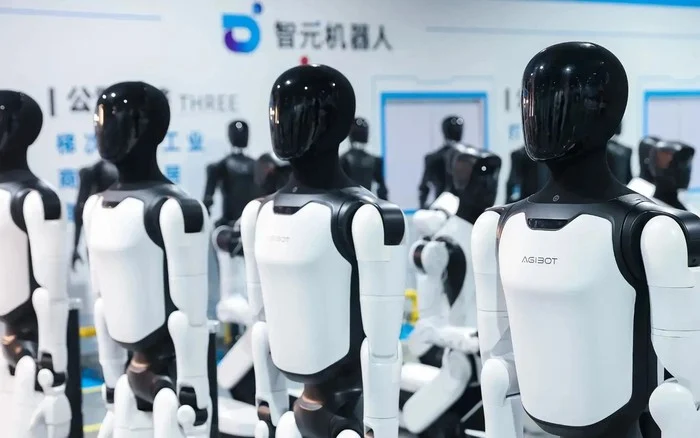
All 110 participating robots are from the Expedition A3 series, about the same size as real people. In the show, the robots perform a variety of dance moves in formation, including jumping, moving, and constantly changing positions while maintaining synchronization. In particular, the group of robots also creates wave-like moving formations and arranges them into many different shapes, including the number 2026.
Guinness World Records representatives were present at the event to confirm the number of participating robots and award an official certificate for the category "simultaneous dancing performance of the most humanoid robots". According to AGIBOT, all 110 robots are standard commercially produced products, not machines built specifically for the event. However, the ability to dance synchronously in a controlled environment does not mean a robot can reliably perform complex tasks in other real-world conditions.
To perform the demonstration, AGIBOT used the LinkBots platform developed by the company. The system is designed to coordinate multiple robots through swarm scheduling and cluster control mechanisms. LinkBots combines communication networks, positioning technology and control software to manage the movements of multiple robots at the same time. In particular, this platform integrates ultra-wideband (UWB) positioning technology, allowing tracking the relative position of the robot with centimeter accuracy.
This positioning ability is very important when robots move close to each other or constantly change formation, helping to maintain distance and limit the risk of collision in complex motion sequences. LinkBots also support synchronous motion assignment and scheduling, allowing each robot to perform tasks in a common scenario without the need for an operator to individually control each device.
In terms of connectivity, the platform uses 5G and Wi-Fi networks to maintain communication between robots and the control system, helping to transmit operating commands and coordination data throughout the formation. AGIBOT also said that LinkBots have the ability to adjust formation and plan movements to avoid obstacles, however, the technical specifications are currently not enough to fully evaluate how these functions can be implemented in a real environment.
The demonstration in China demonstrated AGIBOT's ability to coordinate large numbers of commercially produced humanoid robots, and affirmed the increasingly important role of swarm control systems in managing multiple robots performing the same task.