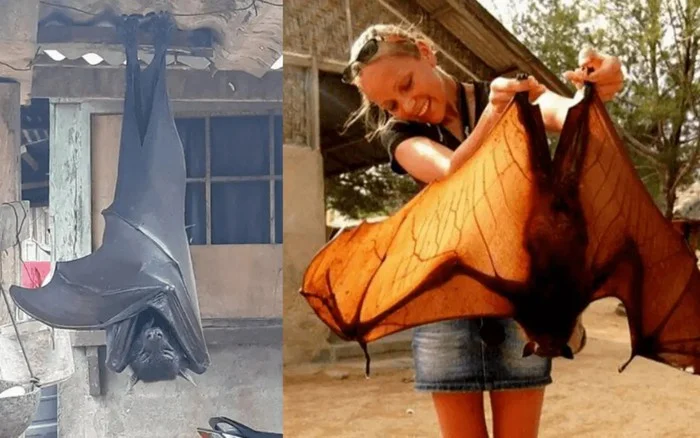
A giant bat as big as a puppy on the island of Madagascar suddenly mysteriously shrunk in size
Executive Briefing
Synthesized and verified with gemini-2.0-flash-thinking-exp
“**With a wingspan of up to 1.5 meters and a fox-like face, the Madagascar crow bat is nature's inval”
Key Takeaways
- 1.**With a wingspan of up to 1.5 meters and a fox-like face, the Madagascar crow bat is nature's invaluable pollinator.
- 2.However, scientists were shocked to realize that this huge creature was increasingly shrinking in size, stemming from paradoxical human interventions.** Amid the tropical forests of the island nation of Madagascar, the image of a creature with a wingspan of up to 1.5 meters and a body size equivalent to a small dog flying across the sky can make anyone shudder in fear.
- 3.However, contrary to the classic obsession with blood-sucking bats carrying dangerous pathogens, the Madagascar crow bat - scientific name Pteropus rufus - is a plant-eating creature that is completely harmless to humans.
With a wingspan of up to 1.5 meters and a fox-like face, the Madagascar crow bat is nature's invaluable pollinator. However, scientists were shocked to realize that this huge creature was increasingly shrinking in size, stemming from paradoxical human interventions.
Amid the tropical forests of the island nation of Madagascar, the image of a creature with a wingspan of up to 1.5 meters and a body size equivalent to a small dog flying across the sky can make anyone shudder in fear.
However, contrary to the classic obsession with blood-sucking bats carrying dangerous pathogens, the Madagascar crow bat - scientific name Pteropus rufus - is a plant-eating creature that is completely harmless to humans. Belonging to the Old World fruit bat family, they have round faces and long, delicate snouts that look exactly like foxes or pet dogs, living mainly on fruits, pollen and nectar of more than 40 native plant species.
Because plant food does not move, this species of bat does not need the ability to locate using sound waves but uses sharp vision and smell to find food. Each night, an individual can fly up to 50 km in search of food sources.
The habit of swallowing fruits whole without damaging the seeds has turned the bat into the most important seed dispersal force in the local ecosystem, as well as an effective pollinator that maintains the biodiversity of the entire island.
However, this precious animal has a very slow reproductive rate when each litter of mother bats only gives birth to one baby after a gestation period lasting from 100 to 150 days.
Currently, the Madagascar crow bat has been included in the list of vulnerable species by the International Union for Conservation of Nature (IUCN). The biggest life-or-death threat to them does not come from natural enemies but comes from human hands.
Indigenous people have long viewed crow bats as a daily source of protein, and at the same time consider them a pest that needs to be eliminated because of their habit of destroying economically valuable fruit orchards. Although local laws have issued a strict time frame for banning hunting, lax monitoring capacity has caused poaching activities to persist throughout four seasons of the year.
Behind that silent massacre is an unusual evolutionary consequence. Since the end of the last century, many biologists have felt that the size of individual bats caught is getting smaller and smaller. This suspicion was finally proven by accurate scientific data in a study just published in the Journal of Mammalogy on October 29, 2026.
The work was conducted by wildlife ecologist Emily Cornelius Ruhs and veteran collaborator Steve Goodman of the Negaunee Center for Integrative Studies at the Field Museum.
To find the root cause of the incident, professor Steve Goodman - who has spent nearly 40 years working in Madagascar - spent many years reviewing 9 famous natural history museums across the US and Europe. The authors meticulously measured the size of the skull and skin of 121 crow bat specimens collected throughout 150 years of history.
The results of statistical processing shocked the scientific community: since 1980, the number of crow bats has not only seriously declined, but their body size has also experienced an unprecedented decline.
The paradox is that the time when the size of this bat species began to suddenly deform coincided exactly with the period when local authorities introduced the first protection regulations.
The law at that time only set a time frame for banning hunting from May to August every year, but left open the imposition of quantity quotas as well as size standards of individuals allowed to be caught.
Realizing that hunting time is limited, indigenous hunters have turned to commercial hunting with an intensity many times more ferocious than during the subsistence period. They massively hunt and wipe out all bat colonies to store meat to sell on the market.
It was this destructive hunting pressure that accidentally triggered a cruel artificial selection. Researcher Emily Cornelius Ruhs points out a grim reality: if a bat possesses the largest stature in the sky, it will become the most obvious target and bring the most meat to poachers' guns.
One by one, each individual of giant stature was shot down, causing the entire gene source of superiority in size to be wiped out from nature. The lucky individuals that survive are mostly those that carry genes that dictate a stunted, smaller physique. After more than four decades of maintaining the species, their descendants today have been noticeably reduced in size.
However, scientists at the Field Museum also emphasize that intense commercial hunting may not be the only culprit leading to this physical change.
The destruction of primary forests, pressure from global climate change and disruption of fruit ripening seasons due to extreme weather may be conspiring to push giant crow bats down a path of rapid physical degeneration.
New research not only uncovers the mystery of an unusual case of physical shrinkage in nature, but also sounds a profound warning about fatal flaws in wildlife conservation policies.

