Afraid of AI stealing credit, the world's leading mathematicians have to hide their research ideas
Executive Briefing
Synthesized and verified with gemini-2.0-flash-thinking-exp
“**Even though AI is helping to solve difficult problems that have existed for decades, it is creatin”
Key Takeaways
- 1.**Even though AI is helping to solve difficult problems that have existed for decades, it is creating a paradox in research that can set back the development of mathematics.** AI is helping solve mathematical problems that once took humans decades.
- 2.But this achievement led to a paradox: instead of freely sharing ideas, some mathematicians began to keep their research directions secret because they were worried that others would use AI to complete their work and publish it before them.
- 3.Terence Tao, one of the world's leading mathematicians, warns about this trend.
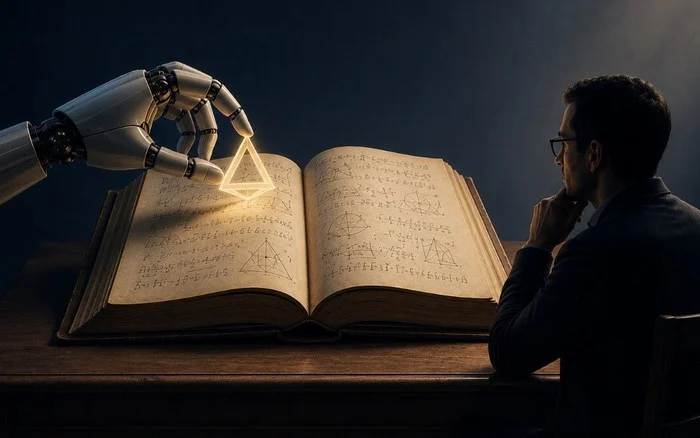
Even though AI is helping to solve difficult problems that have existed for decades, it is creating a paradox in research that can set back the development of mathematics.
AI is helping solve mathematical problems that once took humans decades. But this achievement led to a paradox: instead of freely sharing ideas, some mathematicians began to keep their research directions secret because they were worried that others would use AI to complete their work and publish it before them.
Terence Tao, one of the world's leading mathematicians, warns about this trend. In the past, researchers often publicized promising directions for colleagues to discuss and develop. But when AI can quickly solve difficult problems, revealing an incomplete idea can cause the person who came up with it to lose an advantage.
One researcher can spend years pursuing a direction, while another just needs to put that problem into an advanced AI model to find a solution first. This is threatening the culture of sharing that is the foundation of mathematical research.
When the solution appears faster than human comprehension
In his lecture on the future of mathematics, Professor Tao called the new period the period of "proof abundance", in contrast to thousands of years in which finding a solution to a difficult problem was always a scarce resource.
The change is demonstrated by OpenAI publishing 377 solutions to difficult mathematical problems using AI. However, Professor Tao noted that the company tried about 4,000 problems and only solved about 9%. Successful results often get attention, while most failed attempts rarely appear in the media.
However, the speed at which solutions are created still makes mathematicians face new challenges. Tao said there were about a dozen results in the field he was interested in that had been solved, but he didn't have enough time to read all the proofs.
The problem is that a correct solution may not help people understand why it is correct. Some of the work produced by AI is impressive, but the proof is so complex that it remains difficult for researchers to explain or restate.
Previously, the process of solving problems forced scientists to read documents, discuss with colleagues, share intermediate results, and guide students. It is that journey that creates new insights and also suggests further research questions. When AI can generate solutions without this entire process, mathematics risks losing an important part of its research.
The fear of knowledge falling into the hands of some corporations
In addition to changes in research, the mathematicians are also concerned that access to the most powerful AI tools is concentrated in a small number of businesses.
Martin Bridson, President of the Clay Mathematics Institute, warns that OpenAI or Anthropic could keep important discoveries private, leaving the underlying knowledge behind paywalls. At that time, scientists may have to use chatbots from these companies to access or understand new research results.
Terence Tao also said that Anthropic is paying mathematicians to formalize solutions found by advanced AI models. He questioned whether a private enterprise could decide who could participate in this work.
Inequality also appears between countries. Professor Ana Caraiani of Imperial College London said no organization in Romania, her home country, is qualified to apply for access to advanced AI models. She believes that most countries in the world are in a similar situation.
Martin Hairer, a mathematician who won the Fields Medal, commented that open source models cannot currently compete with leading systems. That leaves one of the key tools of futures research under the control of two American companies.
Math 2.0: Don't just find the solution, but understand the solution
Despite warning of many risks, Professor Tao does not believe that the mathematicians should turn their backs on AI. Instead, he proposed a new approach called Math 2.0, in which technology is used to expand human thinking capacity, instead of replacing the entire research process.
According to Mr. Tao, AI should not only be tasked with solving math problems but can also help find new methods, build research questions and make complex proofs easier to understand.
This challenge is even more important when AI is applied to practical problems such as chip design, power grid operations, air traffic control or drug development. If humans do not understand how the model is working, AI can exploit model weaknesses to produce results that meet technical criteria but do not solve the real problem.
For Professor Tao, the future of mathematics lies not only in finding solutions faster, but also in the ability to leverage the power of AI without losing human understanding, verification and creativity.