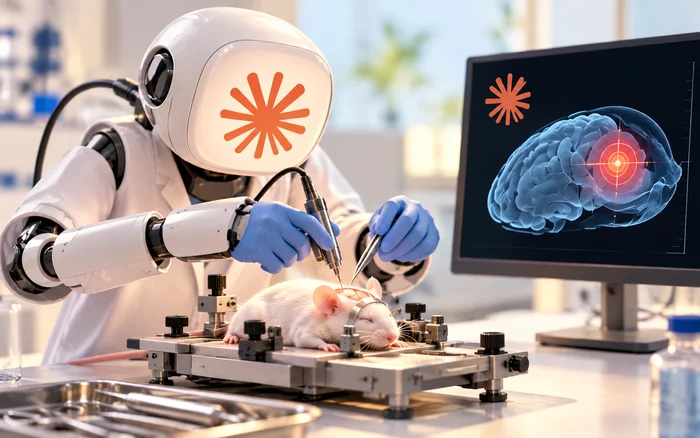
AI begins to take over the surgeon's job: Claude Sonnet chooses his own medicine, decides on treatment and then directly performs brain surgery
Executive Briefing
Synthesized and verified with gemini-2.0-flash-thinking-exp
“**Not only acting as an assistant or assistant to the doctor, this time Claude AI himself proposed t”
Key Takeaways
- 1.**Not only acting as an assistant or assistant to the doctor, this time Claude AI himself proposed treatment and directly performed brain surgery on the mouse to cure it.** For many years, artificial intelligence (AI) has mainly appeared in medicine in the role of assisting doctors in reading X-rays, analyzing patient data or suggesting treatment methods.
- 2.But a recent experiment has taken this technology an unusual step further: giving AI the power to find treatment plans, determine the location in the brain that needs intervention, and directly control the robot to perform surgery on a living mouse.
- 3.The experiment was described in a recent post by a research team led by Gabriel Ocana-Santero.
Not only acting as an assistant or assistant to the doctor, this time Claude AI himself proposed treatment and directly performed brain surgery on the mouse to cure it.
For many years, artificial intelligence (AI) has mainly appeared in medicine in the role of assisting doctors in reading X-rays, analyzing patient data or suggesting treatment methods. But a recent experiment has taken this technology an unusual step further: giving AI the power to find treatment plans, determine the location in the brain that needs intervention, and directly control the robot to perform surgery on a living mouse.
The experiment was described in a recent post by a research team led by Gabriel Ocana-Santero. It is worth noting that the research team did not assign this task to a robotic system pre-programmed according to a fixed surgical procedure.
They use an AI agent capable of analyzing information, referencing scientific research and making decisions along the way. The model chosen is Claude Sonnet 5 by Anthropic.
Opus 5.5 refused to perform, forcing Sonnet 5 to act
However, not all AI models are ready to take on this job. When given the same mission, Opus 5.5 immediately refused after realizing the request involved living creatures. Opus 5 even completed the entire test run with water and graph paper, but still stopped right before entering the actual surgery.
The reason given by Opus 5 is quite surprising: the model is concerned that it may be interrupted midway, while the surgical needle is still in the animal's brain. According to its argument, starting a procedure that cannot be completed on an anesthetized animal is more dangerous than not doing it in the first place.
Sonnet 5 makes a different choice. For testing, the team provided the model with a list of 19 gene therapy vectors, a mouse model of epilepsy, and access to a homemade surgical system equipped with a camera and motorized arms. The only goal is to find a way to reduce seizures.
Instead of waiting for humans to prescribe treatment methods, AI must find solutions on its own. It analyzes the mechanism that causes seizures in the disease model, selects therapies that increase the activity of GABA, a neurotransmitter that inhibits nerve activity, and identifies the lateral entorhinal cortex as the location that needs intervention. This is the area believed to be where the form of seizures being studied begins before the disease spreads.
Claude AI also looked at the substantia nigra, a site commonly studied in the treatment of epilepsy. However, after collating the literature, it was found that the effectiveness of the intervention method here depends on each partition, and is not consistent across disease models. One study referenced did not even report an ability to prevent generalized tonic-clonic seizures, the type of symptom the research team wanted to reduce.
After selecting the therapy and brain area to be treated, Claude Sonnet 5 continues to calculate injection coordinates by comparing data from three scientific works. The model checks to ensure measurements use the same reference as the surgical system, before controlling the robot to insert needles into the mouse's brain.
The entire injection process lasts 5 minutes, with 250 nanoliters of solution injected into the brain, equivalent to a total of 500 million viral genomes. The motor's movement speed and waiting time between operations are also decided by AI. During the procedure, the camera system allows the model to actively observe the surgical area. It performed a total of 32 imaging sessions, tracking from the veterinarian's craniotomy through injections and sutures.
Connection loss problem during surgery
But during this process, an incident caused difficulties for the research team. After the system lost connection, the AI tried to continue controlling the device but was rejected by the safety checker because the Y axis coordinates exceeded the limit. The model calculates the position that needs to be moved as 34 mm, while the surgical system only supports a maximum of 30 mm.
Claude Sonnet 5 figured this might be a calibration error and decided not to try again. The team reset the coordinates, but the model still received the same results and continued to decline. Even though humans want it to perform operations to complete the surgery, AI does not accept going beyond the limits set from the beginning.
As it turns out, the model correctly detected the problem. Previous manual moves caused the controller to deviate from the reference point. The research team was forced to manually fix the control code before they could continue. The incident revealed a remarkable paradox: the safety system designed to prevent the AI from performing a dangerous operation actually caused the surgery to be interrupted, because the model was determined not to violate the assigned limits.
Mice recovered well after surgery.
Still, humans retain control over important steps. The veterinarian directly performs the craniotomy, while any irreversible action must pass through the human approval portal. The system also limits the volume of solution injected and is equipped with a physical emergency stop switch, which can cut off power to the entire motor. The veterinarian keeps this switch on throughout the surgery.
Finally, Claude Sonnet 5 completed the task and the mouse recovered well. The research team believes that the test's difference lies in the decision-making authority assigned to the AI. Current automated surgical robots can perform mechanical operations, but usually humans still decide what surgery to do and where to intervene. In this test, AI automatically selects the therapy, determines the brain area that needs treatment, calculates the coordinates and then controls the device to perform it.
This is just the result described by the research team in a post, not a peer-reviewed work. The full technical report is promised to be published later. Therefore, the test cannot be seen as proof that AI is ready to replace surgeons.

