AI needs to create real value instead of stopping at experiments
Executive Briefing
Synthesized and verified with gemini-2.0-flash-thinking-exp
“# AI needs to create real value instead of stopping at testing Quang NinhAccording to experts, many”
Key Takeaways
- 1.# AI needs to create real value instead of stopping at testing Quang NinhAccording to experts, many AI research in Vietnam is not linked to demand, making the gap from the laboratory to practical applications still large, requiring the coordination of businesses in research.
- 2.At the forum on digital transformation and artificial intelligence, within the framework of Vietnam International Digital Week 2026, held in Quang Ninh, October 28, many business and academic representatives said that the current challenge is to bring AI models out of the testing environment, solve specific problems and create measurable value.
- 3.One of the issues mentioned is the gap between university research and the actual needs of businesses.
Quang NinhAccording to experts, many AI research in Vietnam is not linked to demand, making the gap from the laboratory to practical applications still large, requiring the coordination of businesses in research.
At the forum on digital transformation and artificial intelligence, within the framework of Vietnam International Digital Week 2026, held in Quang Ninh, October 28, many business and academic representatives said that the current challenge is to bring AI models out of the testing environment, solve specific problems and create measurable value.
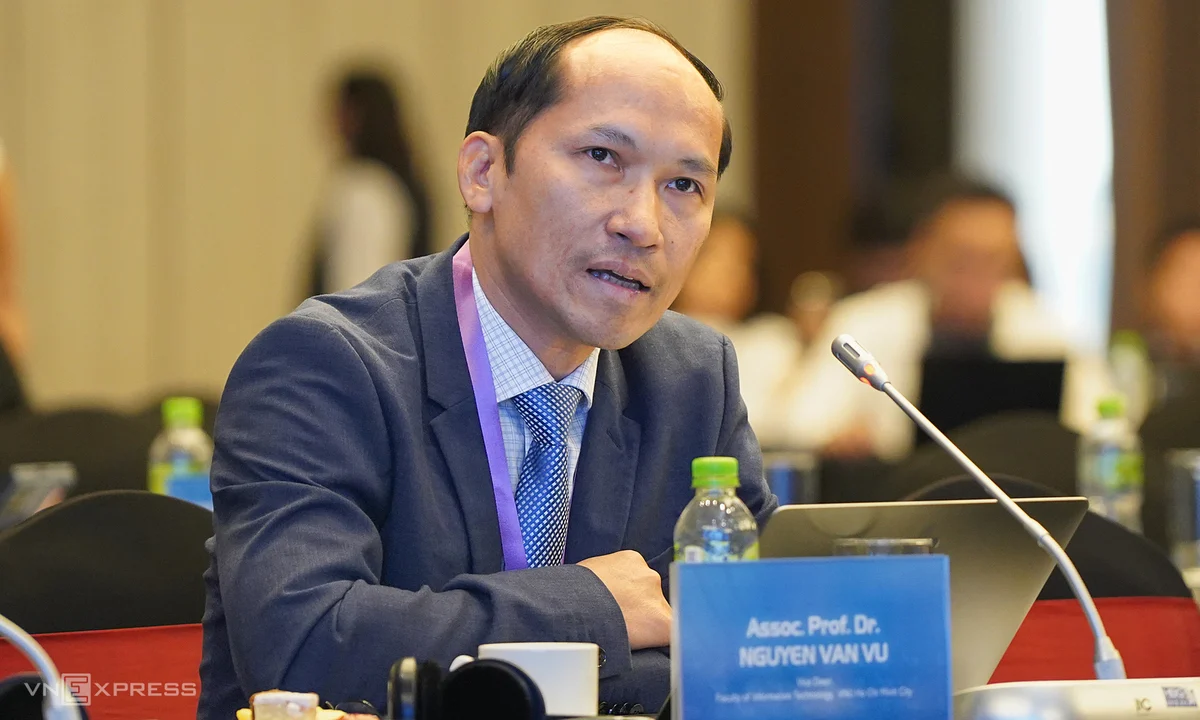
One of the issues mentioned is the gap between university research and the actual needs of businesses. Dr. Nguyen Van Vu, University of Natural Sciences, Ho Chi Minh City National University, said domestic AI research capacity is making significant progress, but the connection with the industrial sector is still limited.
In 2025, the unit will have 1,670 peer-reviewed articles in the fields of IT, AI and related industries. From the beginning of the year to September, this number reached 1,560, bringing the total in 21 months to more than 3,200. The school also has more than 170 PhDs in the field of AI and information technology. The adjacent human resources include more than 19,000 university students and 1,700 students and graduate students studying related fields.
However, according to Mr. Vu, only 3% of the unit's scientific publications originate from direct cooperation with businesses, while less than 10% of research topics are accompanied by the outside industrial sector.
"Deep connection with the industrial sector is still the missing link," he said. Despite having cooperative relationships with a number of large domestic technology corporations, Mr. Vu believes that business participation in research activities is still not commensurate with academic potential. He proposed that universities could take on the role of researching core AI technology, independently evaluating and testing AI systems on Vietnamese data sets, and providing high-quality human resources. Testing the accuracy, fairness, reliability and safety of the model also needs to be done objectively and transparently.
According to Mr. Vassan Pandiyath, AI expert at Cisco Systems, the future of AI is not only determined by technological capacity but also by the ability to convert innovation into practical results. From his experience working with customers and partners in ASEAN, he found that many organizations still have difficulty moving models from pilot environments to large-scale deployment.
He believes that this is an opportunity for universities and businesses to cooperate more deeply. Universities can develop new ideas and technologies, while businesses provide real-world data, production problems and operating environments. If both sides cooperate from the beginning, the process of putting research into commercial application can be shortened.
Ms. Rita Mokbel, President and General Director of Ericsson Vietnam, said that the value of AI does not lie in algorithms in the laboratory, but in specific problems that technology can solve in society. According to her, the telecommunications industry also needs to change the way it measures efficiency: instead of just counting the number of people connected, we need to look at what technology helps them do.
She believes that the combination of 5G, AI and cloud computing can help Vietnam connect seaports, logistics systems, factories, hospitals and power grids into a smart industrial ecosystem. As AI is deeply integrated into manufacturing, IoT devices and vehicles, telecommunications networks must meet the ability to transmit real-time data, connect computing power and ensure safety.
At the forum, Mr. Ngo Dien Hy, Deputy General Director of VNPT, said that the group is providing AI platforms and applications for state management agencies, banks and financial institutions, hundreds of businesses and millions of households and individual users.
According to him, one of the ways to promote application is to share AI platforms and proven effective implementation methods, helping organizations shorten testing time and confidently put the solution into operation on a large scale. However, this process needs to be accompanied by secure connection infrastructure, a clear legal framework and fully prepared human resources. Meanwhile, evaluating the effectiveness of AI applications also needs specific criteria, instead of just being based on the number of models or the scale of technology investment.
Concluding the conference, Minister of Science and Technology Vu Hai Quan affirmed that Vietnam is steadfast in its vision of "AI for everyone" and is ready to cooperate with partners in the spirit of trust, mutual benefit and sustainability. According to him, exchanges need to continue to be concretized by cooperation mechanisms and projects that can create real results.
Vietnam International Digital Week 2026 takes place from October 28 to 30 in Quang Ninh, organized by the Ministry of Science and Technology, including trend and policy dialogue sessions, combined with technology display and demonstration activities.
Liu Quy