Alphabet: from cows and houses to letters A and B we write every day
Executive Briefing
Synthesized and verified with gemini-2.0-flash-thinking-exp
“To read a Vietnamese newspaper, we only need to remember a few dozen letters and a few diacritics.”
Key Takeaways
- 1.To read a Vietnamese newspaper, we only need to remember a few dozen letters and a few diacritics.
- 2.Meanwhile, ancient Egyptian scribes had to study hieroglyphs for many years to become proficient.
- 3.The difference lies in the idea of the alphabet: instead of drawing a symbol for each word or idea, there is just one symbol for each sound.
To read a Vietnamese newspaper, we only need to remember a few dozen letters and a few diacritics. Meanwhile, ancient Egyptian scribes had to study hieroglyphs for many years to become proficient. The difference lies in the idea of the alphabet: instead of drawing a symbol for each word or idea, there is just one symbol for each sound. By combining the sounds, we can write any word in the language, including new words that have never existed before.
Few symbols, can combine all words
Britannica explains this advantage with a simple calculation. A language with 30 consonants and 5 vowels only needs a maximum of 35 letters. If using the syllabic writing system, each combination such as ba, be, bi, bo, bu needs a separate symbol, for a total of 155 symbols. As for word writing systems such as hieroglyphs or cuneiform, they need a much larger number of symbols.
Wikipedia cites that hieroglyphs and cuneiform at that time included many complex characters that took a long time to master, so reading and writing was limited to scribes and the royal and religious classes. The alphabet only has a few dozen symbols, so merchants and ordinary people can learn it too.
Starting from the turquoise mines in Sinai
The ancient Egyptians actually had about 24 hieroglyphs representing only one sound, but they only used them to suggest readings for other hieroglyphs. The real jump came from Semitic speakers working in Egypt. According to Wikipedia, Proto-Sinai script appeared in turquoise mines on the Sinai Peninsula around 1840 BC, probably left by Canaanite miners. In 1999, two Egyptologists John and Deborah Darnell found inscriptions of the same type in the Wadi el-Hol valley, dating to around 1800 BC.
Small sandstone sphinx found in Serabit el-Khadim (Sinai Peninsula), around 1800 BC, now belongs to the British Museum. The row of symbols on the base is Proto-Sinai, one of the earliest forms of letters
In 1904-1905, archaeologist Flinders Petrie discovered strange inscriptions at the temple of the goddess Hathor at Serabit el-Khadim. In 1916, Egyptologist Alan Gardiner recognized a repeated cluster of symbols reading lbʿlt, meaning offering to the goddess Baalat. The British Museum said the sphinx in the photo has both scripts: the right shoulder is engraved with Egyptian hieroglyphs with the beloved of Hathor, the mistress of turquoise, and the left shoulder and base are engraved with Proto-Sinai script called Baalat, so it is very likely that this is a bilingual text.
The cow becomes the letter A, the house becomes the letter B
The way ancient people created letters is quite easy to understand. They borrow a picture, call it a word in their language, and then take the first sound of that word as the value of the word. The shape of a house, the Semitic word bayt, became the phonetic letter b. The first letter is aleph, meaning cow, the fourth letter is dalet, meaning door. The two words aleph and bet later became the Greek alpha and beta, combined to form the word alphabet.
The five Phoenician letters, their original names and meanings, and the Greek and Latin forms they became
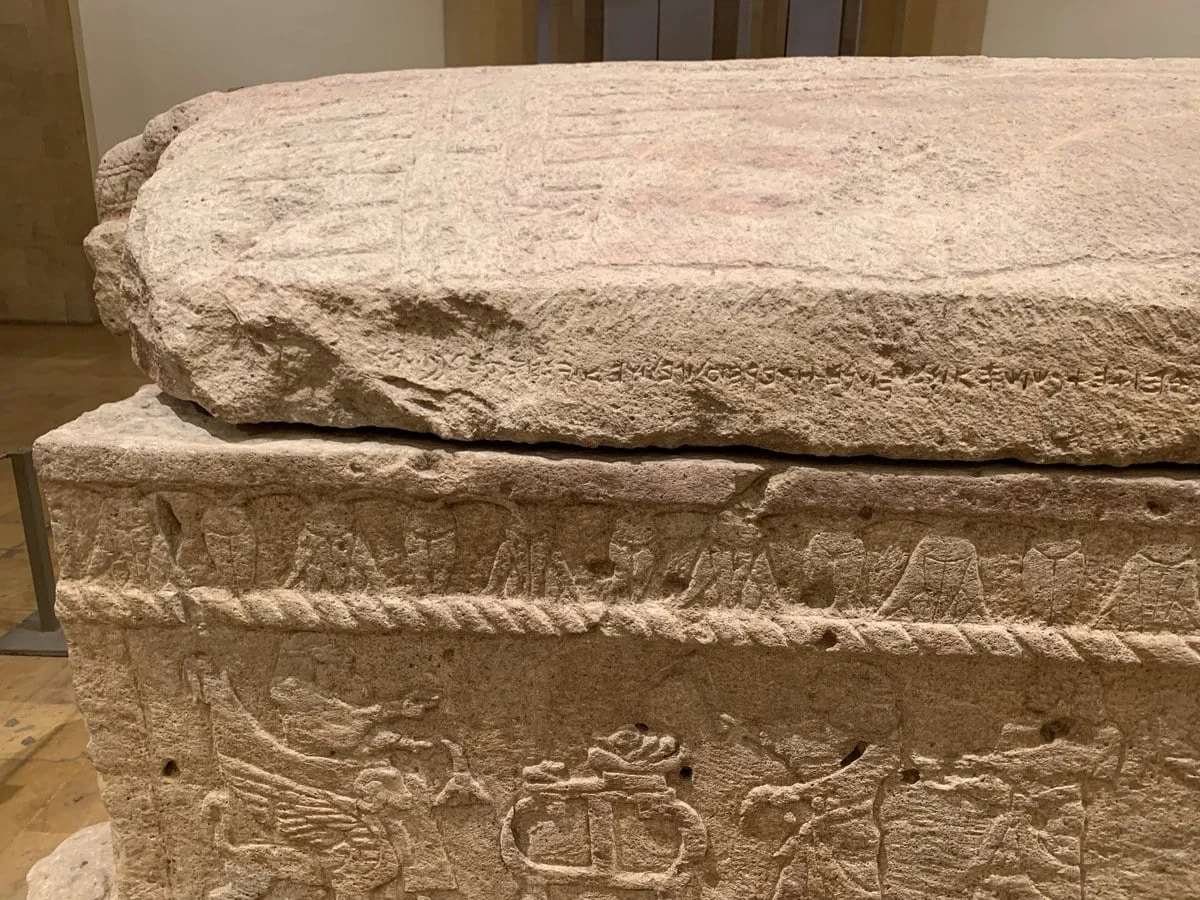
From Proto-Sinai, according to Wikipedia, the Phoenicians in coastal Lebanon today developed a 22-letter alphabet before 1050 BC. This is also the first writing system with a fixed writing direction, from right to left. The oldest known Phoenician text is the inscription on the sarcophagus of King Ahiram at Byblos, although its date is disputed. Thanks to the sea trade network, Phoenician merchants brought the alphabet throughout the Mediterranean.
Phoenician inscription engraved along the edge of the coffin lid of King Ahiram in Byblos, displayed at the National Museum of Beirut (Lebanon). This is the oldest known Phoenician text, usually dated to around 1000 BC
Advertisement
Greeks added vowels
Phoenician script only records consonants, the reader fills in vowels according to the context, which is easy for Semitic languages with roots based on consonants. Greek is different, so when they received this alphabet around 800 BC, the Greeks used letters to record consonants that their language did not have to record vowels. Aleph to alpha sounds a, he to e, ʿayin to o. Wikipedia calls this the earliest known writing system that systematically records both vowels and consonants.
From a variant of the Greek script used in Cumae, the Etruscans in Italy created their own script, which the Romans then converted into Latin. The letters W, J and U were added or separated much later, forming the familiar set of 26 letters. According to Wikipedia, Latin script is today used to write more than 3,000 languages, of about 70% of the world's population, including Vietnamese with its own additional letters and accents.
Source:
Britannica: Alphabet
,
Wikipedia: Alphabet
,
Wikipedia: Phoenician alphabet
,
Wikipedia: Proto-Sinaitic script
,
British Museum: Sphinx EA41748
,
Wikipedia: Greek alphabet
,
Wikipedia: Latin alphabet