America's chilling productivity breakthrough: AI doesn't make the world smarter, it only widens the gap between those who know how to use it and those who "buy it and leave it there"
Executive Briefing
Synthesized and verified with gemini-2.0-flash-thinking-exp
“**Reports from the Financial Times and Dallas Fed poured cold water on the technological illusion, w”
Key Takeaways
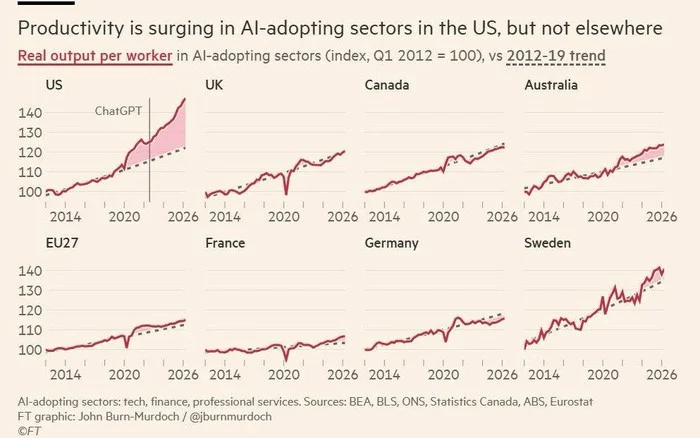
- 1.**Reports from the Financial Times and Dallas Fed poured cold water on the technological illusion, when the world only used AI to type text, the US turned it into the engine to break out labor productivity, widening the record gap by bringing AI deep into the workflow.** ### ChatGPT breaking point and talking productivity numbers Looking at the chart measuring real output per worker (real output per worker) in industry groups approaching AI such as technology, finance and professional services, the difference appears extremely cruel.
- 2.Right at the time of ChatGPT's launch, the US graph immediately bent upward, completely separating from the historical trend line and skyrocketing close to the 145 mark.
- 3.Meanwhile, other developed economies such as the UK, Canada, Australia or the entire EU27 block were almost flatly sticking to the old trend line, except for Sweden, which inched up slightly but not significantly.
Reports from the Financial Times and Dallas Fed poured cold water on the technological illusion, when the world only used AI to type text, the US turned it into the engine to break out labor productivity, widening the record gap by bringing AI deep into the workflow.
ChatGPT breaking point and talking productivity numbers
Looking at the chart measuring real output per worker (real output per worker) in industry groups approaching AI such as technology, finance and professional services, the difference appears extremely cruel. Right at the time of ChatGPT's launch, the US graph immediately bent upward, completely separating from the historical trend line and skyrocketing close to the 145 mark. Meanwhile, other developed economies such as the UK, Canada, Australia or the entire EU27 block were almost flatly sticking to the old trend line, except for Sweden, which inched up slightly but not significantly.
This disparity is even more terrible when dissecting deeply into the country's domestic financial picture. Although the above three industry groups only account for a mere 16% of total working hours in the US, they contribute up to 40% of the entire economy's productivity growth from the beginning of 2024. The productivity of industry groups open to AI grows at a rate of 3.7%/year, completely crushing the meager 1.7% of the rest.
The secret is not in the tools but in the courage to rebuild and rebuild the process
When the Dallas Fed compared this chart with Anthropic's AI Usage Index (which measures the level of use of the Claude model across the working population), the root cause was officially revealed. The level of AI adoption by US workers is 3.69 times higher than the world average, while this figure in the EU27 is only 1.85, Germany is 1.79 and France is 2.66.
The truth is that Americans and Europeans are using the same Claude model, buying the same API with identical technological power. The difference is that American workers actually absorb and push AI deeply into their daily workflow. About 43% of the US workforce claims to use AI for work, while Europe only ranges from 26% to 36%, and the total number of actual hours used in Europe is not even a third of that of the US.
Give up 6 months and change your way of doing things or accept being left behind?
This expensive image is a direct warning to programmers and businesses without having to wait for macro forecasts. The factor that creates the gap between rich and poor in productivity today is absolutely not who owns the "better" tool, but who has the courage to spend 6 months restructuring the entire working method instead of just buying a copyright and typing it like an automatic word suggestion feature.
The Financial Times chart actually only reflects the tip of the iceberg. The scarier part is that the workforces in those same technology and finance industries are widening the productivity gap with the rest of the world every quarter.