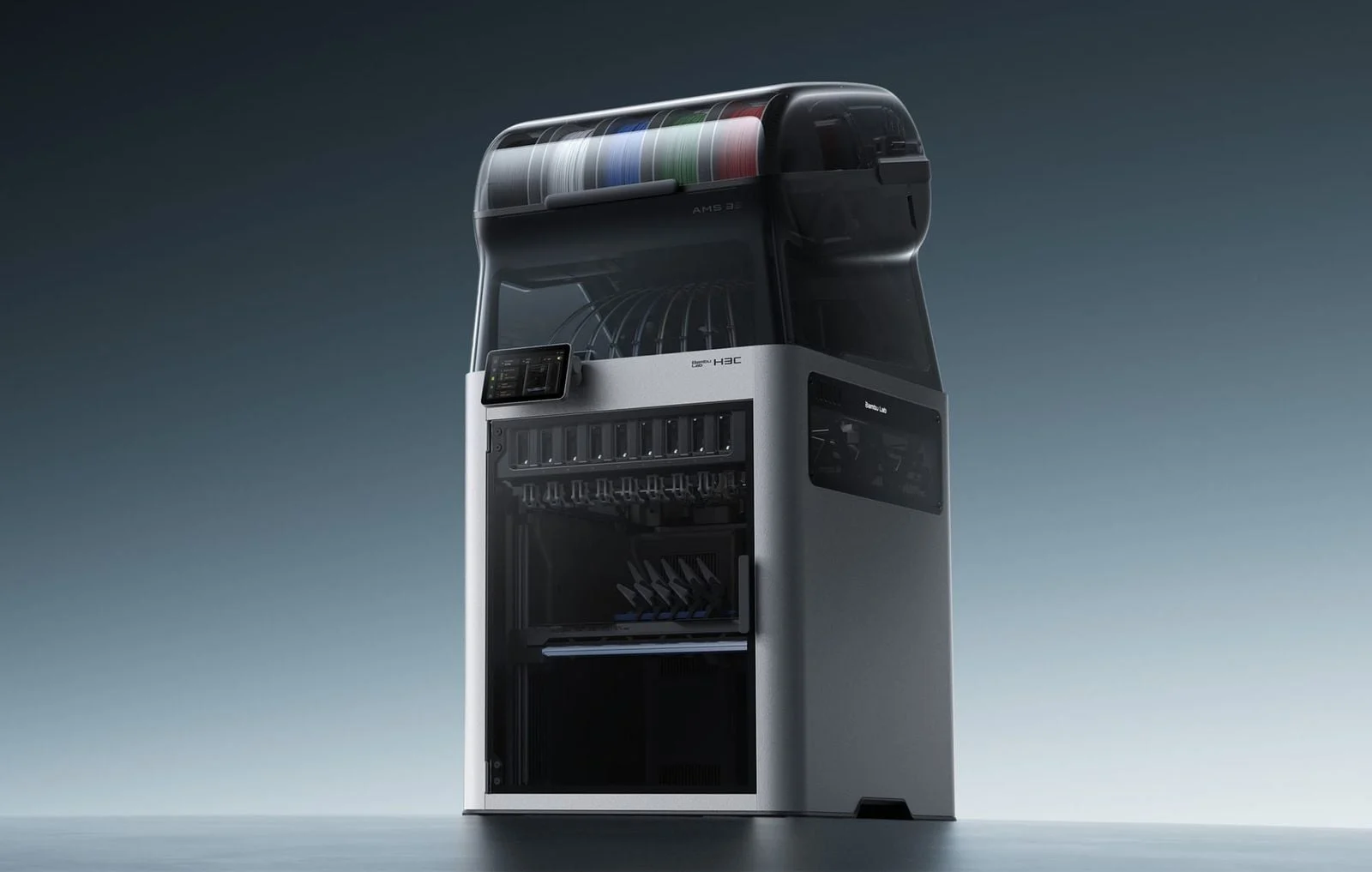
Bambu Lab launches H3C 3D printer: 9 automatic print heads, material exchange in under 6 seconds, new AMS 3H
Executive Briefing
Synthesized and verified with gemini-2.0-flash-thinking-exp
“**Main specifications:** - Print volume: 330 × 320 × 325 mm - Swaptek print head replacement system”
Key Takeaways
- 1.**Main specifications:** - Print volume: 330 × 320 × 325 mm - Swaptek print head replacement system with 9 print heads, changing materials in under 6 seconds - Maximum print head temperature: 350°C, hardened steel print head - Maximum print bed temperature: 120°C - Actively heated printing chamber maximum 65°C - Supported printhead diameter: 0.2 / 0.4 / 0.6 / 0.8 mm - Plastic fiber diameter: 1.75 mm and 2.85 mm - Maximum speed 1,400 mm/s, maximum acceleration 25,000 mm/s² - Integrated AMS 3H set, 2 plastic drying trays maximum 85°C, expandable to 24 plastic rolls - HEPA air filter level H11 - External dimensions: 493 × 571 × 587 mm, weight 36.28 kg (including AMS 3H) - Price of H3C AMS Combo version: 2,499 USD (not including tax, according to Bambu Lab), delivery in the US around November 20, 2026 ## **Design** Bambu Lab says the H3C is built around three main components: the Swaptek system takes care of print head replacement, the FlexFeed resin extruder handles better plastic resin (soft TPU), and the AMS 3H takes care of storing, drying, and loading nine rolls of resin at the same time.
- 2.The notable point is that AMS 3H is no longer a box placed next to the machine like before, but is integrated into the body of the machine, more seamless and beautiful, so according to the company, the entire system only takes up an area equivalent to a printer with a roll of plastic.
- 3.The print head and X-axis assembly are rebuilt from scratch, 40% lighter, meaning less inertia when running fast.
Main specifications:
- Print volume: 330 × 320 × 325 mm
- Swaptek print head replacement system with 9 print heads, changing materials in under 6 seconds
- Maximum print head temperature: 350°C, hardened steel print head
- Maximum print bed temperature: 120°C
- Actively heated printing chamber maximum 65°C
- Supported printhead diameter: 0.2 / 0.4 / 0.6 / 0.8 mm
- Plastic fiber diameter: 1.75 mm and 2.85 mm
- Maximum speed 1,400 mm/s, maximum acceleration 25,000 mm/s²
- Integrated AMS 3H set, 2 plastic drying trays maximum 85°C, expandable to 24 plastic rolls
- HEPA air filter level H11
- External dimensions: 493 × 571 × 587 mm, weight 36.28 kg (including AMS 3H)
- Price of H3C AMS Combo version: 2,499 USD (not including tax, according to Bambu Lab), delivery in the US around November 20, 2026
Design
Bambu Lab says the H3C is built around three main components: the Swaptek system takes care of print head replacement, the FlexFeed resin extruder handles better plastic resin (soft TPU), and the AMS 3H takes care of storing, drying, and loading nine rolls of resin at the same time.
The notable point is that AMS 3H is no longer a box placed next to the machine like before, but is integrated into the body of the machine, more seamless and beautiful, so according to the company, the entire system only takes up an area equivalent to a printer with a roll of plastic.
The print head and X-axis assembly are rebuilt from scratch, 40% lighter, meaning less inertia when running fast. This is why the company says the machine can achieve an acceleration of 25,000 mm/s² and a speed of 1,400 mm/s without ringing on the surface of the printed object.
The machine features dual print-monitoring cameras, with an optional BirdsEye top-view camera, and a separately sold Bambu Station L stand to elevate the machine to working level, with storage for tools and plastic underneath.
Swaptek print head system with the ability to change materials in under 6 seconds
The biggest problem with multi-color, multi-material printing up to now is that each color change is time-consuming and wastes plastic, a lot of plastic, because the machine has to pull out the old filament, load in the new filament, and then discharge a certain amount of plastic to clean.
With Swaptek, 9 print heads are always pre-loaded with resin and waiting on the dock, so the machine does not need to withdraw one filament to load the other.
Advertisement
The Active Pre-Heat feature anticipates the next print head change and preheats that print head while the current head is still printing, so that according to Bambu Lab, new material begins to extrude within 6 seconds.
Description of Active Pre-Heat feature.
There are up to 9 print heads, changing plastic is also fast so the machine can mix many print head sizes in the same print, for example, small details use 0.2 mm head, the body uses 0.4 mm, and Bambu Studio has a new algorithm so that each print head runs the appropriate layer thickness for it.
Note that printheads of different sizes must be purchased additionally. In addition to printing, Swaptek can also run manual tools such as CutTool (cutting), DrawTool (drawing) and DebossTool (debossing). So godly.
Advertisement
New FlexFeed extruder for soft TPU
TPU has always been slow to print because the softer the fiber, the more likely it is to bend or fold before reaching the print head, so the machine has to slow down to print stably. The FlexFeed extruder supports both 1.75mm and 2.85mm filaments, swapping back and forth while printing, and with the dedicated 2.85mm TPU filament, thicker filaments are stiffer when pushed, allowing more resin to flow.
The clock is printed in super detail, they printed a combination of many different materials and different print head sizes.
Video prints the clock.
Compatible with both 1.75 mm and 2.85 mm fibers.
According to Bambu Lab, the H3C stably prints soft TPU up to 75A hardness with a flow rate up to 3 times that of the previous model (the company's internal measurements), suitable for printing wearable items such as watch straps, insoles, and handles. The AMS 3H also has its own TPU loading port to print TPU straight from the AMS, without needing to hang an external plastic roll.
Looking at the detailed print of the shoes is really cool.
Maximum drying 85 degrees.
AMS 3H, drying resin right during printing
AMS 3H is a completely sealed resin management system, each roll is housed in a sealed moisture-proof compartment. When you put in the plastic roll, the RFID tag is immediately read and synchronized with the machine and slicer software. At the same time, the plastic roll is added to the plastic management section with the type, color and remaining weight, so you don't need to remember what roll you have left or which slot it is in.
The machine has 2 dedicated drying slots, maximum drying temperature of 85°C, enough for easily absorbent engineering plastics such as PA, PC and carbon fiber mixed plastics, and drying can run in parallel while printing.
The number of plastic rolls will not stop at 9 rolls: if you connect an old AMS unit via PrintTool No. 1, the machine supports up to 24 plastic rolls in one print, and if more drying is needed, you can attach an AMS 2 Pro or AMS HT. Why is it so cruel?
Heat, cooling and self-calibration
The printing chamber is actively heated in two zones up to 65°C instead of just relying on heat from the print bed, combined with a direct contact heat sensor for more accurate measurements, helping to limit warping and layer separation with technical plastics. All 9 print heads can reach up to 350°C, printing ABS, PC, PA-CF, PET-CF and other high temperature plastics.
The cooling system consists of 4 layers: a print cooling fan on the print head, 2 auxiliary fans on the side of the print chamber, a separate fan for each print head and a print chamber fan behind the AMS 3H.
Before each print, the machine automatically calibrates all 9 print heads, dock, offset compensation and table scale based on sensors and cameras. The new HMS error reporting system with MiniWiki will diagnose the cause and provide step-by-step repair instructions right on the machine screen, while the Vision Encoder accessory (optional) helps keep errors below 50 µm over the entire print volume over time.
Compared to previous life
According to Bambu Lab, the H3C has a 40% lighter printhead and X-axis assembly, prints TPU at 3 times the throughput, and finishes printing on average over 10% faster than the previous flagship. On the contrary, the H2D, H2C and
The Bambu Lab E1 air purifier syncs with the printer and begins filtering as soon as printing begins, capturing volatile compounds and toxic gases, PM2.5 particles and microplastics released during operation. You can print without expanding the window.
According to:
Bambu Lab