Chairman of Samsung Vietnam: Urbanization, AI 'unlocks' the HVAC industry
Executive Briefing
Synthesized and verified with gemini-2.0-flash-thinking-exp
“# Chairman of Samsung Vietnam: Urbanization, AI 'unlocks' the HVAC industry The need for Data Cente”
Key Takeaways
- 1.# Chairman of Samsung Vietnam: Urbanization, AI 'unlocks' the HVAC industry The need for Data Center cooling, along with the development of real estate and industry, creates room to expand the air solutions (HVAC) segment for business groups, according to Mr.
- 2.Samsung's B2B business (sales to corporate partners) in Southeast Asia and Oceania in 2025 increased by 20% over the same period.
- 3.B2B sales in the region in 2026 account for 54% of the segment's total revenue, up sharply from 29% in 2021.
The need for Data Center cooling, along with the development of real estate and industry, creates room to expand the air solutions (HVAC) segment for business groups, according to Mr. Hyung Bin Joo.
Samsung's B2B business (sales to corporate partners) in Southeast Asia and Oceania in 2025 increased by 20% over the same period. B2B sales in the region in 2026 account for 54% of the segment's total revenue, up sharply from 29% in 2021. Among them, HVAC (heating, ventilation and air conditioning) is considered an important growth driver.
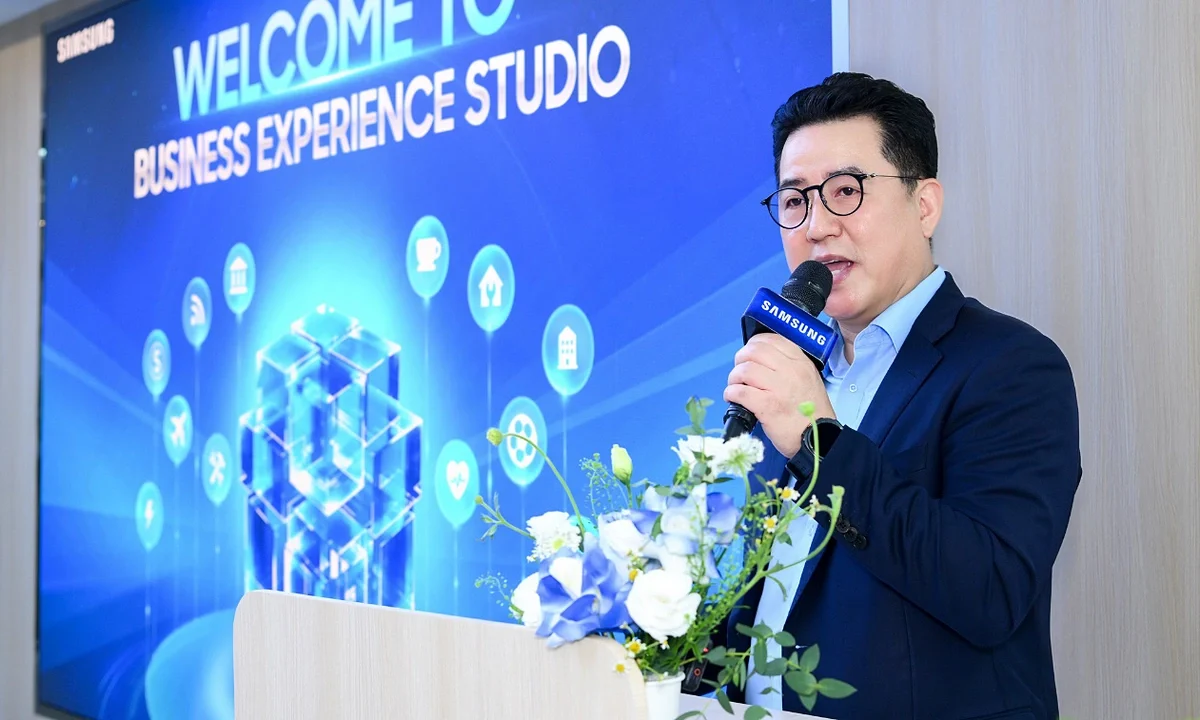
Mr. Hyung Bin Joo, Chairman and General Director of Samsung Electronics Vietnam Company (SAVINA), assessed that the numbers show that businesses are buying more and are increasingly interested in specialized solutions. SAVINA has many advantages to accompany businesses through solutions suitable to constantly changing needs.
Urbanization creates room for HVAC segment
Samsung leaders commented that Vietnam is in the process of rapid urbanization. With the current urbanization rate reaching more than 40%, Vietnam still has much room to continue developing in the future. Urbanization increases large-scale projects (office buildings, apartments, hotels, resorts, public buildings), thereby increasing the demand for intensive air cooling products.
In this group of projects, according to Mr. Hyung Bin Joo, investors increasingly focus on comfort, design and user experience. Therefore, investing in an intensive cooling system is "very necessary". For example, he cited HVAC systems in offices, hotels and resorts that can affect guest comfort and operating costs.
Another trend driving HVAC is industrial development. According to the Foreign Investment Agency, by the end of 2025, the country will have 478 industrial parks established with more than 145,000 hectares of land. At factories and industrial parks, machinery and equipment always need stable temperatures and "tailored" solutions to operate smoothly.
Mr. Hyung Bin Joo acknowledged that more and more projects are applying green building standards and indoor environmental quality such as LEED (the leading international standards system for architecture and green construction in the US), Lotus (green building rating system in Vietnam) and Well (standards focusing on health and quality of life in buildings).
"This trend is driving demand for HVAC systems, contributing to improving energy efficiency and environmental quality in buildings," said Mr. Hyung Bin Joo.
To meet the needs of this customer group, Samsung develops a diverse product portfolio, focusing on gentle cooling and energy-saving technology. In particular, WindFree is the company's signature technology, using microscopic air holes to disperse airflow, bringing a cool feeling without creating a direct cold wind. Devices will be connected and centrally managed through SmartThings Pro. The platform supports businesses in monitoring, controlling systems and proactively managing energy.
Currently, these solutions are provided by Samsung for many large-scale projects. In Ho Chi Minh City, the company provided about 3,000 wall-mounted WindFree air conditioners and four-way ceiling cassettes for CapitaLand's Sycamore project. In Hanoi, the company provides more than 3,000 one-way and two-way WindFree air conditioners for about 600 apartments in the Starlake complex.
In addition to apartments, the company is implementing air conditioning solutions for the Mandarin Oriental Danang Resort & Villas project in Da Nang, including 60 villas, and Alexandre Yersin French International School in Hanoi.
Data center cooling - a new direction in the age of AI
According to a Savills report, the Data Center market in Vietnam will reach a capacity of 524.7 MW by 2025, estimated to generate revenue from 1.04 billion USD to 1.57 billion USD. By 2031, this number is forecast to exceed 3 billion USD, a compound annual growth rate of over 20%.
Mr. Hyung Bin Joo analyzed data centers that must handle large amounts of heat generated from servers and computing devices operating continuously. As computing density increases to serve AI applications, the cooling problem becomes more complex. "The system not only needs to maintain appropriate temperature conditions but also must ensure stability, control energy consumption and limit the risk of operational interruption," Samsung Vietnam leaders emphasized.
For HVAC suppliers like Samsung, data centers are a segment with different technical requirements than conventional residential or commercial air conditioning. Intensive cooling systems need to meet demanding operating conditions and be designed to suit the size and characteristics of each facility. Therefore, technical capacity, integration capabilities and post-deployment support play an important role in addition to device quality.
Samsung is expanding its capabilities in this area through the acquisition of FläktGroup, a Germany-based HVAC business with more than 100 years of experience. FläktGroup specializes in central HVAC systems and cooling solutions for buildings and facilities with high operating requirements, including data centers.
Following the deal, Samsung aims to combine FläktGroup's HVAC expertise with its technology capabilities, AI and building management platforms to expand its solution portfolio for business customers.
In August 2026, Samsung announced plans to invest about 240 billion won, equivalent to 158 million USD, to build FläktGroup's HVAC production line in Gwangju, Korea. The facility has an area of about 21,500 m2, expected to be completed and put into operation in 2028, focusing on HVAC products, including AI data center cooling solutions. This is part of Samsung's plan to develop HVAC into a new growth engine in the global market.
For Vietnam, SAVINA Chairman said that the prospect of expanding digital infrastructure creates a basis for suppliers in the HVAC field to be confident in the future. However, market potential does not mean that a business has a specific position or contract.
"We need to continue to demonstrate our technical capacity and ability to meet the requirements of domestic customers to better serve their needs, contributing to promoting market development," the unit leader emphasized.
To develop the B2B business, the brand said it is focusing on expanding its dealer and partner network, while improving consulting, design and project implementation capabilities. With a diverse portfolio of integrated solutions ranging from HVAC, home appliances and smart management technology, Samsung is supporting businesses and investors through advanced technology solutions. These solutions simplify management across the entire facility, including reducing energy consumption and controlling operating costs.
By participating early in the planning and implementation process, Samsung aims to clearly understand the investor's requirements, thereby providing a plan suitable to the characteristics of each project.
The company also cooperated with Ho Chi Minh City University of Technical Education to open the Samsung Air Conditioning Training Center, aiming to improve the quality of technical training and develop human resources for the industry.
Samsung representative assessed Vietnam as a large and attractive market. The problem in the next stage is to continue upgrading products, service quality, and deployment capabilities to bring the brand to a leading role in the market.
Hoai Phuong