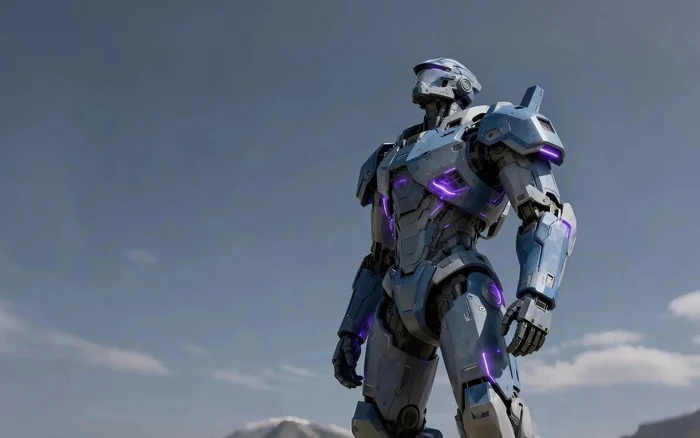
China built a giant robot 4m high that can lift objects weighing 500kg
Executive Briefing
Synthesized and verified with gemini-2.0-flash-thinking-exp
“**With a height equivalent to a monster truck, weighing 1.2 tons and being able to lift objects weig”
Key Takeaways
- 1.**With a height equivalent to a monster truck, weighing 1.2 tons and being able to lift objects weighing 500kg, Neo1 is expected to undertake dangerous tasks that are difficult for humans to perform.
- 2.However, this machine still has a considerable way to go before it can work in reality.** ## Robot 4m high, weighing 1.2 tons attracts attention in China China is promoting the development of humanoid robots for industrial use, of which Neo1 is one of the products with a particularly prominent size.
- 3.Developed by NeodraDynamics, a company based in Beijing, Neo1 is about 4 meters tall, weighs 1.2 tons and possesses 41 independently controlled moving joints.
With a height equivalent to a monster truck, weighing 1.2 tons and being able to lift objects weighing 500kg, Neo1 is expected to undertake dangerous tasks that are difficult for humans to perform. However, this machine still has a considerable way to go before it can work in reality.
Robot 4m high, weighing 1.2 tons attracts attention in China
China is promoting the development of humanoid robots for industrial use, of which Neo1 is one of the products with a particularly prominent size.
Developed by NeodraDynamics, a company based in Beijing, Neo1 is about 4 meters tall, weighs 1.2 tons and possesses 41 independently controlled moving joints.
The machine first appeared at the World Robot Conference in Beijing, before being introduced to JD Industrial, the industrial materials supply division of e-commerce group JD.com, at the China International Industry Exhibition (CIIF) taking place in Shanghai from October 12 to 16.
According to the manufacturer, Neo1 was developed to serve jobs that require great power and pose many risks, such as assembling heavy industrial equipment, mining, rescuing and maintaining nuclear facilities.
The most notable point of the robot lies in its combined hydraulic and electric drive system. Of the 41 moving joints, 39 use small hydraulic actuators, while the remaining two use electric motors to rotate the forearm.
Hydraulic actuators work by using pressurized oil to push pistons, similar to the operating mechanism of an excavator arm. However, this technology is miniaturized to fit the robot body structure.
Each actuator weighs about 1kg but generates a continuous thrust of several tons. This is the force that the part can maintain during operation, rather than only generating for short moments.
NeodraDynamics announced that Neo1 has a maximum load of 500kg when both arms work together. This figure shows that the robot is designed to handle the tasks of lifting, holding and moving heavy goods in industrial environments.
Can't walk on my own yet, still have to connect to the power source with a cable
Despite its impressive size and power, Neo1 is currently unable to operate independently in industrial facilities.
According to Cui Dalong, representative of NeodraDynamics, sharing with New Atlas, the robot is currently controlled remotely through a computer running a pre-set program. Power is also supplied directly by a cable connected to the outside.
The manufacturer plans to equip the battery when the robot can move on its own. Meanwhile, the ability to operate automatically still needs to wait for an artificial intelligence system to act as the control brain. This system is currently still in the training process.
Another notable point is that Neo1 has not yet completed the ability to walk on two legs. NeodraDynamics representatives admitted that developing the ability to move on foot is not a priority for industrial applications.
In fact, the company has no plans to put all of these humanoid robots to work directly at factories or construction sites. Instead, the option considered is to disassemble or integrate the large load-bearing arm system onto a moving wheeled platform.
This approach shows that manufacturers prioritize the ability to perform work over human-like mobility. In industrial environments, a wheel system can meet the needs of moving equipment without necessarily having to develop a complex balancing mechanism like a bipedal robot.
China also has a motorized robot GD01 priced at 650,000 USD
Neo1 is not the only giant robot project in China.
Previously, on May 12, Wang Xingxing, founder of Unitree Robotics, directly sat in the chest cavity of GD01, a manned mechanized robot model that the company claims is the first product of its kind to be mass-produced in the world.
During the performance, Wang controlled the 2.98m tall machine to step forward and punch through a concrete brick wall.
GD01 weighs about 500kg, has a starting price of 650,000 USD. The robot can stand on two legs like a human or switch to a four-legged position. The second way of operating helps lower the center of gravity, increasing stability when moving on uneven terrain.
Compared to the GD01, the Neo1 is significantly larger in size and is oriented towards industrial applications, rather than focusing on direct internal control.
China accelerates in humanoid robot race
Machines like the Neo1 and GD01 are just part of a large-scale industrial automation strategy that China is pursuing.
According to market research company Omdia, Chinese businesses account for nearly 90% of global humanoid robot sales in 2025.
Unitree Robotics alone said it has delivered more than 5,500 humanoid robots to end customers this year. However, Omdia's figures are lower, with about 4,200 products, behind AgiBot with 5,168 units. Meanwhile, Tesla only has about 150 Optimus robots.
These numbers show that Chinese enterprises have a significant presence in the humanoid robot market, from demonstration models to products aimed at practical applications.
As for Neo1, NeodraDynamics is currently introducing the product to seaports, where robots can take on the task of lifting heavy goods and opening container doors. The company also targets highly hazardous work environments such as offshore oil and gas rigs, nuclear refueling facilities and power transmission tower construction.
However, Neo1 is currently only a demonstration robot model, and has not yet proven its ability to operate durably in a real industrial environment. Perfecting the battery system, mobility and artificial intelligence will be important steps before the machine can truly undertake the expected tasks.
With its huge size and ability to lift 500kg, Neo1 shows the new development direction of Chinese industrial robots. Instead of just focusing on creating compact machines that can imitate human movements, manufacturers are aiming for robots with power beyond normal physical capabilities, to handle heavy and dangerous work.

