China's solar power bubble burst: More than 40,000 employees were laid off, selling prices plummeted 63%
Executive Briefing
Synthesized and verified with gemini-2.0-flash-thinking-exp
“**China's five major solar power manufacturers have cut more than 40,000 more jobs in 2025, followin”
Key Takeaways
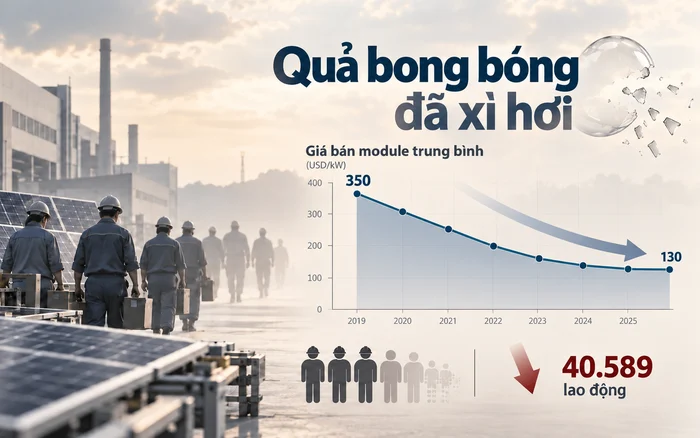
- 1.**China's five major solar power manufacturers have cut more than 40,000 more jobs in 2025, following a wave of sharp streamlining a year earlier, as overcapacity continued to put pressure.** According to Reuters compiled from corporate reports, Longi Green Energy, Trina Solar, Jinko Solar, JA Solar and Tongwei have a total of 154,061 employees at the end of 2025, down 40,589 people compared to a year ago.
- 2.The reduction is equivalent to 21% of the workforce, after this group has cut 31% of personnel in 2024.
- 3.Overall, in the 2 years 2024-2025, the number of employees at 5 businesses has decreased by about half.
China's five major solar power manufacturers have cut more than 40,000 more jobs in 2025, following a wave of sharp streamlining a year earlier, as overcapacity continued to put pressure.
According to Reuters compiled from corporate reports, Longi Green Energy, Trina Solar, Jinko Solar, JA Solar and Tongwei have a total of 154,061 employees at the end of 2025, down 40,589 people compared to a year ago. The reduction is equivalent to 21% of the workforce, after this group has cut 31% of personnel in 2024. Overall, in the 2 years 2024-2025, the number of employees at 5 businesses has decreased by about half.
None of these companies publicly announced large-scale layoffs during the above period and all did not respond to Reuters' request for comment.
This development shows a paradox of China's solar power industry. Renewable energy continues to boom in the world, especially when the crisis in the Strait of Hormuz increases energy security concerns. However, Chinese manufacturers, which occupy a large position in the global supply chain, are still struggling with losses.
Capacity is enough to double global demand
The biggest problem lies in the scale of production. Chinese solar power enterprises have built a total capacity that can meet about twice the global demand. As supply far exceeds demand, price competition becomes increasingly fierce, pulling product prices below profitable levels.
Although the number of solar power installations in the world has continuously set records in recent years, many Chinese manufacturers still lose money both individually and across the industry.
Chinese solar panel companies cut nearly half of their staff compared to the peak
Number of employees at the 5 largest solar panel manufacturers in China, 2021–2025 (unit: people).
Source: Reuters, Morningstar
Meanwhile, efforts to handle the oversupply situation have not brought clear results. Last year, a group of large polysilicon manufacturers developed a plan to set up a fund worth about 7 billion USD to consolidate part of upstream capacity, thereby reducing excess goods and supporting selling prices.
However, this plan later failed due to not receiving enough support in the industry, according to analysts.
Alan Lau, an expert at Jefferies, said that to quickly resolve the oversupply situation, the industry needs an event large enough to remove a significant portion of capacity. According to him, the options could be businesses buying each other according to the proposed model, or a sudden shock causing capacity to disappear from the market.
While the latest personnel figures reflect the situation in 2025, Cheng Wang, an expert at Morningstar, said that job cuts are likely to continue this year.
A new factor causing pressure is the change in renewable electricity pricing policy in China. The previous guaranteed profit mechanism has been replaced by market-based auctions, reducing demand for solar power installations.
Jefferies forecasts that China will install about 150-200 GW of solar power in 2026, significantly lower than the record 315 GW in 2025.
The international market is also not strong enough to absorb all the excess supply. In the first eight months of this year, Chinese solar panel and battery exports decreased by 10% year-on-year, in terms of volume.
Selling price decreased by nearly 2/3 compared to 2019
Reducing personnel helps businesses reduce costs, but cannot completely solve the problem of an industry selling goods below cost, according to Lau.
Data from research firm Thunder Said Energy shows that the average selling price of solar power modules of 5 large enterprises will decrease to about 130 USD/kW in 2025, compared to 350 USD/kW in 2019. Thus, the price has decreased by nearly 63% within 6 years.
Meanwhile, the average EBIT margin of this group of businesses decreases to negative 13% in 2025, from negative 8% in 2024. EBIT is profit before interest and taxes. EBIT margin reflects the remaining revenue after deducting production and operating costs, before calculating interest and taxes. The negative 13% level means that the core business activities of the companies are still making significant losses.
EBIT margin of 5 major Chinese solar power companies
2019–2025, % of revenue.
Source: Financial reports
“If a business can't even make a gross profit margin, no matter how much it cuts costs, it's basically just reducing losses,” Lau said.
Corporate reports show a shrinking workforce mainly in manufacturing, research and development, and administrative departments.
Trina Solar said the rate of employees voluntarily quitting their jobs in 2025 will be about 18-19%. Tongwei reported a 21% decrease in technical staff. Longi also reduced research and development spending by 15% in the same year.
These numbers show that savings efforts not only take place at the production stage but also spread to departments that are considered important to the long-term competitiveness of the business.
The industry may be near bottom
Morningstar expects overcapacity in 2026 to be even more severe than last year due to weak demand.
However, China's solar power industry may be nearing the bottom of its decline cycle. One of the factors that can accelerate the purification process is a series of new standards that Beijing plans to apply from January 1, 2027.
China will put into effect stricter energy consumption standards for polysilicon and wafers, and raise efficiency requirements for solar PV modules.
Factories or projects that cannot meet the new standards are at risk of having to stop operating. This can help eliminate some of the inefficient capacity and reduce excess supply in the market.
Cheng Wang believes that the overcapacity situation may persist in 2027, but the most difficult phase of the current cycle will likely pass.
However, the immediate problem for businesses has not changed. After two years of cutting nearly half of its workforce, product prices remain low and profit margins continue to be negative. Meanwhile, demand in China is down from last year's record level and exports are also down.
Synthetic

