Colosseum: 80 numbered doors release 50,000 spectators in a few minutes, the underground bunker has 60 animal hoists
Executive Briefing
Synthesized and verified with gemini-2.0-flash-thinking-exp
“Getting about 50,000 people into their seats and then getting them out safely is a problem that toda”
Key Takeaways
- 1.Getting about 50,000 people into their seats and then getting them out safely is a problem that today's stadiums still have to solve.
- 2.The Romans solved it nearly 2,000 years ago with the Colosseum, with numbered tickets, numbered doors and walkways leading directly into the stands.
- 3.Below the arena, they also built a two-layer basement with dozens of human-powered elevators, so that wild animals and scenery could suddenly appear in the middle of the arena.
Getting about 50,000 people into their seats and then getting them out safely is a problem that today's stadiums still have to solve. The Romans solved it nearly 2,000 years ago with the Colosseum, with numbered tickets, numbered doors and walkways leading directly into the stands. Below the arena, they also built a two-layer basement with dozens of human-powered elevators, so that wild animals and scenery could suddenly appear in the middle of the arena.
The Works of the Three Emperors
Colosseum, officially known as the Flavius arena, was started during the reign of Emperor Vespasian between 70 and 72 AD, on the foundation of an artificial lake in Nero's Domus Aurea palace. His son Titus inaugurated the project in 80 AD with a 100-day festival, according to Britannica, and his younger brother Domitian completed it a few years later. This is the largest ancient arena ever built: the ellipse is 189 m long, 156 m wide, and the outer wall is 48 m high. The building stands alone instead of leaning against the hillside, the main frame is made of travertine stone, the arches are made of Roman concrete.
Capacity depends on the source: a calendar document from 354 recorded 87,000 seats, while modern estimates used by Britannica and Smithsonian put it at about 50,000 people.
80 doors and a ticket made of ceramic shards
With such a large number of people, Roman architects used solutions that Wikipedia commented were very similar to modern stadiums. Around the ground floor there are 80 entrances, of which 76 are for normal audiences. Each door and each staircase is numbered. The northern main door is reserved for the emperor, the remaining three axis doors are most likely for the upper class.
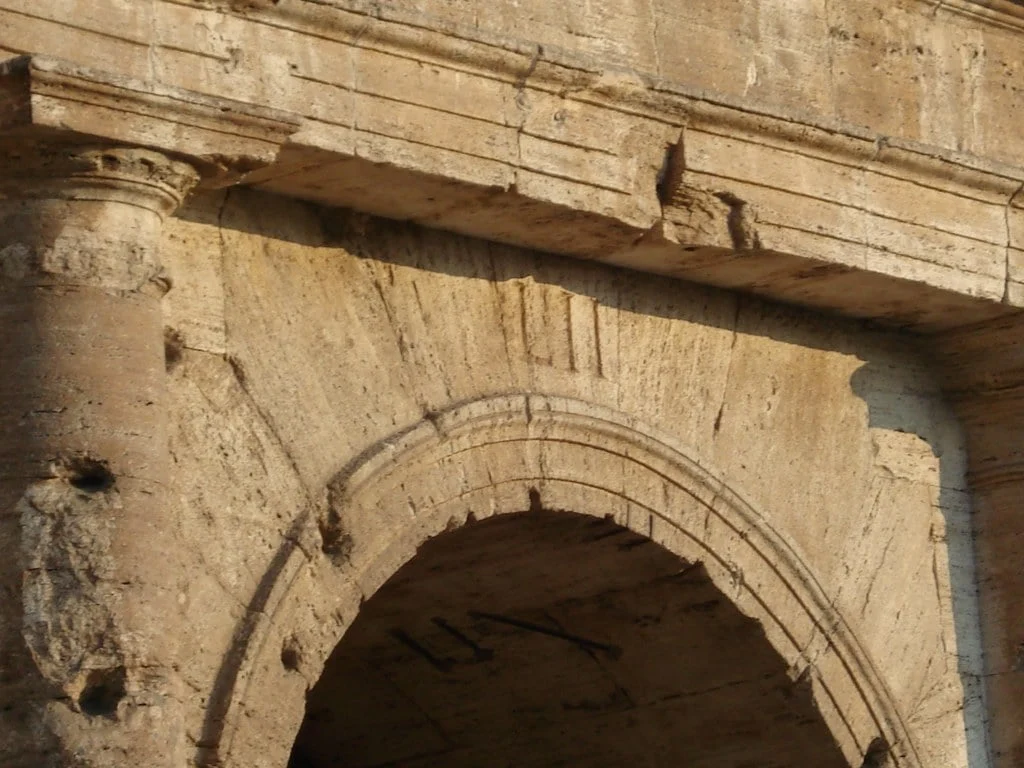
Entrance number LII (52) is on the Colosseum ground floor. Roman numerals engraved above the arch let spectators know which door leads to their seating area
The audience is given tickets, which are numbered ceramic pieces, pointing to the correct area and row of seats. From the entrance, they followed the stairs and circular corridors to the vomitoria, passageways that opened into the stands from below or behind the rows of seats. This strange-sounding name comes from the Latin verb vomere, meaning to pour out, and has absolutely nothing to do with the popular rumor that the Romans ate and then vomited. Thanks to this system, the crowd quickly disperses to their seats, and when the show ends or there is a problem, the entire arena can be cleared in just a few minutes.
Seating is divided according to social hierarchy. The emperor and the priestesses of Vesta had separate lots at both ends, the councilors sat on the podium next to the ring, the upper floor was the knights, then the rich commoners and poor commoners. The top wooden floor added by Domitian was for women, slaves and the poorest. Each row of seats has a number, so each seat is accurately identified by section, row and seat number.
Hypogeum: behind the scenes under the sand
The 83 x 48 m wide arena is a layer of wooden planks covered with sand, and the English word arena comes from harena, the Latin word for sand. Below is the hypogeum, meaning under the ground, a network of tunnels and two-story cages built by Domitian, where gladiators and wild animals wait their turn. Tunnels connected the hypogeum to the stables and the nearby Ludus Magnus gladiator training school.
Archaeologist Heinz-Jürgen Beste of the German Archaeological Institute spent years measuring grooves, holes and gouges in the hypogeum wall to reconstruct the lost mechanism. According to a 2011 Smithsonian Magazine article, he concluded that at its peak, there were 60 vertical winches, each two stories high and pushed around in a circle by four people on each floor. 40 winches are used to lift animal cages, the remaining 20 winches lift decorative platforms about 3.7 x 4.6 m wide. When the cage reaches the floor, a wooden ramp slides into place so the animal walks straight out into the arena. According to Beste, the largest animal that fits in a cage is a lion.
Diagram illustrating an animal cage elevator under the hypogeum: the person pushes the winch on two levels, the rope pulls the cage up along the groove leading to the trap door on the floor
Advertisement
In 2015, a documentary film crew for PBS reconstructed an elevator about 7 meters high, weighing two tons, using only materials and tools the Romans might have had, and then donated it to the Colosseum. In the film, a ladder lifts a wolf into the ring, the first time in more than 1,500 years that a wild animal has been lifted in this way.
From fortress to tourist destination
The final battles took place in the 6th century. After that, the Colosseum was used as a home, workshop, and fortress of the Frangipane family, and was quarried for many centuries. The Hypogeum was covered under about 12 m of soil and was only cleared in the 1930s. Since October 2010, visitors have been able to visit this basement.
Colosseum viewed from above in 2021. In the middle is the network of walls and corridors of the hypogeum, partly covered with a newly built arena
Source:
Wikipedia: Colosseum
,
Britannica: Colosseum
,
Smithsonian Magazine: Secrets of the Colosseum
,
Smithsonian Magazine: How Ancient Romans Lifted Wild Animals Into the Colosseum
,
Wikipedia: Vomitorium