Electromagnetic waves: Wi-Fi, light and X-rays are actually the same thing, just different wavelengths
Executive Briefing
Synthesized and verified with gemini-2.0-flash-thinking-exp
“Cellular waves, Wi-Fi, sunlight, X-rays in a film studio, and gamma rays from radioactive materials”
Key Takeaways
- 1.Cellular waves, Wi-Fi, sunlight, X-rays in a film studio, and gamma rays from radioactive materials sound like different things, but they are all electromagnetic waves: oscillations of electric and magnetic fields that travel at the speed of light, about 300,000 kilometers per second in a vacuum.
- 2.What makes them different is just the wavelength, from thousands of kilometers to smaller than an atomic nucleus.
- 3.That entire range is called the electromagnetic spectrum.
Cellular waves, Wi-Fi, sunlight, X-rays in a film studio, and gamma rays from radioactive materials sound like different things, but they are all electromagnetic waves: oscillations of electric and magnetic fields that travel at the speed of light, about 300,000 kilometers per second in a vacuum. What makes them different is just the wavelength, from thousands of kilometers to smaller than an atomic nucleus. That entire range is called the electromagnetic spectrum.
The light extends beyond sight
In 1800, William Herschel placed a thermometer along the color strip separated by a prism from sunlight and found that the hottest spot was in the dark area right behind the red color. That's infrared rays. The following year, Johann Ritter discovered invisible purple rays that change chemicals, later called ultraviolet rays.
In the 1860s, Scottish physicist James Clerk Maxwell wrote a system of equations about electricity and magnetism, predicting they could form self-propagating waves. From electrical measurement data at that time, he calculated the speed of this wave to be about 310,740 km/s, very close to the speed of light. In his 1865 paper, Maxwell concluded that light is an electromagnetic wave, and his equation also allowed for frequencies no one had seen yet.
In 1886, Heinrich Hertz, a professor in Karlsruhe (Germany), built a transmitter using an electric spark and an open loop of wire as a receiver. When the transmitter sparks, the receiver ring slot also flashes even though the two sides are not wired. Hertz measures this wave traveling at the speed of light, reflecting and refracting like light. Those are radio waves. He believed that the experiment had no use other than proving Maxwell was right, and died in 1894 at the age of 36. The frequency unit hertz (Hz) is named after him.
Heinrich Hertz, photo by Robert Krewaldt (Bonn). From 1886 to 1889, he created and received radio waves, proving Maxwell's predictions
One spectrum, seven regions
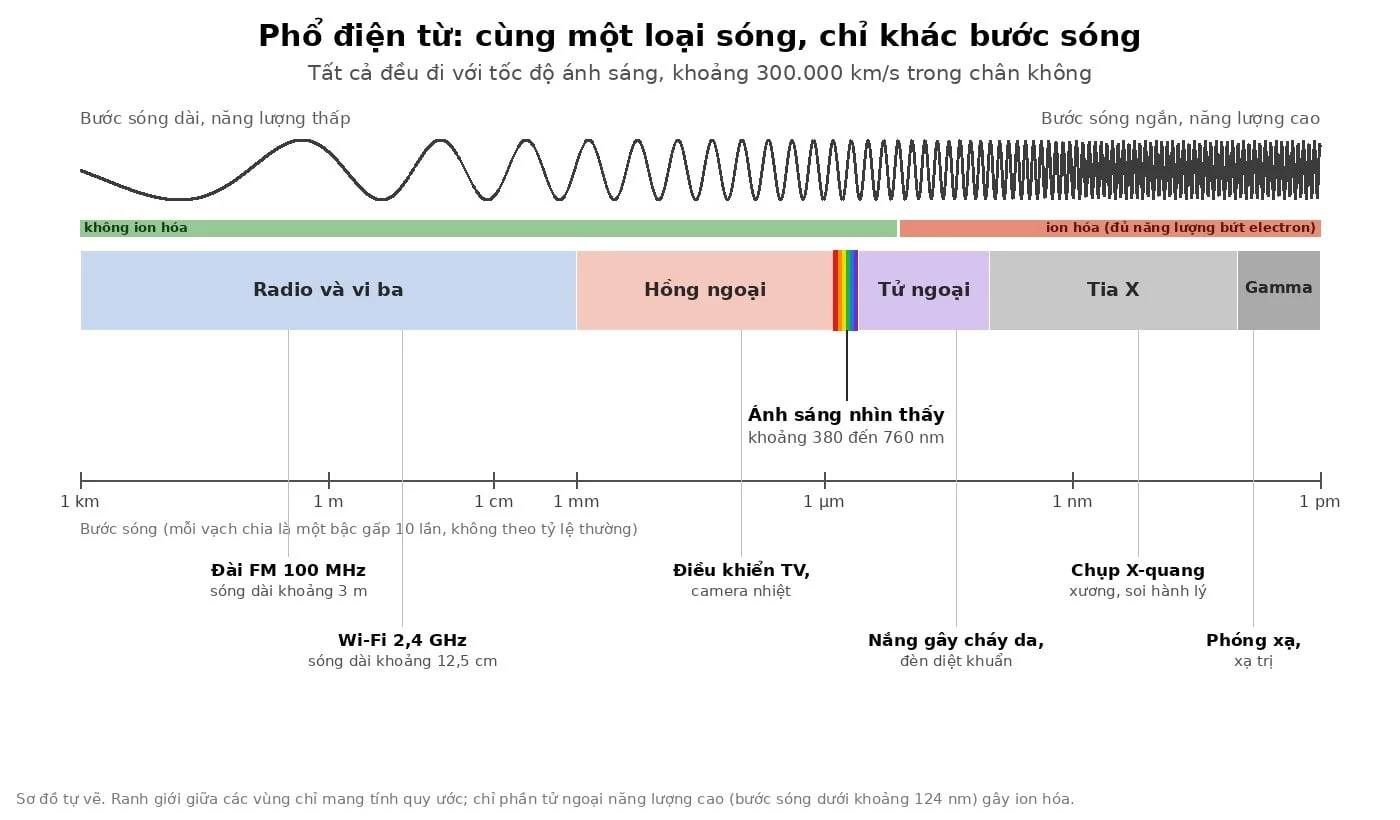
The electromagnetic spectrum is often divided into seven regions, from long to short wavelengths, also from low to high energy. Wavelength multiplied by frequency is always equal to the speed of light, so a 2.4 GHz Wi-Fi wave is about 12.5 cm long, and a 100 MHz FM radio is about 3 m long. Main regions include:
- Radio waves and microwaves: from thousands of kilometers down to millimeters, penetrate the atmosphere and most construction materials. This is the area of radio, television, cell phones, Wi-Fi, radar and microwaves.
- Infrared: from about 1 mm down to 760 nm, used in thermal cameras and TV controls.
- Visible light: about 380 to 760 nm, a narrow gap across the spectrum.
- Ultraviolet (UV): down to about 10 nm, sunlight causes skin burns.
- X-rays: from 10 nm to about 10 pm (1 pm is one trillionth of a meter), penetrates soft tissue but is blocked by bone.
- Gamma rays: the shortest, produced from radioactive decay and high-energy phenomena in the universe.
Diagram illustrating the electromagnetic spectrum, from kilometer-long radio waves to gamma rays. The light the human eye sees is only a narrow slit in the middle
X-rays and gamma rays fill in the last part
On the afternoon of November 8, 1895, Wilhelm Röntgen at the University of Würzburg (Germany) saw a luminescent curtain shining next to a high-pressure vacuum tube even though the tube was covered with black cardboard. Not knowing what this invisible ray was, he temporarily called it X-ray, after the unknown symbol in mathematics. About six weeks later, he photographed his wife, Anna Bertha's hand, clearly seeing the bones and the ring. Röntgen received the first Nobel Prize in Physics in 1901.
Print of an X-ray plate Röntgen took of his wife's left hand in late 1895. The bone and ring are clearly visible because they block X-rays more than soft tissue
Advertisement
In 1900, Paul Villard (France) discovered in radium radiation a type of penetrating ray much stronger than alpha and beta rays. Rutherford named it gamma rays in 1903, and in 1914 he and Edward Andrade measured its wavelength, which is shorter than X-rays. The electromagnetic spectrum was then filled from one end to the other.
Why Wi-Fi is not like X-rays
Electromagnetic waves carry energy in packets called photons. The higher the frequency, the stronger each photon. Photons of radio waves, infrared or visible light do not have enough power to remove electrons from atoms, so they are called non-ionizing radiation and mainly only heat up objects. From high-energy ultraviolet particles onwards, to X-rays and gamma rays, each photon is strong enough to ionize atoms and can damage cells and DNA. Therefore, the X-ray room must be shielded.
According to NASA, Earth's atmosphere blocks gamma rays, X-rays and some ultraviolet rays from the Sun, while visible light and some wave bands pass through, called "atmospheric windows". Therefore, X-ray and gamma telescopes must fly in space.
More than 150 years after Maxwell, much of the technology around us exploits each segment of this spectrum: phones use radio waves, TV remotes use infrared, screens emit visible light, hospitals use X-rays.
Source:
Wikipedia: Electromagnetic spectrum
,
NASA Science
,
Wikipedia: James Clerk Maxwell
,
Wikipedia: Heinrich Hertz
,
Wikipedia: Wilhelm Röntgen
,
Wikipedia: Gamma ray
,
Wikipedia: Electromagnetic radiation
n