Entropy: why does the room always make itself messy but never tidy itself up?
Executive Briefing
Synthesized and verified with gemini-2.0-flash-thinking-exp
“The ice in the glass of water gradually melts, the hot coffee cools down, and the scent of perfume s”
Key Takeaways
- 1.The ice in the glass of water gradually melts, the hot coffee cools down, and the scent of perfume spreads throughout the room.
- 2.In the opposite direction, no one has seen: water automatically freezes into ice in a warm room or coffee heats up on its own.
- 3.These everyday things obey the second law of thermodynamics, and the quantity behind it is entropy.
The ice in the glass of water gradually melts, the hot coffee cools down, and the scent of perfume spreads throughout the room. In the opposite direction, no one has seen: water automatically freezes into ice in a warm room or coffee heats up on its own. These everyday things obey the second law of thermodynamics, and the quantity behind it is entropy. The room itself is often used as an example, but as the last part of the article will say, that is just a misleading comparison.
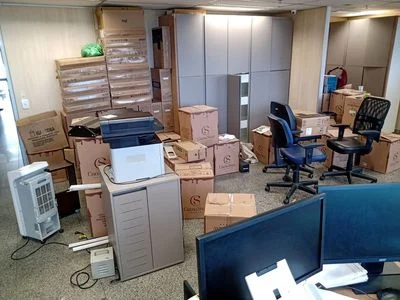
The room is littered with cardboard boxes. This image is often used to illustrate entropy, although the entropy of the objects themselves does not change when they are disturbed
From the steam engine comes the word "entropy"
In 1824, French engineer Sadi Carnot suggested that a heat engine produces work when heat "falls" from a hot object to a cold object, like a stream of water turning a water wheel. In 1850, German physicist Rudolf Clausius stated that heat naturally only flows from hot objects to cold objects, not the other way around. That is the first statement of the second law.
Clausius found that in a steam engine, the energy that could no longer be used to do work gradually increased as the steam passed from the inlet to the exhaust. In 1865, he named this quantity entropy, combining the prefix "en-" for "energy" with the Greek word "tropē", meaning change, because he thought it was closely related to energy. When a small amount of heat enters a system at absolute temperature T, the increase in entropy is equal to that amount of heat divided by T.
From there, the second law is stated concisely: the entropy of an isolated system, that is, a system that does not exchange heat or work with the outside world, never decreases. Britannica takes the example of a rock placed next to a stove: considering both as an isolated system, when the rock melts, the total entropy increases.
Rudolf Clausius (1822-1888), German physicist who coined the term entropy in 1865
Boltzmann: entropy is a matter of counting the number of arrangements
In 1877, Austrian physicist Ludwig Boltzmann explained entropy at the molecular level using probability. According to him, entropy is proportional to the logarithm of the number of microscopic states, that is, the number of ways to arrange the position and energy of molecules that still produce the same state seen from the outside.
Imagine a divided box containing a few gas molecules in chaotic motion. With 4 molecules, the chance of all 4 being in the left half is 1/16, which sometimes happens. With 100 molecules, the chance is (1/2) to the 100th power, about one part in a trillion trillion, that a liter of air contains about 10^22 molecules. The well-mixed state has an overwhelming number of arrangements, so the system almost certainly drifts there. The second law, in this view, is a statement of probability: there is nothing that prevents molecules from collapsing into a corner, it's just that it's so rare that it can never be observed.
Some real examples of increased entropy indoors:
- Ice melts in a glass of water: heat from warm water transfers to the ice, the energy is distributed more evenly.
- Coffee cools gradually: heat goes out into the air until both sides are the same temperature.
- Perfume smell spreads throughout the room: fragrance molecules diffuse throughout the entire volume, where they have many more arrangements.
The grave of Ludwig Boltzmann (1844-1906) in Vienna Central Cemetery (Austria), on the stele is engraved his entropy formula S = k log W
Advertisement
So does the room really "increase entropy"
The room is messy for a very similar reason: there are only a few ways for every item to be in the right place, but there are countless ways for it to get messy. However, in 1999, chemist Frank Lambert wrote in the magazine
Journal of Chemical Educationthat it is wrong to consider shuffling cards, messy desks, or messy dorm rooms as examples of increased entropy. Moving a book from the shelf to the floor does not change the number of its microscopic energy states, so the object's thermodynamic entropy change is zero. Things don't fall apart on their own, someone or the wind has to move them. Entropy actually increases in that agent, such that energy in the muscles is consumed and radiated as heat.
This also shows why housekeeping does not violate the second law. The room is not an isolated system. When cleaning, the body burns energy from food and releases heat into the environment, causing the total entropy to increase more than the amount of order gained. The same goes for a refrigerator: it consumes electricity and releases heat out the back to cool the inside.
The ice gradually melts outdoors. Heat always transfers from a warm environment to rocks, no one has ever seen water spontaneously freeze in warm air
The second law is also the reason time seems to flow only in one direction: when a movie shows scenes of melting ice or spilled ink, the viewer immediately recognizes it. In 1865, Clausius also wrote that the entropy of the universe tends to reach a maximum, leading to the hypothesis of "heat death", when everywhere is the same temperature and there is no difference left to do work. As for the room, the only way to make it neater is to spend time cleaning it.
Source:
Wikipedia
,
Britannica
,
Frank L. Lambert - Journal of Chemical Education (1999)
,
EBSCO Research Starters
,
NASA Glenn Research Center
Advertisement