Eupalinos Tunnel: dug from two sides through the mountain and still meeting in the middle of the rock
Executive Briefing
Synthesized and verified with gemini-2.0-flash-thinking-exp
“In the 6th century BC, on the island of Samos in the Aegean Sea, two groups of workers began chiseli”
Key Takeaways
- 1.In the 6th century BC, on the island of Samos in the Aegean Sea, two groups of workers began chiseling into opposite slopes of Mount Kastro.
- 2.They had no compass, no modern surveying machines, only hand tools and geometrical calculations.
- 3.A few years later, the two branches met in the middle of the mountain, creating a 1,036 m long tunnel.
In the 6th century BC, on the island of Samos in the Aegean Sea, two groups of workers began chiseling into opposite slopes of Mount Kastro. They had no compass, no modern surveying machines, only hand tools and geometrical calculations. A few years later, the two branches met in the middle of the mountain, creating a 1,036 m long tunnel. According to Wikipedia, this is the second known tunnel in history to be dug from both ends, and the first to do so based on geometric calculations.
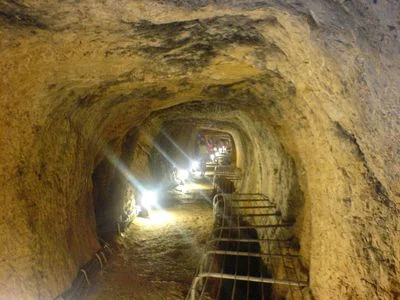
Inside the Eupalinos tunnel in Pythagoreio, Samos island (Greece). The tunnel is 1,036 m long, most of it has a cross-section of about 1.8 x 1.8 m
Why must we go through a mountain
The ancient city of Samos, now the town of Pythagoreio, grew so large that the wells and cisterns in the city did not have enough water. The main water source is located on the other side of Kastro Mountain, near today's Ayiades village, flowing out about 400 m³ per day. Channeling underground water through mountains also has defensive benefits: it is difficult for enemies to find and cut off the water line.
The historian Herodotus speaks of the tunnel as one of the three greatest feats of the Samos people, and names the designer as Eupalinos, son of Naustrophos, of Megara. The exact date is still unknown. Herodotus mentioned the building when talking about the tyrant Polycrates, who ruled about 540 - 522 BC, but did not directly say he was the one who built it. It is suggested that the structure belonged to an earlier government, early in the 6th century BC.
Two teams of workers, one straight line
The tunnel is narrow, each side only has enough room for two people to work. Archaeologist Hermann Kienast estimated that every day the workers chiseled 12 - 15 cm of stone, so the entire project took at least eight years. Caltech mathematician Tom Apostol gives a broader estimate, ranging from eight to 15 years. Digging from both ends shortens the time, but it must be done so that the two branches do not deviate from each other.
How Eupalinos determined the direction of digging is still debated. For nearly 2,000 years, he was believed to have used the method later described by Hero of Alexandria, measuring a series of perpendicular lines around the base of the mountain. Apostol and previous researchers said that this method is difficult to implement on Samos terrain and easily accumulates errors. According to Kienast and researcher Åke Olson, Eupalinos built a landmark road across the top of the mountain at the easiest place to go, then connected the two ends of this road with the digging direction of each branch. On the tunnel wall, there are Greek characters painted in alphabetical order, spaced 20.59 m apart, which is believed to be the unit of length he used.
A section of the tunnel is reinforced with a pointed roof assembled from large stone slabs to prevent rock collapse
Tips to make sure you meet
- Detour to avoid weak rocks: After 273 m from the north gate, the north branch encounters an area with a lot of water, weak rocks and mud, so you have to turn west in an isosceles triangle and then turn back. The southern branch is dug completely straight.
- Bend direction near the rendezvous point: two parallel lines will never meet, so when approaching, Eupalinos let the north branch bend to the left, the south branch to the right. This method extends the "catching" area by 17 m, and the two branches meet almost perpendicularly.
- Loosen the height: to prevent level deviation, the north branch keeps the floor flat but raises the ceiling by 2.5 m, the south branch keeps the ceiling flat but lowers the floor by 0.6 m near the meeting point.
- Hear chisel sound: when two teams are about 12 m apart, with this type of stone they can hear each other's voices and adjust direction.
Diagram illustrating the site: the north branch must go around to avoid the weak rock area, then both branches turn to make sure they meet
High altitude precautions turned out to be almost unnecessary. Wikipedia cites measurement data that the elevation error at the encounter site is only a few inches. Apostol calculated the floor difference at the joint to be about 60cm, less than one-eighth of one percent of the distance excavated.
Advertisement
Water does not flow on the basement floor
The tunnel floor is about 3 m higher than the water level at the source, perhaps because the source source collapsed after a storage tank was built around the source. Workers must dig a separate trench below, from 4 m deep at the north end to 8.5 m at the south end, connected to the main tunnel by vertical wells about 10 m apart. Water flows in terracotta pipes, each section is 72 cm long and 26 cm in diameter, a total of about 5,000 sections. The top of the pipe is cut open to scrape off mud.
The tunnel carried water for about 1,100 years before being filled up. From 1971 to 1973, Ulf Jantzen's team cleared the entire length of the tunnel, then Kienast performed a detailed survey. In 1992, the tunnel was recognized by UNESCO as a World Heritage Site along with the Pythagoreion and the Temple of Heraion, and in 2017 was honored as an International Historic Works of Civil Engineering.
The tunnel is currently lit for visitors. The structure has been used as an aqueduct for about 1,100 years
Today, visitors can go into part of the tunnel, between the cliffs that more than 2,500 years ago two groups of workers carved by hand under oil lamps.
Source:
Wikipedia
,
UNESCO
,
Caltech Engineering & Science (Tom Apostol)