Families with young children: Which type of heat-insulating film should you choose to effectively protect against UV rays?
Executive Briefing
Synthesized and verified with gemini-2.0-flash-thinking-exp
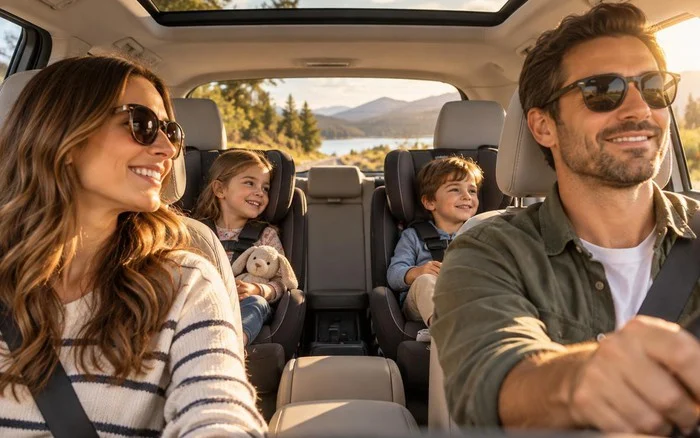
“**Family trips will be more comfortable when children are not constantly exposed to direct sunlight”
Key Takeaways
- 1.**Family trips will be more comfortable when children are not constantly exposed to direct sunlight through glass windows, especially on hot days.** Therefore, besides the ability to reduce heat, UV protection is also a factor that many families are interested in when choosing car insulation film.
- 2.However, darker film does not mean higher UV protection.
- 3.Young children often spend a lot of time in the backseat on family trips, where sunlight from the side windows can shine directly into the car compartment.
Family trips will be more comfortable when children are not constantly exposed to direct sunlight through glass windows, especially on hot days.
Therefore, besides the ability to reduce heat, UV protection is also a factor that many families are interested in when choosing car insulation film. However, darker film does not mean higher UV protection.
Young children often spend a lot of time in the backseat on family trips, where sunlight from the side windows can shine directly into the car compartment.
UV protection: Factors to consider when choosing heat insulation film
Even when sitting in a car, users can still be exposed to ultraviolet rays from the sun. According to the Skin Cancer Foundation, laminated windshields on modern cars typically block most UV rays. Meanwhile, the side glass and some other glass positions can still let UVA rays pass through.
When choosing window film, three parameters to consider include UVR, VLT and TSER. In particular, UVR represents the rate of ultraviolet ray removal; VLT indicates the amount of visible light transmitted through the glass, while TSER reflects the proportion of total solar energy rejected.
Light transmittance (VLT) and UV rejection (UVR) are different parameters when evaluating window film.
However, the ability to block UV does not mean the ability to reduce heat correspondingly. Heat-insulating film also does not replace measures to protect children from heat, especially when the temperature in the car increases.
3M Crystalline CR BLK: Many light transmittance levels, high UV rejection ability
One of the film lines that uses multilayer optical technology is 3M Crystalline CR BLK, which combines a multilayer optical structure with ceramic nanomaterials to control UV rays and solar energy.
According to 3M Vietnam's technical documents, code groups CR BLK 15 to CR BLK 60 have VLT light transmittance from 14% to 57%, TSER total solar energy rejection rate from 54% to 64% and high UV rejection ability.
The 3M Crystalline CR BLK 50 window film model has a VLT light transmittance of 48% according to the manufacturer's reference parameters.
In particular, CR BLK 60 has VLT 57%, suitable for the need to prioritize brightness. CR BLK 50 has a VLT of 48%, while CR BLK 40 has a VLT of 41%. Codes such as CR BLK 35 and CR BLK 15 have lower light transmittance, suitable for consideration in locations that need to reduce glare and increase privacy.
The above figures are reference parameters from the manufacturer. Actual effectiveness depends on the original glass, film configuration and usage conditions.
The rear seat side glass is one of the places to keep in mind when choosing anti-UV film for the family car.
How should families with young children choose movies?
With driving glasses, light transmittance needs to be prioritized to maintain visibility, especially when traveling at night or in adverse weather conditions. The film code must be considered along with the original glass's brightness and applicable safety requirements.
On the side and rear glass, where children often sit during trips, families can consider codes with lower light transmittance such as CR BLK 35 or CR BLK 15 to reduce glare and increase privacy. However, the darkness still needs to be balanced with the ability to see from the inside.
With sunroofs or Panorama glass, the large glass area makes the ability to control solar energy a factor worth considering when choosing a film.
Choose the right film at 3M Pro Shop
3M Pro Shop & 3M Training Center are developed in the Auto365.vn ecosystem - Headquarters, part of 365Group
3M Pro Shop & Training Center is a solution provider. This model will be operational from June 2026, combining product experience, configuration consulting and construction activities.
Here, customers can learn the parameters, compare the brightness of film samples and choose configurations according to each glass position. The service process also includes film code confirmation, acceptance and post-construction warranty support.
For families with young children, experiencing film samples before deciding helps to better consider UV protection, glare reduction and actual visibility. Instead of just choosing the darkest film, it's important to find the configuration that suits your vehicle and your family's travel needs. This is also a way to balance the ability to control sunlight and safety during each journey.
Contact information for 3M Pro Shop & 3M Training Center
- ─Address: 4/4/3/3 Street 3, Quarter 31, Hiep Binh Ward, Ho Chi Minh City.
- ─Phone: 0365 365 365.
