Filter coffee: how the small filter works, the brewing steps and what regions the beans come from
Executive Briefing
Synthesized and verified with gemini-2.0-flash-thinking-exp
“In Vietnam, the most popular way to make coffee requires no machinery, no electricity, and no filter”
Key Takeaways
- 1.In Vietnam, the most popular way to make coffee requires no machinery, no electricity, and no filter paper.
- 2.Just need a metal filter placed on the rim of a glass, a few teaspoons of powder and hot water, then wait for each drop to fall.
- 3.This article is the opening article in a series of articles about coffee, starting with the most familiar things: the filter, how to brew step by step and the regions where the coffee beans in the cup are grown.
In Vietnam, the most popular way to make coffee requires no machinery, no electricity, and no filter paper. Just need a metal filter placed on the rim of a glass, a few teaspoons of powder and hot water, then wait for each drop to fall. This article is the opening article in a series of articles about coffee, starting with the most familiar things: the filter, how to brew step by step and the regions where the coffee beans in the cup are grown.
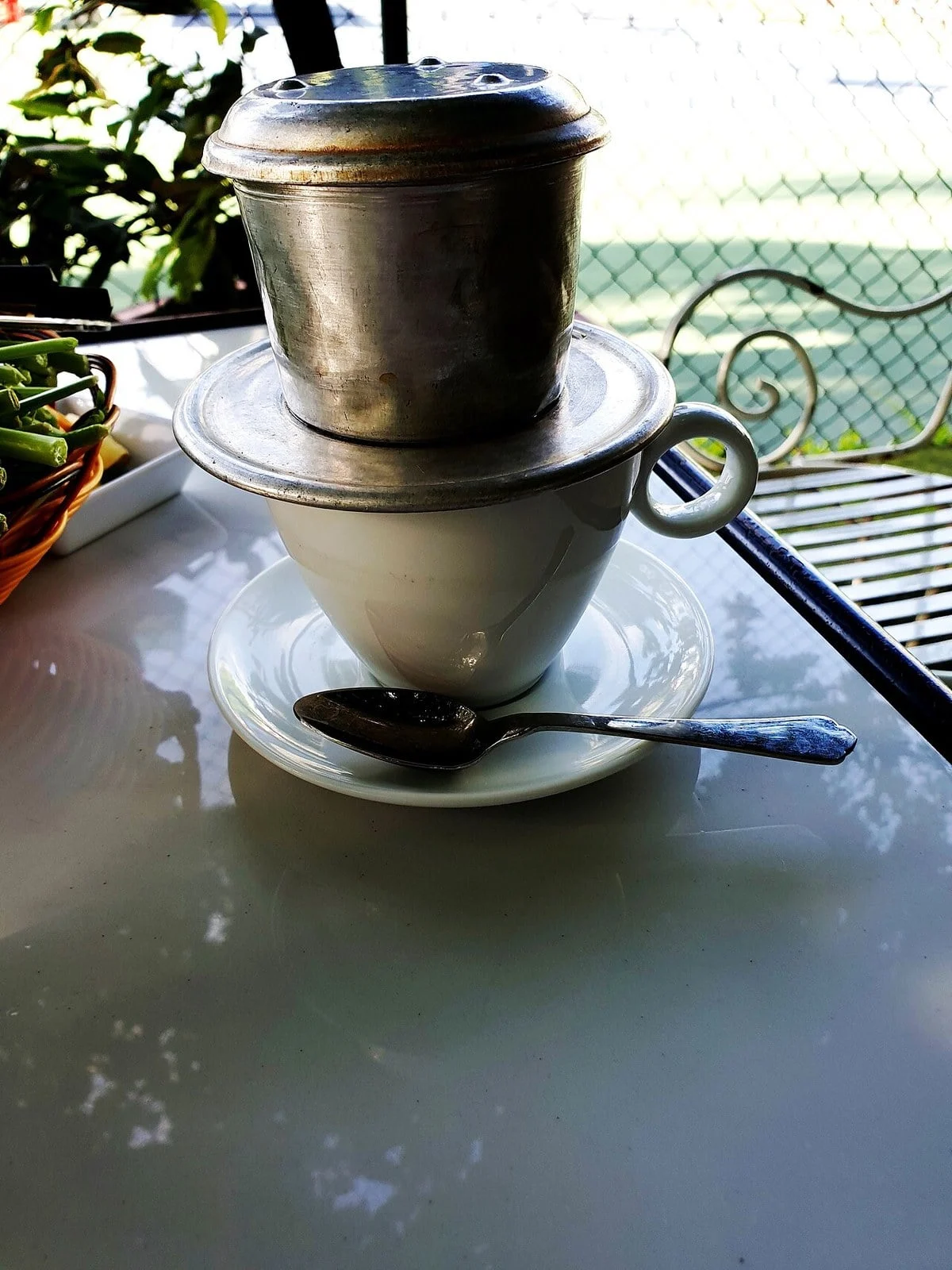
A cup of drip coffee at a coffee shop in Vietnam. The filter is placed directly on the cup mouth, the lid keeps the heat while waiting
What does the filter include
Phin is a drip brewer that uses gravity. A filter set usually has four parts: a perforated base plate, which both supports the filter on the rim of the cup and acts as a filter layer; coffee and water chamber; compressed lid placed on the coffee layer; and top cover. Filters are usually made of aluminum or stainless steel.
Compression caps come in two main styles. The drop-down style only rests on the coffee surface by its weight, while the screw-in style attaches to the filter chamber and allows adjustment of tightness. According to Nguyen Coffee Supply, the difference between the filter and hand-pouring methods like the V60 is that the compression cap is placed before pouring water, keeping the coffee layer stable and producing a more concentrated cup of coffee. The lid also has a small use: flip it over to place the filter on it after mixing.
Put ground coffee into the filter chamber. Coffee should be spread flat, gently shaken to be even, not compacted
Step by step brewing
Instructions vary regarding coffee quantity and water temperature, so the numbers below are just a starting point for adjusting to taste:
- Hot rinsing: rinse the filter and cup with boiling water and then pour it away, warming the filter first.
- For coffee: Use about 14 g of ground coffee as fine as sand. Gently shake the coffee surface until it is flat and not compressed.
- Incubation: pour about 20 - 30 ml of hot water, wait 30 - 45 seconds for the coffee to expand and release air. The recommended water temperature is around 90 - 96 °C.
- Fill and wait: pour the remaining water, close the lid. The first drop should fall within about 2 minutes, the whole batch is usually done in about 4 - 6 minutes.
If the water rushes down for a minute or two, the coffee may be ground a little too rough or the amount of coffee is small. If you wait forever and don't see any drops, the lid may be hand-tightened or the coffee may be ground finer than needed.
Pour hot water into the filter. At first, just pour a little to brew the coffee, then fill it up
Why condensed milk
Iced milk coffee, or iced brown coffee as it is called in the North, is made by dripping coffee through a filter into a cup containing sweetened condensed milk, stirring well and then pouring into a glass of ice. According to Wikipedia, this drink originated during the French colonial period, as a variation of French milk coffee. Fresh milk was then scarce and perishable in hot climates, so people used canned condensed milk. The bitterness of dark roasted robusta balances the sweetness of condensed milk.
Advertisement
From the basic cup, Vietnamese people have come up with many variations. Bac Xiu was born in the Chinese community in Cho Lon around the 1950s, the name was shortened from reading a Cantonese phrase meaning a glass of white milk with a little coffee. Egg coffee was created by Mr. Nguyen Van Giang in Hanoi in 1946, while salt coffee appeared in Hue in 2010.
Coffee hill in Gia Lai, Central Highlands, 2020. The Central Highlands is Vietnam's main coffee growing region, mainly robusta
Where do coffee beans come from
Coffee plants are said to have been brought to Vietnam by French missionaries in 1857, and the first plantations were established in 1888 in Ninh Binh and Quang Binh. Today Vietnam is the second largest coffee producer in the world after Brazil. Robusta accounts for the overwhelming majority, about 97% of output according to FAO data cited by Wikipedia, while the VietFarm site calculates by area nearly 90%. The two numbers are different because one side calculates the yield, the other side calculates the planted area.
Some typical regions, called by familiar place names before the reorganization of provinces and cities in 2025:
- Buon Ma Thuot (Dak Lak): Robusta capital on basalt red soil, about 500 - 600 m altitude according to Dak Lak province information portal. According to FAO, Dak Lak alone accounted for about 46% of the country's coffee area in the early 2000s.
- Gia Lai, Kon Tum, Dak Nong, Lam Dong: together with Dak Lak form the main robusta region in the Central Highlands.
- Cau Dat (Da Lat): the most famous Arabica region, about 1,500 m altitude, cool climate all year round.
- Son La, Dien Bien: arabica grown at altitudes below 1,200 m.
- Khe Sanh (Huong Hoa, Quang Tri): arabica at an altitude of about 500 - 900 m, described as having a bright sour taste.
Advertisement
A bunch of robusta coffee berries (Coffea canephora) are still green. When ripe, the fruit turns red and is harvested for its kernel
Robusta has nearly twice the amount of caffeine as Arabica and a more bitter taste, so it is suitable for mixing with strong filter and condensed milk. Arabica is more fragrant and sour, and is often brewed in a filter or machine by specialty coffee shops to preserve the flavor. Which type to choose is a matter of taste, but knowing where the beans come from and how to mix them will make each time waiting for the drip filter more enjoyable.
Source:
Wikipedia: Vietnamese iced coffee
,
Wikipedia: Coffee production in Vietnam
,
Nguyen Coffee Supply
,
Vietnamese Iced Coffee
,
VietFarm
,
Dak Lak province information portal
,
FAO

