Four outcomes of a "stone" falling from the sky
Executive Briefing
Synthesized and verified with gemini-2.0-flash-thinking-exp
“**At the same time, about 50 meters away, a rock exploded in the sky in Siberia, while a block of ir”
Key Takeaways
- 1.**At the same time, about 50 meters away, a rock exploded in the sky in Siberia, while a block of iron carved a hole 1.2 km wide in the United States.
- 2.Why is that so?** At around 6:13 p.m.
- 3.on November 1, a streak of green light streaked across the northern sky and then disappeared.
At the same time, about 50 meters away, a rock exploded in the sky in Siberia, while a block of iron carved a hole 1.2 km wide in the United States. Why is that so?
At around 6:13 p.m. on November 1, a streak of green light streaked across the northern sky and then disappeared. People from Hanoi, Hai Phong, Quang Ninh, Hung Yen, Phu Tho, Tuyen Quang to Nghe An and Ha Tinh saw it. Just a few minutes later, clips shot from the balcony, from security cameras and from the highway spread across social networks.
Mr. Dang Vu Tuan Son, President of the Vietnam Astronomy and Cosmology Association, said it was most likely a large meteor, also known as a fireball. The meteorite that created it was big enough to burn brighter and longer than meteors that usually only flash for a second or two. Up to now, no one knows whether the stone burned completely above or left any pieces on the ground. That question does not have a common answer, because a rock entering the Earth's atmosphere has up to four different outcomes.
A meteor is a streak of light, not a rock
In space, there are countless pieces of rock and dust floating around, collectively called meteorites. Some pieces are as small as a speck of dust, some are as big as a mountain. When a piece enters the atmosphere and glows, that's when a meteor forms.
The meteor enters the atmosphere at a speed of 11 to 72 km/s, 40 to nearly 300 times faster than a passenger plane. At that speed, it compressed the air in front so strongly that the air heated up to more than 1,600 degrees Celsius, heating the rock from outer space red.
Many people think meteors burn because they rub against air, but the real culprit is that pent-up gas. Just like when we pump a bicycle, the pump tube heats up mainly because the air inside is compressed.
Most meteors are created from particles as small as 1 mm or less. They start glowing at an altitude of 75 to 120 km and burn out when they are 50 to 95 km above the ground. That is the first outcome, also the most common outcome.
Size determines fate
The larger the stone, the harder it is to burn completely. The US Aeronautics and Space Administration (NASA) estimates that objects smaller than about 25 m will most likely burn up in the air and rarely cause major damage. But when a celestial body gets larger than 25 meters, it begins to have the power to wreak havoc on the land below.
Size is not the only factor. Stone is brittle, iron is much stronger, so two blocks of the same size can meet two very different ends.
50 to 60 m
5 to 14 km
Exploded in the sky
The second outcome is an explosion in the air. The lower the rock goes, the denser the air and the greater the pressure on the front surface. At one point, that force exceeded the rock's bearing capacity, the rock broke into countless pieces and released almost all of its energy at once.
On the morning of February 15, 2013, a meteorite about 18 m wide exploded at an altitude of about 30 km above the city of Chelyabinsk (Russia). The energy of the explosion was about 30 times that of the atomic bomb dropped on Hiroshima. The shock wave damaged more than 7,200 buildings, and 1,491 people had to be treated, mostly because of broken glass.
In 1908, a 50 to 60 m meteorite exploded over the Tunguska region (Siberia, Russia), knocking down forests over an area of about 2,150 km². More than a century has passed, scientists have still not found a hole that matches the destructive power of the explosion.
A cold meteorite
The third outcome is falling to the ground without creating a hole. On the evening of March 8 this year, a piece of rock several centimeters in size punctured the roof of a house in Koblenz (Germany) without making any holes. In this situation, the atmosphere acts like an invisible brake system, causing the celestial speed to decrease significantly. According to the American Meteor Society (AMS), the remaining pieces are gradually slowed down until they are only free-falling at a speed of 90 to 180 m/s, about 320 to 650 km/h, slower than a passenger plane.
In the last leg, the rock piece stopped glowing, so researchers call it the dark flight. Only the outer shell was melted in a few seconds, the inner core barely had time to heat up, and then the whole rock fell for about another minute through the cold air. Therefore, the meteorite hitting the ground is only slightly warmer than the surrounding air, and may even be cold, not bright red like we see in movies or in illustrations.
Some people describe a burning sensation when touching these celestial bodies. Most likely, their sense of touch confused the sensations of heat and cold.
When the atmosphere gives in
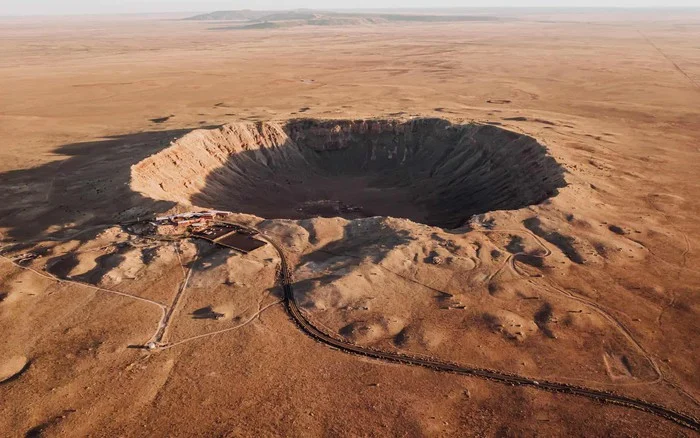
The fourth outcome, and the rarest, is that the meteorite leaves a giant mark on the ground. Only objects large enough and strong enough, passing through the atmosphere almost without stopping and crashing into the ground at a speed of tens of kilometers per second, can create an impact crater of that size.
Meteor Crater in Arizona (USA) is about 1.2 km wide and 170 m deep, created by a block of iron about 50 m wide about 50,000 years ago. That block of iron was the same size as the Tunguska meteorite, but stronger than rock so it did not break in the sky but crashed straight to the ground. Most of the iron mass evaporated during the fall and impact, leaving only fragments scattered around the crater. To date, NASA has only recorded about 190 impact craters across the Earth.
How long until it's my turn?
Every day the Earth receives from a few dozen to more than 100 tons of dust and rocks from space. Millions of meteors flashed, including several thousand fireballs, but most fell into the sea or flashed in the middle of the day so no one saw them.
The big ones are much rarer, and whether or not we encounter them depends on the time horizon we take into account.
What's there to see next?
The night of November 16 and morning of November 17 is the best time to watch the Leo meteor shower in Vietnam, with about 10 to 20 streaks per hour if it's dark enough. Those streaks of light are dust from comet Tempel-Tuttle, rushing into the atmosphere at a speed of about 71 km/s, among the fastest in annual meteor showers. They will burn out at an altitude of several tens of kilometers, exactly like the first outcome we just discussed.
And of the four endings, that is also the most peaceful one. Next time we see a shooting star, let's just make a wish, because what's burning up there is smaller than a grain of sand and will never reach the ground.
* General data on meteors and meteorites according to NASA, American Meteor Society (AMS), Encyclopedia Britannica and Space.com. Meteor temperature at impact according to AMS and Washington University in St. Louis (USA). Passenger aircraft's flight speed is about 900 km/h.
* Data for the Koblenz, Chelyabinsk, Tunguska, Meteor Crater, Chicxulub and Hoba iron block cases compiled by English Wikipedia from published research. Frequency of collisions according to NASA and estimates compiled by Wikipedia; The probability in block 03 is calculated from the average frequency, assuming collisions occur randomly.
* Time and speed of Leo meteor shower according to Universal Time Date; The forecast peak is around 13:00 on November 17 Vietnam time, so the night before is the most favorable time for observation.
* Images in block 01 are taken from Wikimedia Commons according to the license written in the corner of each image, especially the Chicxulub image is an illustration by Detlev van Ravenswaay/Science Source. Charts and meters are graphical.

