Gathering of 2.8 million eels around Mount Patience
Executive Briefing
Synthesized and verified with gemini-2.0-flash-thinking-exp
“# Gathering of 2.8 million eels around Mount Patience AustraliaScientists calculate that the school”
Key Takeaways
- 1.# Gathering of 2.8 million eels around Mount Patience AustraliaScientists calculate that the school of eels that appear every year at Patience Mountain under the sea has a total weight of 3,500 tons, is 3 km long and 2 km wide.
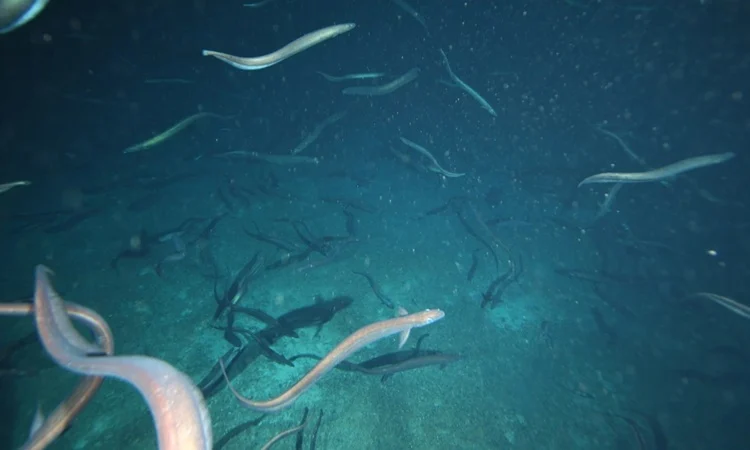
- 2.According to *Science Alert*, every year, millions of basketwork eels (*Diastobranchus capensis*) gather around the underwater mountain called Patience Seamount in southern Tasmania to reproduce.
- 3.In research published on October 28 in the journal *Royal Society Open Science*, a team of experts led by marine scientist Ben Scoulding at CSIRO Australia quantified for the first time the incredible scale of this mysterious gathering.
AustraliaScientists calculate that the school of eels that appear every year at Patience Mountain under the sea has a total weight of 3,500 tons, is 3 km long and 2 km wide.
According to Science Alert, every year, millions of basketwork eels (Diastobranchus capensis) gather around the underwater mountain called Patience Seamount in southern Tasmania to reproduce. In research published on October 28 in the journal Royal Society Open Science, a team of experts led by marine scientist Ben Scoulding at CSIRO Australia quantified for the first time the incredible scale of this mysterious gathering. Scoulding and colleagues determined that at its peak, the event could gather 2.8 million eels with a total weight of more than 3,500 tons.
The process of discovering the scale of the annual gathering at Patience was a decades-long work. Fisheries have reported unusual numbers of basketwork eels in the area since at least the 1980s and 1990s, but it was not until 2007 that CSIRO scientists recorded the event by towing a camera on the back of a research vessel. Subsequent surveys revealed that although eels live year-round in seamounts, their numbers peak in the fall in the Southern Hemisphere, from March to May.
"Finding millions of eels concentrated around a single underwater mountain is unusual. Patience is relatively small, covering only about 2 km², but continuously supports large seasonal gatherings for many months," commented Scoulding.
From 2023 to 2025, Scoulding's research team conducted a series of surveys around Patience, using sonar to map eel concentrations underwater. One major difficulty is that basketwork eels are not the only species that congregate around Patience. The orange roughy (Hoplostethus atlanticus) also occurs there and sonar cannot distinguish between the two species.
So the researchers combined acoustic measurements with underwater camera images, helping to determine how much each species contributed to the sonar signal. The analysis revealed that the gathering was of astonishing scale. At its peak, the eel school stretched about 3 km long, 2 km wide and 150 m high above the seabed. The team estimates the biomass of basketwork eels increased from about 750 tons in March to more than 3,500 tons in May.
However, Scoulding and his colleagues are unclear what makes Patience especially attractive to eels, according to UA News. "Patience is one of about 120 seamounts in the Huon and Tasman Fracture marine parks in southern Tasmania. Although nearby seamounts have similar depths and environmental characteristics, they do not support similar gatherings. Currently, we have some hypotheses but cannot yet draw a clear answer," they shared. The team speculates that the close distance between the submarine mountain and the continental shelf could affect fish movements or ocean currents.
ABC News said basketwork eels are considered vulnerable to extinction on the list of globally threatened animals, partly because they are often caught by bycatch. Eel numbers on a continental slope in New Zealand have decreased by 85% in the past 40 years and it is unclear whether the same situation will occur in the Patience population.
An Khang summary

