How did humans accidentally prevent a new ice age on Earth?
Executive Briefing
Synthesized and verified with gemini-2.0-flash-thinking-exp
“**Under the distant permafrost, scientists have just unearthed a shocking truth.”
Key Takeaways
- 1.**Under the distant permafrost, scientists have just unearthed a shocking truth.
- 2.By releasing greenhouse gas emissions, humanity not only warms the Earth but also accidentally nips a new ice age in the bud.** On the remote plateau of Baffin Island in the Canadian territory of Nunavut, the melting edge of the Barnes ice cap is revealing a secret buried for thousands of years.
- 3.Here, long-dead moss carpets, which have not seen sunlight since Roman times, are gradually appearing.
Under the distant permafrost, scientists have just unearthed a shocking truth. By releasing greenhouse gas emissions, humanity not only warms the Earth but also accidentally nips a new ice age in the bud.
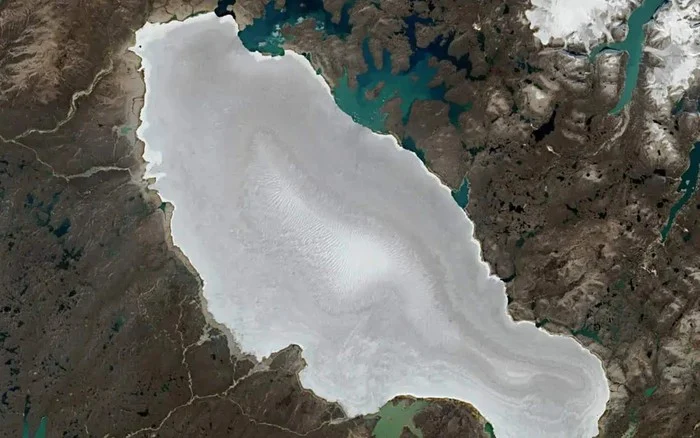
On the remote plateau of Baffin Island in the Canadian territory of Nunavut, the melting edge of the Barnes ice cap is revealing a secret buried for thousands of years.
Here, long-dead moss carpets, which have not seen sunlight since Roman times, are gradually appearing. Over the course of 2,000 years, this ice dome the size of the state of Delaware slowly expanded across the tundra, burying every plant in its path.
However, around 1960, the advance of this giant ice sheet suddenly and unusually reversed.
According to a new study published in the journal Science, the current melt is by no means a normal local deterioration phenomenon. The two-millennium expansion of the Barnes ice cap essentially marked the birth of the next ice age on Earth.
However, man-made greenhouse gas emissions have ended this process in its infancy. Scientists argue that by burning fossil fuels, humanity has completely overwhelmed the delicate planetary cycles that have governed the global climate system for the past 2.6 million years.
Dr. Nicolás Young, paleoclimatologist at Columbia University's Lamont-Doherty Earth Observatory and lead author of the study, told CNN that everything was going normally and the next freeze was about to happen, but then it was forced to stop.
He asserts that this is an extremely powerful example of how human intervention has shaken the natural climate system to an unprecedented degree.
To better understand this impact, we need to look back about 20,000 years ago. At that time, the giant Laurentide ice sheet covered nearly 30% of North America, stretching from the Arctic circle to the state of Illinois with ice layers more than two miles thick.
Today, the Barnes ice cap is the last remaining remnant of this ancient giant. Located on a bedrock about 500 meters above sea level, this 700-meter-thick dome serves as an important historical landmark for glaciation in North America.
Normally, moving ice sheets crush and destroy everything below them. However, the Barnes ice cap possesses a different property when frozen solidly into the bedrock.
After the ancient ice sheet shrank during the current warming - the Holocene, which began 11,700 years ago - mosses proliferated on the exposed land.
When the ice cap begins to expand again, instead of crushing the surface, it acts like a giant freezer, slowly covering and preserving the delicate plants that lie intact in their original position.
Dr. Young's team carefully pieced together evidence from two separate geological clocks to reconstruct the entire ice cap timeline. First, they measured cosmic ray exposure by analyzing a form of radioactive beryllium trapped in 35 boulder and bedrock samples. This isotope revealed that the ancient ice sheet shrank to its smallest extent around 3,560 years ago.
They then went on to collect 88 new samples of dead vegetation exposed when modern warming pushed the ice edge back 200 to 800 meters between 1960 and 2022. Radiocarbon dating showed that the ice began expanding again about 2,000 years ago due to a decline in summer sunlight across the Northern Hemisphere.
This process peaked during the unusually cold summers that lasted from 1780 to 1880. Columbia University geochemist Joerg Schaefer emphasized that this approach provided a rare opportunity for scientists to better understand how the Laurentide ice sheet regenerates itself.
By 1960, atmospheric greenhouse gas concentrations had increased by about 62 parts per million of carbon dioxide equivalent above pre-industrial levels and continued to increase sharply by 138 parts per million by 2024. This resulting warming has caused the Barnes ice cap to completely lose its snow accumulation zone since 2010. Greenhouse gases have effectively overwhelmed the natural orbital mechanisms that were operating to cool the entire region. hey.
This groundbreaking research method has received great praise from experts. Professor of Earth Sciences Meredith Kelly at Dartmouth College highly appreciates the application of the novel radiocarbon dating method in plants. However, there are still conflicting scientific opinions surrounding the conclusions made.
Physicist Andrey Ganopolski from the Potsdam Institute for Climate Impact Research, who published in the journal Nature in 2016 that emissions will delay the ice age by 50,000 years, said that Barnes' development is not large enough to confirm that a new ice age cycle has officially begun.
According to traditional models, an ice age is only recognized when ice locks up enough water to change global sea levels by several meters. In response to this, Dr. Young's team sharply countered that if we continue to wait for giant ice sheets to form, we will miss the moment of their true birth.
Although the debate continues, Dr. Young issued a stern warning: global warming should not be seen as a savior to help humanity escape an ice age.
We are entering an unprecedented period in history, where humans have probably single-handedly repelled any chance of natural freezing for a very long time.
As Earth scientist Shaun Marcot concluded in an article in the journal Science, the number of glacial cycles missed by the planet depends entirely on humanity's current choices and is closely tied to future carbon emissions.

