How does air conditioning cool a room: it does not create cold but pumps heat outdoors
Executive Briefing
Synthesized and verified with gemini-2.0-flash-thinking-exp
“The air conditioner does not produce cold air.”
Key Takeaways
- 1.The air conditioner does not produce cold air.
- 2.What it does is take heat from the air in the room and bring it outdoors, like a heat pump that moves in the opposite direction of nature, from a cool place to a hot place.
- 3.The hot air blowing from the heater on the balcony is the heat that has just been withdrawn from the room, plus the electricity consumed.
The air conditioner does not produce cold air. What it does is take heat from the air in the room and bring it outdoors, like a heat pump that moves in the opposite direction of nature, from a cool place to a hot place. The hot air blowing from the heater on the balcony is the heat that has just been withdrawn from the room, plus the electricity consumed.
Starts from a damp print shop
The first modern air conditioning systems were not created to cool people. In 1902, Willis Carrier, a 25-year-old engineer at Buffalo Forge, was assigned to handle humidity at the Sackett & Wilhelms printing factory in Brooklyn (New York). According to Carrier's history page, the paper in the factory absorbed moisture from the summer air, so it stretched, causing the overlapping color layers to be misaligned, the edges of the paper wavy, jamming the machine, and the ink taking a long time to dry.
Carrier lets air blow through cold water pipes. Cold air cannot hold as much water vapor as warm air, so water vapor condenses on the pipes, the humidity in the workshop decreases and the temperature also decreases. System drawing dated July 17, 1902. Cooling water was initially pumped from artesian wells, and an ammonia compressor was added in the spring of 1903. On January 2, 1906, Carrier was granted patent number 808,897 for "Air Handling Apparatus". Also in 1906, textile engineer Stuart Cramer used the phrase "air conditioning", and Carrier later named the company after it.
Engineer Willis Carrier in 1915, the year he and six colleagues founded Carrier Engineering company. In 1902, he designed the first modern air conditioning system for a printing factory in Brooklyn (New York)
Evaporation to absorb heat, compression to release heat
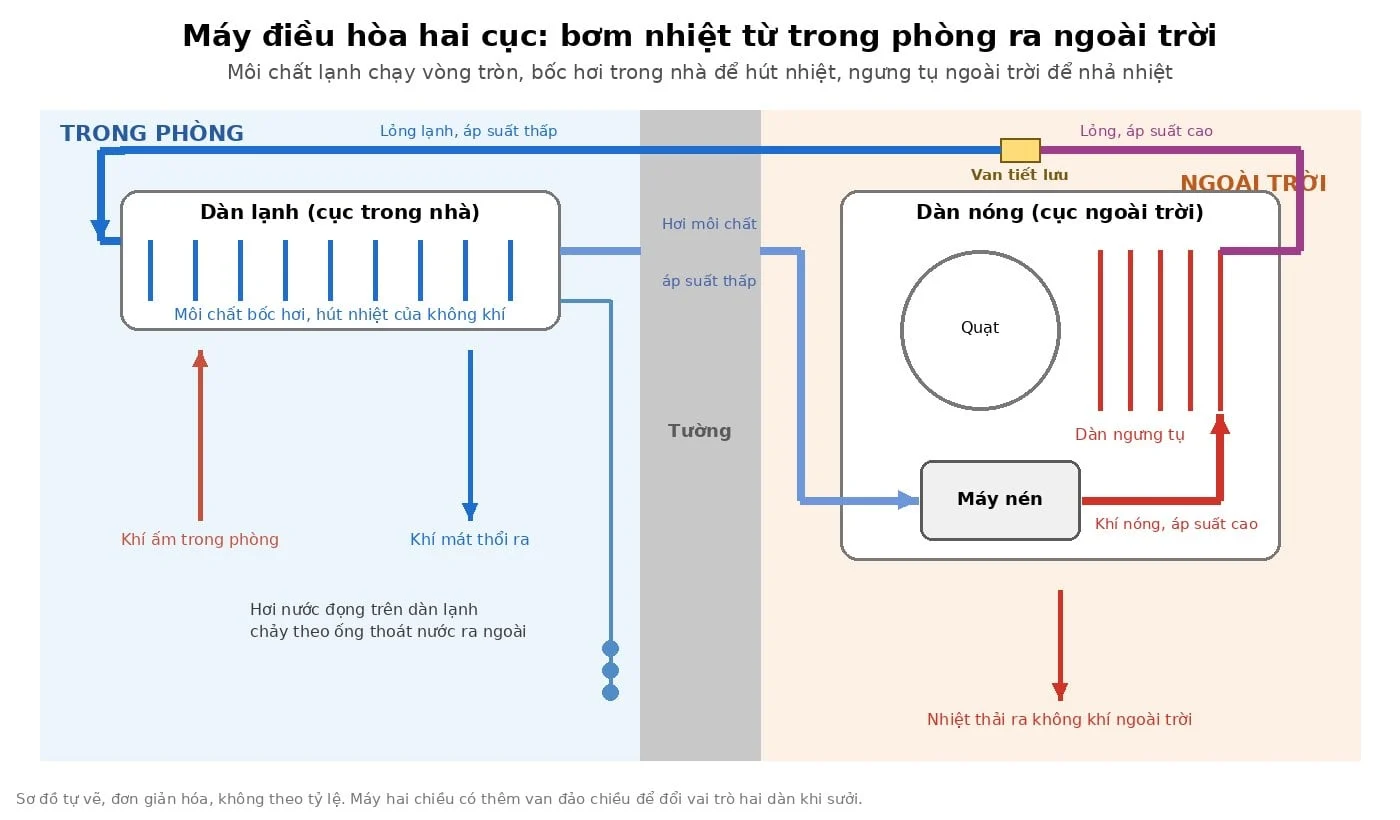
The principle of air conditioning is similar to the cool feeling when sweat evaporates on the skin: to evaporate liquid, it must take heat from the surrounding area. The machine uses a substance called refrigerant (cold gas), which runs in a circle in a sealed copper tube connecting the indoor and outdoor units. A cycle consists of four steps:
- Indoor unit (indoor): low pressure liquid evaporates in the tubes of the indoor unit, absorbing heat from the air in the room that the fan blows through. The air coming out is cooler.
- Compressor (outdoor): sucks in refrigerant vapor and compresses it. Being compressed, the refrigerant vapor heats up, hotter than the outdoor air.
- Outdoor unit (outdoor): heat flows through the condenser, a large fan blows outside air through to take the heat away. Losing heat, the medium condenses back into liquid.
- Throttle valve: the liquid passes through a narrow constriction, the pressure suddenly drops so the temperature drops, ready to return to the evaporator and start a new cycle.
The secret lies in the pressure. At low pressure, the medium boils at a low temperature so it can evaporate immediately in a cool room. At high pressure, it condenses at high temperature so it can release heat even when it is hot outside. The compressor provides the necessary work to push the heat back in the natural direction. This is the same cycle that the refrigerator in the kitchen is using, except that the cabinet walls are replaced by the four walls of the room.
Diagram illustrating the vapor compression cycle in a two-unit air conditioner. The refrigerant absorbs heat from the indoor condenser, is pushed by the compressor to the condenser to release heat, and then returns through the expansion valve
Why does the air conditioner drip water
Like Carrier's first system, the condenser usually has a temperature lower than the dew point of the air in the room, so water vapor condenses in drops on the surface of the condenser, like the outside of a cup of ice on a hot day. This water flows down to the drip tray and then out through the drain pipe. Thanks to that, the machine both cools and dries the air, making air-conditioned rooms much more comfortable on humid days.
Most home air conditioners are two-unit type. According to Wikipedia, Toshiba sold the first two-unit split system in Japan in 1961, Mitsubishi Electric sold the first wall-mounted model in 1968, because Japanese houses are small so compact machines are needed. Inverter air conditioners, which change the compressor speed instead of constantly turning it on and off, appeared in 1980 to 1981. Two-way air conditioners have a reversing valve to change the roles of the two units, then it pumps heat from outdoors for heating.
Advertisement
The hot unit of an air conditioner located outdoors. Large fan blows air through the condenser to carry heat from the room outside
Carrying heat away is cheaper than generating heat
Because it only transfers heat and does not create cold, an air conditioner can carry away more heat than it consumes. This ratio is called the coefficient of performance (COP), usually greater than 1 and depends strongly on the temperature difference inside and outside the house: the hotter it is outside, the harder the machine has to work. However, the total amount of electricity is still very large. According to data cited by Wikipedia, in 2016 the world had about 1.6 billion air conditioners. The International Energy Agency predicts this number will increase to about 4 billion by 2050, and by 2022, air conditioners use about 7% of global electricity.
Source:
Wikipedia: Air conditioning
,
Carrier
,
U.S. Department of Energy
,
HowStuffWorks
,
Wikipedia: Vapor-compression refrigeration

