How long is the Great Wall really: 21,196 km of walls, moats and gates of many dynasties
Executive Briefing
Synthesized and verified with gemini-2.0-flash-thinking-exp
“The name Great Wall means a wall that is ten thousand miles long.”
Key Takeaways
- 1.The name Great Wall means a wall that is ten thousand miles long.
- 2.One li in ancient times was often converted to about 540 m, so ten thousand li is about 5,400 km, but the word "ten thousand" here only has a conventional meaning, like "countless".
- 3.The actual measured number is much larger.
The name Great Wall means a wall that is ten thousand miles long. One li in ancient times was often converted to about 540 m, so ten thousand li is about 5,400 km, but the word "ten thousand" here only has a conventional meaning, like "countless". The actual measured number is much larger. In 2012, the National Cultural Heritage Administration of China announced that the total length of all sections of the Great Wall throughout the dynasties was 21,196.18 km. To understand that number, you need to know that the Great Wall is not a single wall.
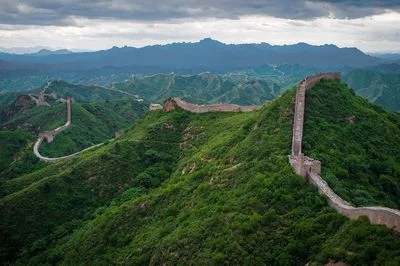
The Jinshanling Great Wall (Jinshanling) near Beijing was built by the Ming Dynasty, running along the mountain ridge with successive watchtowers
Many dynasties, many walls
The first walls date back to the 7th century BC, built by countries during the Spring and Autumn - Warring States period to protect their borders. According to BBC, around 220 BC, Qin Shi Huang connected these passages. The Han, Northern and Sui dynasties continued to repair and build more. The most famous passages that tourists often visit near Beijing were built by the Ming Dynasty (1368-1644).
Each dynasty built according to its own border, so the walls did not overlap. Some places run parallel with many layers, some places are hundreds of kilometers apart. The entire system stretches from Liaodong in the east to Lop Nur Lake in the west, forming an arc that roughly follows the edge of the Mongolian steppe.
Map of the Great Wall routes through different construction periods. The routes do not overlap so the total length is much greater than a continuous wall
Where does the number 21,196 km come from
Previously, the length of the Great Wall was mainly estimated from historical records. In 2009, a preliminary study found that the Ming route was 8,850 km long. Since 2007, the Chinese heritage agency has conducted field surveys, recording 43,721 relic sites. The results announced in June 2012 included 10,051 wall sections, 1,764 ramparts and trenches, 29,510 individual structures and 2,211 gates and fortresses. The length is divided as follows:
- Ming Dynasty: 8,850 km, including 6,259 km of built walls, 359 km of moats and 2,232 km of natural barriers such as hills and rivers.
- Qin, Han Dynasty and before: total 3,080 km.
- Border fortifications during the Jin Dynasty (1115-1234): 4,010 km.
- Total for all periods: 21,196.18 km, more than half of the Earth's circumference at the equator (about 40,075 km).
Thus, if only the human-built wall of the Ming Dynasty is counted, the number is about 6,259 km. According to the BBC report, only 8.2% of the original wall is intact, the rest has deteriorated.
Rammed earth, bricks and sticky rice mortar
Transporting materials over long distances is very difficult, so builders always use local materials: stone in the mountains, rammed earth in the plains. The walls of the Warring States period were mainly made of stone, or earth and gravel packed tightly between two moldings. Most of the Qin Dynasty walls have been eroded over the centuries, with only a few sections remaining.
Remains of the Great Wall of the Han Dynasty in Dunhuang (Gansu), a western desert region, where the wall was built with local materials instead of bricks
Advertisement
The Ming Dynasty built much stronger thanks to using bricks and stones instead of rammed earth. The bricks are attached with mortar made from sticky rice porridge mixed with slaked lime. It is estimated that up to 25,000 watchtowers were built along the wall. From 1567 to 1570 alone, General Thich Ke Quang commanded the construction of 1,200 watchtowers from Son Hai Quan to Xuong Binh. In Kim Son Linh, the wall is 5 to 8 m high, the base is 6 m wide and the top is up to 5 m wide.
Can it be seen from space
According to NASA, the Great Wall generally cannot be seen with the naked eye from low orbit, much less from the Moon. The wall is long enough but narrow, and made from local materials so it blends into the landscape. China's first astronaut, Yang Liwei, also said he did not see it when flying in 2003. In 2004, Leroy Chiao took a photo in Inner Mongolia, about 320 km north of Beijing, but he himself said he did not see the wall and was not sure if the photo was taken or not.
Photo taken by International Space Station commander Leroy Chiao in Inner Mongolia on November 24, 2004 with a 180 mm lens, considered by NASA to be the first photo confirming the Great Wall taken from low orbit
The Great Wall was recognized by UNESCO as a World Heritage Site in 1987. Although invisible from space, more than 21,000 km of walls, moats and gates are the result of more than 2,000 years of successive construction, from the 7th century BC to the end of the Ming Dynasty, and are called the largest man-made structure in the world by the BBC.
Source:
Wikipedia
,
BBC News
,
NASA
,
NASA Gateway to Astronaut Photography

