How Wi-Fi transmits data through walls: 2.4 and 5 GHz waves pass through brick, glass and concrete
Executive Briefing
Synthesized and verified with gemini-2.0-flash-thinking-exp
“The router is placed in the living room and the phone in the bedroom can still watch videos normally”
Key Takeaways
- 1.The router is placed in the living room and the phone in the bedroom can still watch videos normally even though there is a wall between the two places.
- 2.Wi-Fi doesn't use anything mysterious: it's radio waves, in the same family of electromagnetic waves as radio or light waves, only at frequencies around 2.4, 5 or 6 GHz.
- 3.It is this frequency that determines both speed and ability to penetrate walls, and explains why waves are strong in one room but weak in another.
The router is placed in the living room and the phone in the bedroom can still watch videos normally even though there is a wall between the two places. Wi-Fi doesn't use anything mysterious: it's radio waves, in the same family of electromagnetic waves as radio or light waves, only at frequencies around 2.4, 5 or 6 GHz. It is this frequency that determines both speed and ability to penetrate walls, and explains why waves are strong in one room but weak in another.
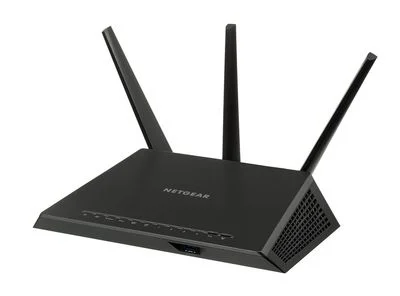
A Netgear Nighthawk AC1900 home Wi-Fi router with three external antennas, transmitting simultaneously in the 2.4 GHz and 5 GHz bands
Turns bits into radio waves
According to HowStuffWorks, the wireless transceiver in your computer or phone converts data into radio signals and transmits them through the antenna. The router receives the signal, decodes it, then forwards it to the Internet via wire, and the reverse happens exactly the same. In essence, this is a pair of two-way radios that speak in 0s and 1s.
To carry bits, the transmitter changes the amplitude and phase of the carrier wave. Each combination of amplitude and phase is a symbol that represents a group of bits, a technique called QAM modulation. The 802.11ac (Wi-Fi 5) standard uses up to 256-QAM, which means 256 different symbols, each symbol carrying 8 bits. From the 802.11a standard, Wi-Fi also uses OFDM, dividing the channel into many narrow subcarriers transmitted in parallel to reduce interference. The 802.11n (Wi-Fi 4) standard adds MIMO, using multiple antennas to transmit multiple data streams at the same time.
Board of a Ruckus ZoneFlex R700 Wi-Fi access point for office use, with antennas located on the board to transmit multiple data streams at the same time
Why do waves pass through walls
Wood, plaster, glass or brick do not conduct electricity well, so radio waves can pass through and only lose a portion of their energy. This loss is measured in decibels (dB): a loss of 3 dB means about half the power, a loss of 10 dB means one tenth, a loss of 20 dB means one hundredth. NHS England's (UK) reference table for construction materials gives the following attenuation levels:
- Light barrier: approximately 0.9 dB at 2.4 GHz and 1.2 dB at 5 GHz.
- Wooden door: 1.9 dB and 3.2 dB.
- Glass: 3.6 dB and 4.9 dB.
- Lightweight concrete: 8 dB and 16 dB.
- Heavy concrete: 22 dB and 44 dB, meaning that at 5 GHz, the signal behind such a wall is less than one ten-thousandth of its power.
Metal and water are the two strongest barriers to Wi-Fi. According to Wikipedia, signals are strongly influenced by steel reinforcement in concrete, low-e coatings on energy-saving glass, rocks such as marble, and water, for example in trees. In addition to passing through, waves also reflect and diffract around obstacles, so sometimes the signal reaches the next room through the door frame or hallway, not through the wall.
2.4 GHz, 5 GHz or 6 GHz
The wavelength of 2.4 GHz is about 12 cm long, that of 5 GHz is about 6 cm. In general, low frequencies travel farther but carry less data, and the 5 GHz band is absorbed more by building materials than 2.4 GHz. In return, 2.4 GHz is cramped: Cisco says this band has 14 channels but only three non-overlapping channels, which in the US are channels 1, 6 and 11. This band is also subject to interference from microwaves, cordless phones and Bluetooth devices.
Map of Wi-Fi channels in the 2.4 GHz band. Each channel is approximately 22 MHz wide while the centers of two adjacent channels are only 5 MHz apart, so they overlap
Advertisement
According to Intel, the 5 GHz band is about 500 MHz wide, allowing for 80 MHz channels and speeds up to about 1 Gbps. The 6 GHz band is 1,200 MHz wide, for Wi-Fi 6E and above devices only, with 160 MHz wide channels. Therefore, when close to the router, the 5 or 6 GHz band provides higher speeds, while when several rooms away, 2.4 GHz may be more stable.
From the cash register to every home
In 1985, the US Federal Communications Commission (FCC) opened some ISM frequency bands for unlicensed use, including the 2.4 GHz band that microwaves also use. In 1991, NCR and AT&T developed WaveLAN in Nieuwegein (Netherlands) for cash register systems, the predecessor of the 802.11 standard. In Australia, John O'Sullivan's group at the CSIRO research agency built an experimental wireless LAN in 1992 and filed a patent. The first 802.11 version was released in 1997 with a speed of 2 Mbit/s, and in 1999 the 802.11b standard was raised to 11 Mbit/s.
Also in 1999, the Wi-Fi Alliance was founded, and the company Interbrand coined the name Wi-Fi, which sounds like Hi-Fi, to replace the phrase "IEEE 802.11b Direct Sequence". Apple brought Wi-Fi to the iBook in 1999 under the name AirPort. Since 2018, the Wi-Fi Alliance has been numbering generations to make it easier to remember, and Wi-Fi 7 (802.11be) now operates in all three bands 2.4, 5 and 6 GHz.
Apple iBook clamshell in Blueberry color. This laptop line launched in 1999 was the first mass product to support Wi-Fi, which Apple called AirPort
Source:
Wikipedia
,
HowStuffWorks
,
Intel
,
Cisco
,
NHS England

