Humanoid robot uses cheap smartphone as 'brain'
Executive Briefing
Synthesized and verified with gemini-2.0-flash-thinking-exp
“# Humanoid robot uses cheap smartphone as 'brain' PhoneBot, researched by the University of Califor”
Key Takeaways
- 1.# Humanoid robot uses cheap smartphone as 'brain' PhoneBot, researched by the University of California, Los Angeles (UCLA), uses smartphones to process data and sensors, priced at 400 USD.
- 2.Announced over the weekend on the *arXiv* scientific repository, PhoneBot is 483 mm tall, weighs 1.8 kg, and uses 13 servo motors to control its legs and body rotation during movement.
- 3.Instead of requiring expensive cameras, motion sensors, and onboard computers, humanoid robots rely on hardware on the phone for these functions.
PhoneBot, researched by the University of California, Los Angeles (UCLA), uses smartphones to process data and sensors, priced at 400 USD.
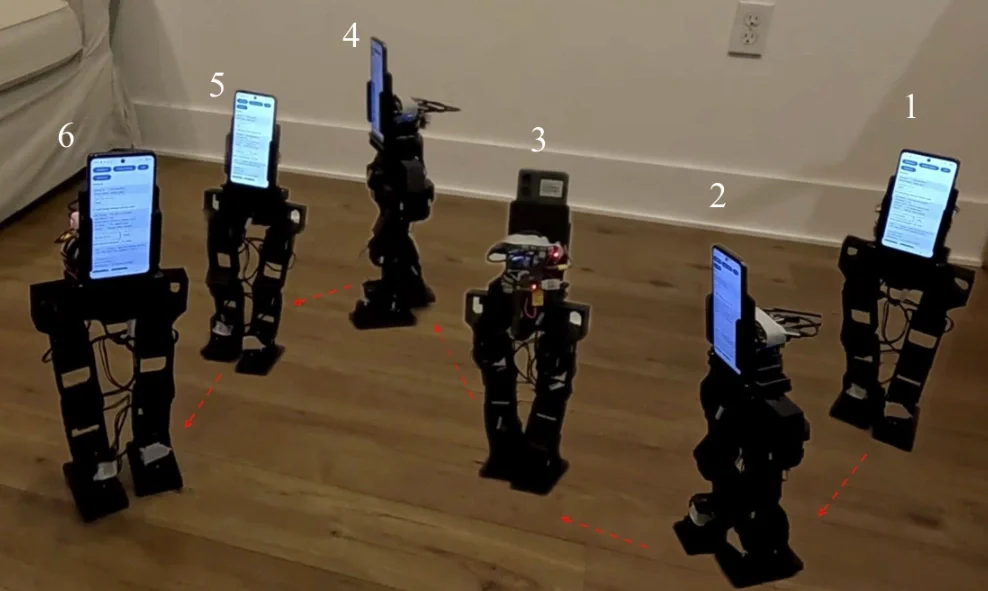
Announced over the weekend on the arXiv scientific repository, PhoneBot is 483 mm tall, weighs 1.8 kg, and uses 13 servo motors to control its legs and body rotation during movement. Instead of requiring expensive cameras, motion sensors, and onboard computers, humanoid robots rely on hardware on the phone for these functions.
When attached to the robot, the smartphone camera is responsible for tracking movement, while the integrated inertial meter provides real-time data to help the robot maintain balance and perform movements. Inside, a separate computer is in charge of control, receiving commands wirelessly from smartphones via wifi and converting them into joint movements.
PhoneBot has six control joints on each leg, including the hips, knees and ankles, and another joint that helps rotate the body and the smartphone attached to it. This arrangement allows the camera to point towards the person, without the need for the robot to rotate its entire body, helping to support tracking and other vision-based interactions.
UCLA researchers tested four Android phones, including the Honor 9 launched in 2017 and three low-cost models priced at $50-80. All four meet core application requirements such as motion sensing, walking control, image recognition and user interaction. However, with some features, there are differences depending on the phone model.
The application runs the TensorFlow Lite migration algorithm. The research team trained PhoneBot's walking controller using reinforcement learning in a simulated environment. The system is rewarded for performing desired movements, and penalized for creating unstable postures or subjecting the motor to excessive load.
A UCLA representative told TechRadar that in initial tests, the robot had an unbalanced gait, relying heavily on one leg. To fix this, the team added symmetry training patterns, which help the controller learn to coordinate movements between the left and right sides to improve gait balance without physical training.
As a result, through 5 independent training sessions, the symmetry learning method helps reduce the joint angle symmetry error from 0.254 to 0.003 radians in subsequent evaluations. The torque difference between the left and right sides and the mechanical power difference also improve over time.
However, PhoneBot is still limited by its low-power servo motor, making it difficult to carry heavy objects or perform complex movements stably. The movement control system trains on flat surfaces, so the ability to move on uneven terrain has not yet been tested. In addition, the robot is not equipped with hands for manipulation.
According to *Tech However, their limited size and features limit their practical applications.
Bao Lam summary
- Inside Boston Dynamics' humanoid robot factory
- Chinese company produces 4 meter tall humanoid robot
- Robot hand that can do magic