Japan launched a spacecraft to take samples of the moon of Mars
Executive Briefing
Synthesized and verified with gemini-2.0-flash-thinking-exp
“# Japan launched a ship to retrieve samples of the moon of Mars The Japanese spacecraft successfull”
Key Takeaways
- 1.# Japan launched a ship to retrieve samples of the moon of Mars The Japanese spacecraft successfully took off, starting a 10-month journey to Mars to retrieve samples of the moon Phobos, bringing them back to Earth in 2031.
- 2.*Space* reported that the Martian Moons eXploration (MMX) took off on the H3 rocket from pad No.
- 3.2 at the Yoshinobu Launch Complex at the Tanegashima Space Center in Kagoshima, Japan at 4:41 a.m.
The Japanese spacecraft successfully took off, starting a 10-month journey to Mars to retrieve samples of the moon Phobos, bringing them back to Earth in 2031.
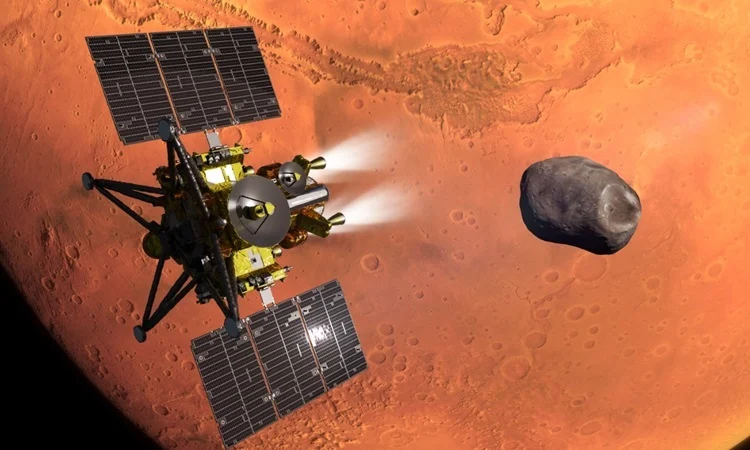
Space reported that the Martian Moons eXploration (MMX) took off on the H3 rocket from pad No. 2 at the Yoshinobu Launch Complex at the Tanegashima Space Center in Kagoshima, Japan at 4:41 a.m. on October 20 (2:41 a.m. same time and date in Hanoi). The MMX spacecraft will head to Mars orbit to study the planet's two moons Phobos and Deimos.
If everything goes as planned, MMX will become the first spacecraft to land and retrieve samples from Phobos for return to Earth, helping to unravel a decades-old mystery about the origin of moons and reveal clues about the formation of the early solar system.
This is the 10th launch of the H3 two-stage rocket jointly developed by the Japan Aerospace Exploration Agency (JAXA) and Mitsubishi Heavy Industries. After leaving the launch pad, the 63-meter-high launch vehicle flew on a planned trajectory over the Pacific Ocean, removing four solid fuel booster boosters in pairs. The rocket then proceeds to remove the cargo compartment protective cover, revealing the MMX for the first time.
According to Mitsubishi Heavy Industries, the H3's first stage is powered by two LE-9 rocket engines, which combine liquid hydrogen and oxygen to create a total thrust of 1,471 kN. About 5 minutes after takeoff, H3 disconnected the main engine and separated from the upper stage so that this unit could fire its own engine for 5.5 minutes. Next, the H3 upper stage activates the engine a second time, bringing MMX to a maximum speed of about 38,858 km/h to escape Earth's orbit and begin the long journey to Mars.
The MMX spacecraft was released from the rocket's upper stage on schedule about 71 minutes after leaving the launch pad. Currently, MMX is driving itself to Mars. The interplanetary trip will last about 10 months, expected to reach the red planet in August 2027. Upon arrival, MMX's propulsion module will ignite its engines to enter a quasi-satellite orbit (QSO) around Phobos.
According to Japan Times, MMX will spend three years in the Mars system, spending most of the time studying the moon Phobos, which is 22 km wide and orbiting the planet at a distance of 6,000 km.
The 5-ton spacecraft will synchronize with Phobos's orbit around Mars and deploy the Idefix autonomous robot of the French and German space agencies to the surface of Phobos in late 2028 or early 2029. Because the gravity on Phobos is only 1/1,000th that of Earth, the 4-wheeled autonomous robot will bounce for a few minutes on the surface of Phobos before stopping completely. It will spend 100 days surveying the celestial surface to find a safe landing location and sample collection before the quadruped lander collects the samples. The lander will spend just two hours on Phobos to drill and extract material and then launch it back into space.
Guardian said NASA has landed nine spacecraft on Mars in the past half-century, while China landed on the red planet in 2021. However, this is the first time a mission has sought to land on the moon Phobos.
Next, MMX will temporarily return to QSO before moving to a longer orbit around Mars, intersecting the smaller moon Deimos, which is only 14 km wide. During the last few months of the mission, MMX will fly many times over Deimos and then depart for Earth in November 2030. It is expected that MMX's sample capsule will land in Australia in 2031.
Scientists hope that samples and data collected during the MMX mission will contribute to answering decades-old questions about the origin of the Martian moon. Both Phobos and Deimos have a long, concave potato-like shape instead of a spherical shape. This shape combined with their chemical composition suggests that Phobos and Deimos may have been asteroids from the early solar system attracted by the gravity of Mars.
Another theory is that they were born in a violent collision similar to Earth's Moon. Finding the true origin story of the moons will provide important clues about Mars' geological past as well as the early history of the solar system.
Once the MMX samples are safely returned to Earth, scientists will study their composition and minerals, then compare them with chemical traces from Martian rocks and asteroids. The results of the analysis will allow them to determine the origin of Phobos and Deimos.
The $578 million MMX mission marks an international collaborative effort between JAXA, NASA, the European Space Agency (ESA), along with several companies providing scientific and communications equipment for the spacecraft. NASA invested about $87 million until the end of the mission, in return for at least 15% of the 10-gram Phobos sample. This amount of samples will be transferred and preserved at NASA's Johnson Space Center in Houston for analysis.
MMX is not the first Phobos sample collection project undertaken. The first mission was Russia's Phobos-Grunt, launched in November 2011 but could not escape Earth orbit due to rocket failure. The 4.5-ton spacecraft then fell back to Earth in the Pacific Ocean in January 2012.
An Khang summary