Lydian coins: from the Pactolus River electrum to the state lion seal
Executive Briefing
Synthesized and verified with gemini-2.0-flash-thinking-exp
“Before there were coins, people exchanged goods with objects of equal value or by weighing gold and”
Key Takeaways
- 1.Before there were coins, people exchanged goods with objects of equal value or by weighing gold and silver bars.
- 2.Around the end of the 7th century BC, the Lydian kingdom in western Asia Minor (now in Türkiye) began casting small metal coins according to weight standards, stamped with the state symbol.
- 3.It is considered by many historians to be the first regulated coinage, and from there the idea of state-backed money spread to the Mediterranean.
Before there were coins, people exchanged goods with objects of equal value or by weighing gold and silver bars. Around the end of the 7th century BC, the Lydian kingdom in western Asia Minor (now in Türkiye) began casting small metal coins according to weight standards, stamped with the state symbol. It is considered by many historians to be the first regulated coinage, and from there the idea of state-backed money spread to the Mediterranean.
Electrum and lion mark
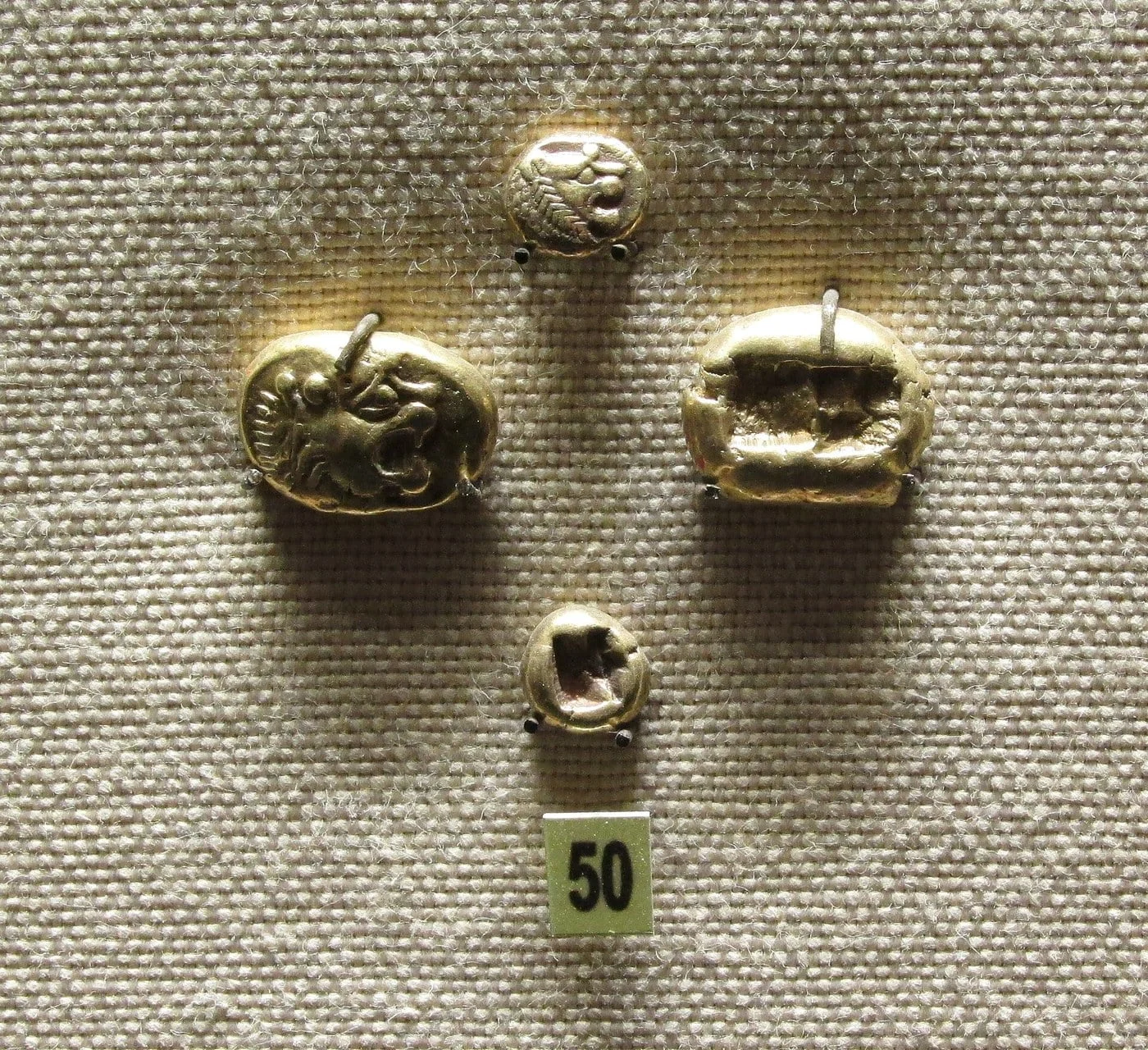
According to Britannica, during the reign of King Alyattes (about 610–560 BC), Lydia issued coins made from electrum, a natural alloy of gold and silver taken from the river. They have a rough shape like a bean, bearing the royal symbol of a lion's head. The British Museum records that the earliest electrum coins around 650 BC were made according to strict scales: value was based on the mass of metal, even though the shape was still irregular.
Lydia electrum coin with a lion's head, around the end of the 7th century BC. Electrum is a natural alloy of gold and silver, minted according to weight standards
LBMA and archaeological studies at Sardis show that Lydian early copper electrum often has a lower percentage of gold than natural river electrum, suggesting that Lydian metalworkers knew to separate the silver and then re-alloy it before casting. The copper backing usually has only simple chisel marks from hammering the mold.
Croesus: gold and silver separated
Alyattes' son Croesus (reigned c. 560–546 BC) further reformed the currency. Herodotus wrote that the Lydians were the first people he knew of to use gold and silver coins, and were also the first to retail goods. Croesus replaced the electrum with a system of pure gold and pure silver coins, with the same motif: half of a lion's body facing half of a bull's body.
View attachment 8656913
Golden Stater of King Croesus (c. 560–547 BC) at the British Museum: half of a lion's body facing half of a bull's body, on the back are two chisel marks
According to numismatists, this is the earliest known example of a bimetallic regime, in which the state fixed the exchange relationship between gold and silver. The gold Stater weighs about 10.8 g (later reduced to about 8.1 g), with many smaller fractions. Excavations at Sardis found a smelter that separated electrum into gold and silver bars around 560–550 BC, consistent with the pre-Croesian period.
Silver stater in the same lion-bull style of Croesus's time at the British Museum. Croesus separated electrum into pure gold and silver, creating a bimetallic coin system
From Sardis spread to the Mediterranean
In 546 BC, Cyrus the Great of Persia conquered Lydia. The lion–bull coinage continued for some time, then under Darius I appeared the gold daric and silver siglos with the image of the Persian archer. The idea of minting money according to state standards spread to Greek city-states; In the Mediterranean economy, money gradually became common.
Britannica and the British Museum emphasize that the key point is not just precious metals, but the authority's stamp on standardized quantities. When the state stamps the coin, the person holding the coin does not need to weigh it and retry each transaction. The value is guaranteed by the reputation of the place of issue, and that is the transition from metal bars to true coins.
Advertisement
BBC and LBMA also associate the name Croesus with wealth in Western culture because of this money system. His gold stater appears in the British Museum's A History of the World in 100 Objects series. Although the Pactolus river electrum and the Lydia gold mine nourished the treasury, what remains today on museum trays are small coins marked with lions and oxen: physical evidence that exchange value was stamped and standardized by the state.
Source:
Britannica Kids: A Brief History of Money
,
British Museum: Money Gallery guide, Room 68
,
LBMA: Lydian Electrum Coin
,
LBMA: Croesus Stater
,
Wikipedia: Coin
,
Wikipedia: Croesus

