Meet Mori, a Cute Robot Mushroom That Doesn’t Really Say (or Do) Anything
Executive Briefing
Synthesized and verified with gemini-2.0-flash-thinking-exp
“You've had a long day. You finally get home, fling the door open, plonk on the couch, and let out a big sigh. In the cor”
Key Takeaways
- 1.You've had a long day. You finally get home, fling the door open, plonk on the couch, and let out a big sigh. In the corner of your eye, you notice yo
- 2.It does a little jiggle because it sees you're back. Its name is Mori.
- 3.As you move around the space—maybe it's time to start cooking dinner—the little robot's face follows you, observing your movements and making soft sou
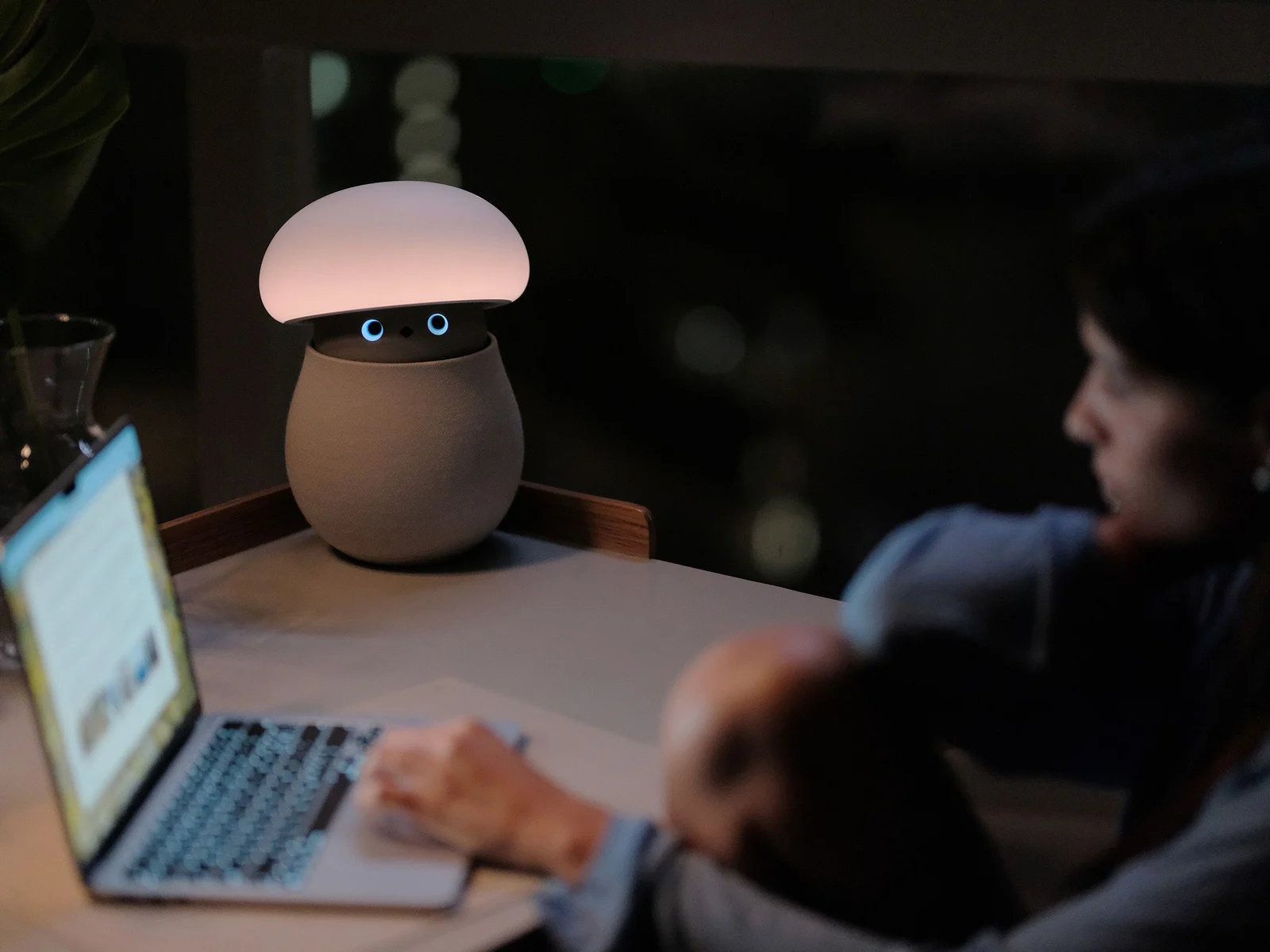
You've had a long day. You finally get home, fling the door open, plonk on the couch, and let out a big sigh. In the corner of your eye, you notice your mushroom lamp perk up. Its microphone must have heard you come in. Its head raises to reveal round, animated eyes, and a little diamond-shaped nose—which actually houses a camera.
It does a little jiggle because it sees you're back. Its name is Mori.
As you move around the space—maybe it's time to start cooking dinner—the little robot's face follows you, observing your movements and making soft sounds that are a cross between a bird and R2-D2. The day's stress catches up, and you need a moment to relax, so you head over to Mori, touch its head, and its eyes and camera-nose dip back inside its body. It goes back to being a lamp, except now it plays nature soundscapes so you can feel at ease.
That's the pitch from OKA, or One Kind Artifact, a new startup based in Cambridge, Massachusetts, and Shenzhen, China, focusing on experimental technology. CEO Hua Wang tells WIRED he wants his company to create five experimental “Artifacts” over the course of OKA's lifetime. Mori is the first.
“There are certain relationships in this era we want to fix between humans and our surroundings—human with nature, human with one another—every product is an experience trying to reconnect some of those relationships,” Wang says. Before cofounding OKA, he was a general manager at Meipai, a video-sharing app from the Chinese phone brand Meitu. He also cofounded Bondee, a now-defunct social media app that briefly went viral in Asia.
According to the company, the point of Mori, the nearly 12-inch-tall home robot lamp, is to reconnect its owners with nature. It can play nature soundscapes. It will glow different colors—inspired by rain, forests, fire, and wind—while reacting to your movements. It can guide you through a calming breathing session.
It also uses its built-in camera and microphones to serve as a fun little interactive companion in your home. Ask it how your outfit looks, and Mori will jiggle excitedly. If you're playing music or watching TV, Mori can dance to the tunes and react to the action on your TV screen.
It intentionally does not do anything else. Unlike an Amazon Echo, it isn't an assistant: You can't use voice commands to control smart lights or cue up Spotify tracks, and it won't answer if you ask about the weather.
The Founder's Edition is a staggering $649 and is available starting today, though stock is limited to a few hundred units. That price also includes a two-year warranty and two years of Mori's subscription service. If you miss out on the Founder’s Edition, you can still buy a standard edition Mori, but that costs $799, and that higher price shockingly does not include any of the subscription features.
The breathing exercises are free, and you can still access those without a subscription. But if you want the nature soundscapes, you need to subscribe. Otherwise, Mori is just a glorified lamp that dances a little bit while pointing its camera at you and any other people in your home.
Wang says today's home robots have mostly taken on “machine-like” forms that don't mesh well with personal environments, so OKA designed a lamp that blends in, but is also anthropomorphized to make being at home “feel better.”
OKA's AI algorithms (powered by multiple local large language models) let Mori understand the room's context through the camera and microphone, so it knows when to interact and when to stay quiet. The company calls this “Attentive Intelligence.” It has memory, so it remembers you and interacts with you a certain way over time, whereas it might act a little more shy if you bring home a guest. If it doesn't see someone for a month, it will forget them.
It might notice, for example, that you've been on your phone doomscrolling for two hours straight on the couch. Mori might then try to get your attention so you come over, listen to some wind rustling through the leaves, and give your eyes a break. When you're on a phone call, or maybe having an argument with a significant other, it understands what’s happening and goes silent so as not to distract you.
“All gadgets try to capture more of your attention,” Wang says. “Mori gives your attention back to you. It invites you to do meditative experiences. Nature has this restorative power to humans.”
The robot can connect to Wi-Fi, which should give you pause from a security standpoint, but Wang says the internet connection is only used for firmware updates.

