NASA's $250 million telescope is falling to Earth
Executive Briefing
Synthesized and verified with gemini-2.0-flash-thinking-exp
“# NASA's $250 million telescope is falling to Earth NASA announced that the Neil Gehrels Swift obse”
Key Takeaways
- 1.# NASA's $250 million telescope is falling to Earth NASA announced that the Neil Gehrels Swift observatory will plunge to Earth, possibly reentering the atmosphere at about 3:30 a.m.
- 2.on November 4, EST (3:30 p.m., same date and time in Hanoi).
- 3.According to *Live Science,* NASA's latest estimate on November 2, the Swift observatory weighs about 1,450 kg and has the ability to return to the atmosphere with a maximum time difference of 11 hours.
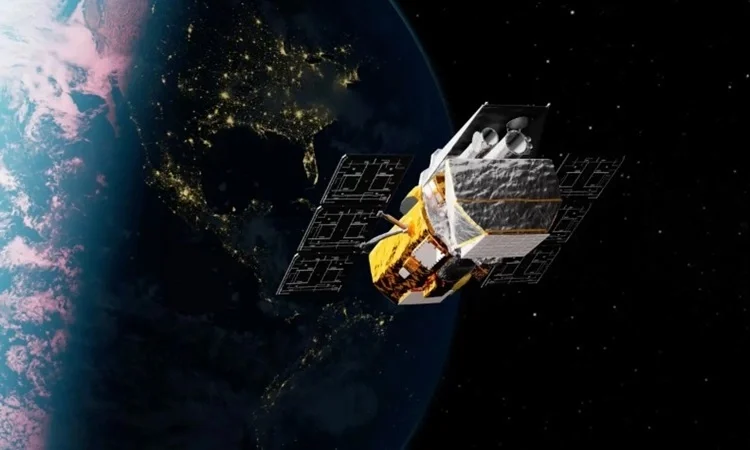
NASA announced that the Neil Gehrels Swift observatory will plunge to Earth, possibly reentering the atmosphere at about 3:30 a.m. on November 4, EST (3:30 p.m., same date and time in Hanoi).
According to Live Science, NASA's latest estimate on November 2, the Swift observatory weighs about 1,450 kg and has the ability to return to the atmosphere with a maximum time difference of 11 hours.
An independent analysis by the private non-profit organization Aerospace Corporation, which tracks thousands of objects in orbit, also estimates that the telescope will reenter the atmosphere at 5:19 a.m. on November 4, EST (5:19 p.m., same date and time in Hanoi), with a time difference of 2 hours.
As with all retrosphere spacecraft, the risk to humans is minimal. According to NASA, most of the Swift telescope will burn up in the atmosphere. Any remaining debris is likely to fall in the area between 20.6 degrees south latitude and 20.6 degrees north latitude, a range that includes parts of Mexico, the Caribbean, Central and South America, the Arabian Peninsula, India, Africa and Oceania.
NASA predicts the chance of Swift's debris falling into a populated area is about 1/2,100, about 7 times higher than the risk of a person being struck by lightning in their lifetime (1/15,300). The agency will continue to update the forecast as the return period gets closer.
The $250 million Swift Observatory is a multi-wavelength optical, ultraviolet and X-ray telescope launched in November 2004 with the mission of studying the most powerful explosions in the universe. After its two-year primary mission, the telescope operated 10 times longer than its expected lifespan, searching for supernovae, gamma-ray bursts and exploding black holes in space.
Swift's altitude has decreased rapidly over the past year. Every spacecraft operating in low Earth orbit is subject to drag from the upper atmosphere. Swift does not have a propulsion system, so it cannot raise its own orbit. According to NASA, increased solar activity over the past few years (peaking in an 11-year cycle in 2024) has amplified that drag. As the Sun becomes more active, it heats and expands Earth's upper atmosphere, leading to more gas molecules getting in the way.
Swift's orbital lift mission with a private spacecraft failed shortly after launch on July 3. Guardian said NASA signed a $30 million contract with Flagstaff, Arizona-based Katalyst in September 2025 and gave them a one-year deadline to design, build, test and launch the Link spacecraft to meet, capture and lift the Swift observatory higher.
After entering space and completing initial tests, the vehicle began experiencing communications loss and directional control problems. An electronic error caused two of the three jet flywheels used to rotate the spacecraft to stop working, and a valve problem caused the vehicle to spin out of control. Engineers restored control, but the Link had no fuel left to carry out its mission.
The engineering team in charge of the project stopped the observatory's scientific operations on October 20 because the spacecraft fell too low in orbit to continue observing the sky. Swift left behind a rich trove of scientific data, including contributions to more than 7,000 articles to date. This number will increase as Swift's final observations are processed.
An Khang summary

