Pantheon Temple: unreinforced concrete dome has stood firm for nearly 1,900 years
Executive Briefing
Synthesized and verified with gemini-2.0-flash-thinking-exp
“In the center of Rome there is a nearly 1,900-year-old building that is still in use every day.”
Key Takeaways
- 1.In the center of Rome there is a nearly 1,900-year-old building that is still in use every day.
- 2.That is the Pantheon, with a concrete dome more than 43 meters wide, without a single steel bar inside.
- 3.According to Wikipedia, this is still the largest unreinforced concrete dome in the world.
In the center of Rome there is a nearly 1,900-year-old building that is still in use every day. That is the Pantheon, with a concrete dome more than 43 meters wide, without a single steel bar inside. According to Wikipedia, this is still the largest unreinforced concrete dome in the world. The secret to its stability lies not in any magical material, but in the way the Romans calculated the shape, thickness and weight of each dome.
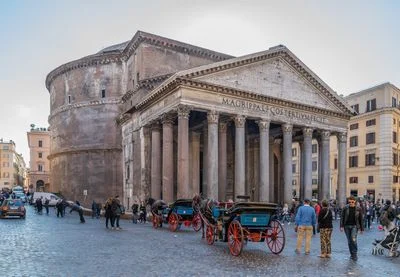
Facade of the Pantheon in Rome with Corinthian granite columns and Agrippa inscription. Behind is a circular block made of concrete covered with bricks supporting the dome
A rebuilt temple
The first temple in this location was built by Marcus Agrippa, right-hand man of emperor Augustus, in 27 BC. After the old building burned down, Emperor Hadrian completely rebuilt it between 118 and 128, according to Britannica. Hadrian did not write his name but had the old inscription M·AGRIPPA·L·F·COS·TERTIVM·FECIT, meaning Marcus Agrippa, son of Lucius, built when he became consul for the third time. This inscription makes people still think that the current building belongs to Agrippa many centuries later.
In 609, the Byzantine emperor Phocas gave the building to Pope Boniface IV, who turned it into a church of Our Lady and the Martyrs. According to Wikipedia, its continuous use throughout history is a big reason why the Pantheon is among the best-preserved ancient Roman buildings.
The numbers of the dome
According to Wikipedia, the height from the floor to the opening at the top is exactly equal to the inside diameter of the building, which is 43.3 m. In other words, a giant sphere could fit inside. In Roman units, the dome is 150 feet wide, and the oculus opening is 30 feet wide, about 9 m.
Simplified cross-section of the Pantheon: the arch is 6.4 m thick at the base and only 1.2 m near the opening, the aggregate in the concrete gradually lightens from the bottom up, the entire interior space fits into a sphere 43.3 m in diameter
- Thinning towards the top: the arch is 6.4 m thick at the base and only 1.2 m around the opening.
- Lighter to the top: the lower part is mixed with heavy travertine stone, the upper part is a piece of burnt brick and tile, near the top is tufa stone and light porous pumice stone.
- Removing the top: instead of building it closed, the Romans left a round hole right where the dome was most likely to collapse, making the top part lighter.
- Hidden cavity in the wall: according to Wikipedia, pre-calculated cavities inside the circular block form a structural system and help reduce weight.
- Thick pillar wall: according to Britannica, the circular wall is about 6 m thick, inside there are brick arches and overlapping pillars to support the horizontal thrust of the arch.
The entire dome weighs about 4,535 tons. Its thrust is channeled through eight arches in the wall down to eight large pillars.
Why is there no need for reinforcement
Concrete is very resistant to compression but poor to tensile strength, so modern construction must place steel in areas subject to tension. The way the Romans chose was to shape it so that the arch was almost just compressed. Wikipedia cites simulation results using Mark and Hutchison's finite element method: the maximum tensile stress in the arch is only about 0.128 MPa, where the arch connects to the wall. Meanwhile, Roman concrete samples tested in Libya had an estimated tensile strength of about 1.47 MPa. According to these two researchers, if the same heavy concrete is used from the base to the top, the stress in the arch will be about 80% greater.
Roman concrete itself is also different from today's concrete. It consists of lime mortar mixed with pozzolana volcanic ash and large stones and pieces of brick, applied layer by layer instead of being poured liquid. In 2023, the MIT research team published in the journal Science Advances that the Romans may have mixed quicklime at high temperatures. This method leaves small particles of lime in the concrete. When there is a crack and water seeps in, the lime particles dissolve and then recrystallize into calcium carbonate, filling the crack itself. MIT says a test sample made this way self-healed the crack within two weeks.
Advertisement
View from below to the dome: five rings of concave ceiling panels, each ring of 28 panels, surrounding the always open oculus opening, the main source of natural light for the whole building
Light and rain through the same hole
The oculus opening has never been covered. According to Wikipedia, along with the main door, this is the only natural light source of the interior space, and the sunlight moves on the ceiling and walls according to the hour of the day like a reverse sundial. When it rains, water falls straight to the floor, so the floor is slightly sloped about 30 cm toward the drainage holes.
Nearly 1,300 years later, Brunelleschi built a 42 m dome for the church of Santa Maria del Fiore in Florence, completed in 1436, and the Pantheon became the model for many later domes in Europe. However, no unreinforced concrete dome has ever exceeded its size.
Source:
Wikipedia: Pantheon, Rome
,
Britannica: Pantheon
,
Wikipedia: Roman concrete
,
MIT News: Riddle solved: Why was Roman concrete so durable?
,
Wikipedia: Dome