Petra: a city in the desert that lives on flood dams, cisterns and terracotta water pipes
Executive Briefing
Synthesized and verified with gemini-2.0-flash-thinking-exp
“Petra is famous for its temple facades carved straight into the pink sandstone cliffs of southern Jo”
Key Takeaways
- 1.Petra is famous for its temple facades carved straight into the pink sandstone cliffs of southern Jordan.
- 2.But what makes a city able to exist in this arid land lies in a place that few people pay attention to: the system of dams, canals, pipes and tanks that the Nabataean people used to retain every drop of rainwater and bring spring water from far away.
- 3.UNESCO calls it an ingenious system of water management that allowed humans to densely settle in an essentially dry region.
Petra is famous for its temple facades carved straight into the pink sandstone cliffs of southern Jordan. But what makes a city able to exist in this arid land lies in a place that few people pay attention to: the system of dams, canals, pipes and tanks that the Nabataean people used to retain every drop of rainwater and bring spring water from far away. UNESCO calls it an ingenious system of water management that allowed humans to densely settle in an essentially dry region.
Nomads hide water underground
According to Wikipedia, the Nabataeans were a nomadic Arab tribe that arrived in the Petra region in the 4th century BC. By the 2nd century BC, Petra became the capital of the kingdom of Nabataea, located on the spice trade routes connecting Arabia with Egypt and Syria. In the 1st century AD, the city's population was estimated to have reached about 20,000 people.
Petra's climate is semi-arid, with only about 193 mm of rain per year, mainly falling in winter. Greek historian Diodorus Siculus recorded that the Nabataean people dug bottle-shaped rainwater cisterns in rock or clay foundations, then carefully camouflaged them so that invaders could not find them. According to Diodorus, the dry land itself is the best shield for them.
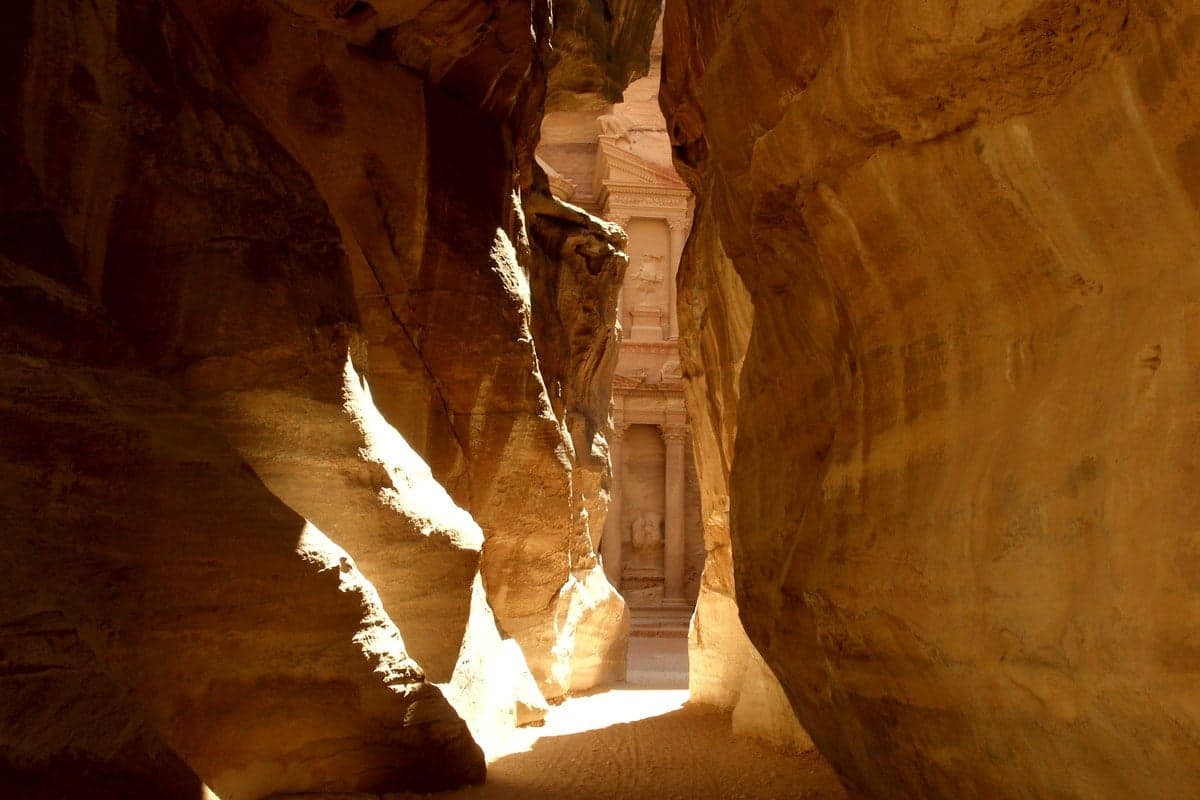
At the end of the Siq canyon, the Al-Khazneh facade appears between two sandstone cliffs. The Siq is the main entrance to Petra from the east and is also the waterway into the city
Dam and flood-blocking tunnel at Siq mouth
Rain in Petra is rare, but when it falls it becomes a flash flood. The main entrance to the city is Siq, a narrow canyon about 1.2 km long, with some sections only 3 m wide, which is the natural drainage of the Wadi Musa stream. According to research by hydraulic engineer Charles Ortloff published in Water magazine in 2020, in the 1st century, the Nabataean people built a dam and a tunnel at the mouth of the Siq. The floodwaters of Wadi Musa were blocked and pushed into the Wadi Mataha valley, instead of overflowing the Siq, carrying sand and mud into the city center.
According to Wikipedia, the dam at the mouth of the Siq was rebuilt in 1963 and 1991, quite close to the original Nabataean construction. UNESCO names the Muthlim tunnel and the diversion dam as outstanding examples of irrigation engineering from the centuries around the Common Era. The organization also noted that if this diversion system is not regularly monitored and repaired, the Siq could still be overwhelmed by flash floods.
14 km long terracotta pipe
Petra's main water source is the Ain Musa spring in the east of the city. Ortloff describes that at first, water was carried through the Siq by an open channel dug into the canyon floor, covered with stone slabs. Between the 1st and 1st centuries BC, this canal was replaced by a pipeline running along the north wall of the Siq, connecting to a pipeline about 14 km long from the Ain Musa stream. The south bank of the Siq has an additional open channel, most likely used for camels and horses accompanying trading caravans.
A section of the Nabataean water canal runs close to the foot of the Siq cliff, right next to the paved road. In its heyday, this canal carried water from Ain Musa stream to the city center
The pipeline is assembled from thousands of nested terracotta pipe sections, each section is about 35 cm long, internal diameter is from 14 to 23 cm, and the joints are plastered with water-resistant mortar. Along the tube in the Siq there are four open tanks. According to Ortloff's analysis, these tanks are both a place to deposit sand and mud and for passersby to get drinking water, and also help the water in each pipe section flow only down the pipe instead of being filled. As a result, the pressure on the joint is lower and the tube leaks less.
Storage tank for dry season and camel caravans
In addition to spring water, Petra also collects rainwater. On the slopes around the city, there are many small dams and canals that carry rainwater into above-ground and underground tanks. The high Zurraba reservoir, connected to the Ain Musa stream, has a capacity of about 10,000 m³, enough reserves for the dry season and for caravans to stop. Ortloff also pointed out that Petra has many pipelines that take water from different sources, so that when one line has to be stopped for repair, there will still be another line to supply water.
Advertisement
The mouth of an ancient Nabataean water tank cut into sandstone bedrock in the desert near Petra. Rainwater flowing over the rock surface is directed into the tank for gradual use
In 106, the kingdom of Nabataea was annexed into the Roman Empire. According to Wikipedia, Petra gradually declined as trade routes switched to sea routes, then the earthquake in 363 destroyed many buildings and paralyzed the city's vital water management system. Petra was recognized as a World Heritage Site in 1985. To this day, Ain Musa stream still supplies water to the town of Wadi Musa right next to the relic site.
Source:
UNESCO World Heritage Center: Petra
,
Charles R. Ortloff, Water (MDPI) 2020: Hydraulic Engineering at 100 BC-AD 300 Nabataean Petra
,
Wikipedia: Petra
,
Wikipedia: Siq
,
Wikipedia: Nabataeans
Attribution & Original Source
Synthesized and verified from Tinhte.vn. All copyrights and intellectual property belong to the original publication.