RO water purifier: membrane retains salt ions at the cost of a lot of wastewater
Executive Briefing
Synthesized and verified with gemini-2.0-flash-thinking-exp
“Many families place RO water purifiers under the sink and are accustomed to seeing it both produce d”
Key Takeaways
- 1.Many families place RO water purifiers under the sink and are accustomed to seeing it both produce drinking water and discharge wastewater into the sewer.
- 2.The word RO stands for reverse osmosis, meaning reverse osmosis.
- 3.The heart of the machine is a thin membrane that can filter to the point of retaining dissolved salts in water, something that activated carbon or cotton cores cannot do.
Many families place RO water purifiers under the sink and are accustomed to seeing it both produce drinking water and discharge wastewater into the sewer. The word RO stands for reverse osmosis, meaning reverse osmosis. The heart of the machine is a thin membrane that can filter to the point of retaining dissolved salts in water, something that activated carbon or cotton cores cannot do.
Observe, then do the opposite
The phenomenon of osmosis was recorded by French scientist Jean-Antoine Nollet in 1748. When a semi-permeable membrane, the type that only allows water to pass through, separates clean water and salt water, the water will naturally flow from the thin side to the thick side to balance the concentration. This pushing force is called osmotic pressure.
Reverse osmosis does the opposite. People use a pump to force the salt water side, overcoming the osmotic pressure, causing the water to be pushed through the membrane to the clean side, while the salt and impurities stay. According to Wikipedia, seawater has a natural osmotic pressure of about 27 bars, so the seawater desalination system must press at 40 to 82 bars. For fresh and brackish water, only about 2 to 17 bars are needed.
Natural osmosis and reverse osmosis: when pressed hard enough, water goes from the salty side to the clean side, while the salt ions are retained. Below is the particle size that each filter type retains
Filtration to the ion level
Conventional filter cores act like a sieve, blocking particles larger than the filter pores. Wikipedia says that RO membranes are almost holeless in that sense: water passes by diffusion through the membrane material, while other substances are blocked because they are difficult to dissolve or diffuse in the membrane. The CDC (US Centers for Disease Control and Prevention) describes RO membranes as having a pore size of about 0.0001 microns.
According to the CDC, RO systems remove parasites, bacteria and viruses, and also remove certain chemicals such as lead, copper, chromium, chloride and sodium. It can also reduce arsenic, fluoride, sulfate, nitrate and minerals such as calcium, magnesium and potassium. Each machine removes different substances, so the CDC recommends looking at each product's label.
In the mid-1950s, researchers at UCLA and the University of Florida managed to desalinate seawater, but the water passed through the membrane so slowly that it was not practical to use. Sidney Loeb at the University of California, Los Angeles (UCLA) and Srinivasa Sourirajan at the National Research Council of Canada found a way to make an asymmetric membrane: a thin skin that does the filtering, placed on a thick, porous support layer. Then John Cadotte at FilmTec company found a way to create membranes by surface polymerization, allowing water to pass through quickly and very little salt to pass through. Wikipedia says nearly all commercial RO membranes today are made this way.
The layers of a coiled RO membrane core are opened at the Jacob Blaustein Desert Research Institute (Israel): membrane sheets are interwoven with thin mesh layers, rolled into many turns to have a large filtration area in a compact tube
Inside the home purifier
An under-sink RO machine usually has more than just a membrane. The CDC says water can pass through other filter elements before and after the RO membrane, and Clemson University's information page describes how to incorporate activated carbon before and after the membrane. A set usually includes:
- Sediment filter core: retains sand and suspended particles to protect the membrane.
- Activated carbon core: retains chlorine and odor-causing substances. According to Wikipedia, chlorine can damage the thin composite membrane used in RO.
- RO membrane: separates clean water from concentrated water containing salt and impurities.
- Core behind the membrane: usually activated carbon to improve water taste.
The water trapped in front of the membrane cannot stand still, otherwise the salt will build up and clog the membrane. Therefore, the machine must continuously discharge this concentrated water stream. According to Wikipedia, a home RO machine that produces one liter of usable water wastes about 3 to 25 liters, due to low water pressure in the house. For this reason, the National Green Tribunal of India once proposed to ban RO machines where water has total dissolved solids below 500 mg/liter.
Advertisement
From sink to seawater plant
According to the International Desalination Association, in 2011 RO accounted for 66% of the world's installed desalination capacity. In 2013, the largest RO plant was Sorek in Israel, producing 624,000 m³ of water per day. Large plants utilize the remaining energy in the condensed water stream to reduce pumping power, and capture 40 to 50% of the incoming seawater as fresh water.
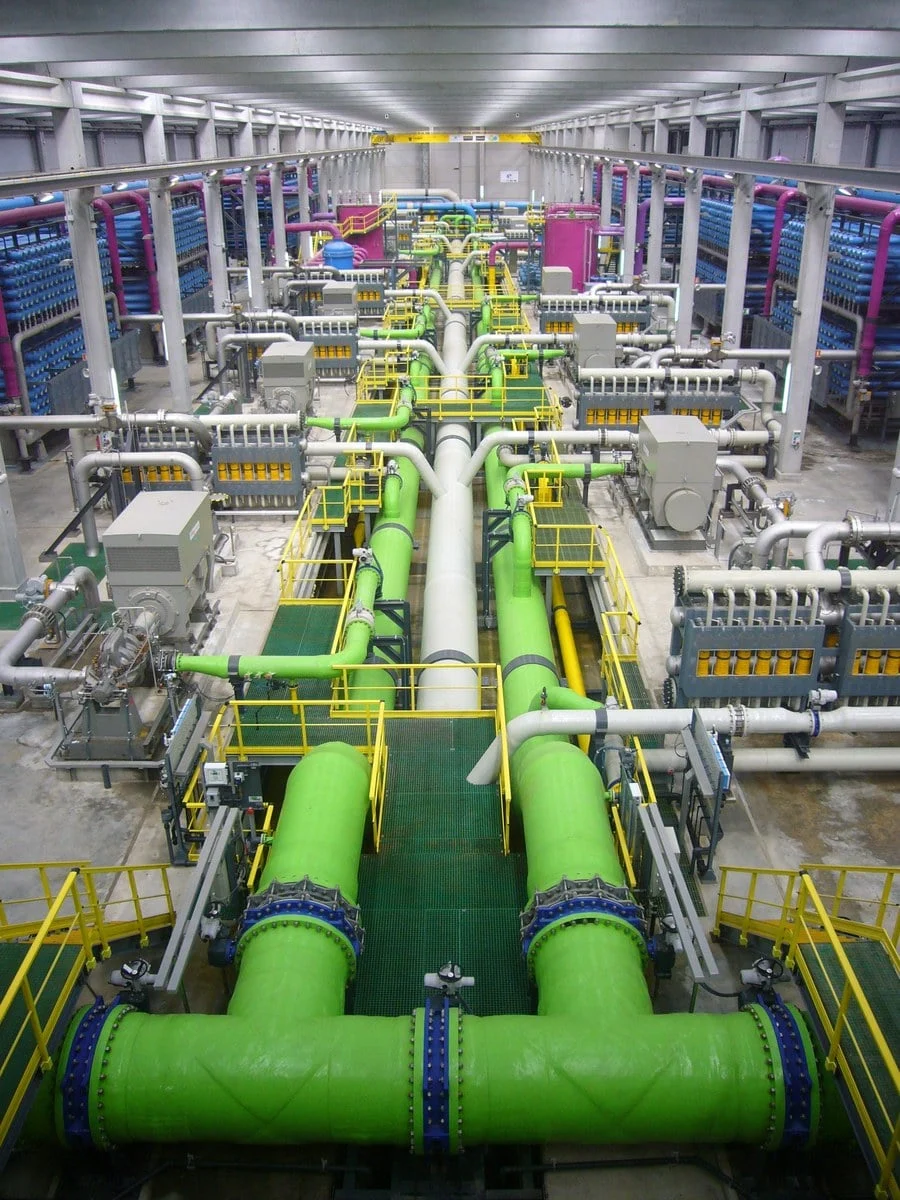
The El Prat desalination plant near Barcelona uses reverse osmosis technology to turn seawater into drinking water. Each blue tube is a pressure tube containing multiple membrane cores
Understanding how the membrane works also helps to use the machine more appropriately. The CDC recommends testing your water first, because if the water does not contain harmful chemicals or pathogens, a treatment system may not be needed. For well water or brackish water with many dissolved substances, RO is a choice worth considering, as long as the pre-membrane filter elements are replaced on time.
Source:
CDC: About Home Water Treatment Systems
,
CDC: Choosing Home Water Filters
,
Britannica: Reverse osmosis
,
Wikipedia: Reverse osmosis
,
Clemson University HGIC: Water Treatment Options
,
Wikipedia: Osmosis

