Robot dog walking profession in America
Executive Briefing
Synthesized and verified with gemini-2.0-flash-thinking-exp
“# Robot dog walking profession in America A startup specializing in software development is looking”
Key Takeaways
- 1.# Robot dog walking profession in America A startup specializing in software development is looking for employees to walk robot dogs part-time at a salary of 20 USD/hour to collect real-world data.
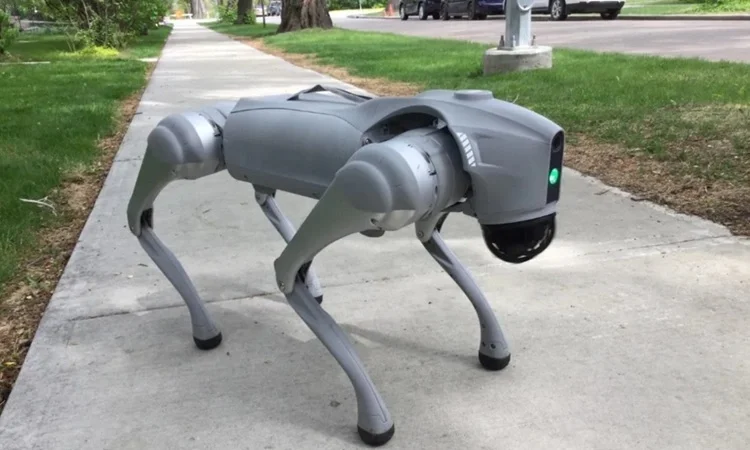
- 2.According to *Gadget Review*, in early October, startup Dimensional posted a recruitment notice for a $2,000 Unitree robot dog walker to walk through the streets of San Francisco using a hand-held remote control or mobile app for 4-6 hours daily at a salary of $20 per hour.
- 3.Applicants do not need experience with robotics and receive paid training.
A startup specializing in software development is looking for employees to walk robot dogs part-time at a salary of 20 USD/hour to collect real-world data.
According to Gadget Review, in early October, startup Dimensional posted a recruitment notice for a $2,000 Unitree robot dog walker to walk through the streets of San Francisco using a hand-held remote control or mobile app for 4-6 hours daily at a salary of $20 per hour. Applicants do not need experience with robotics and receive paid training. They can start work immediately and receive pay upon completion of each shift. In a since-deleted job posting on Facebook, operators were told to take the machine, weighing about 15 kilograms, back to Dimensional's office if it overheated and stopped halfway.
A resident caught a staff member walking a robot dog in and provided video to the New York Times. Stash Pomichter, the company's founder, said that during travel, cameras and sensors on the machine will record the trip, creating real-life data that helps the robot improve its autonomous navigation ability. The company did a comparison experiment between human-controlled routes and self-driving AI. The results obtained are very clear. "Currently, the agent is still very poor at controlling hardware," Pomichter admitted to Times.
The above acknowledgment explains the reason why the company posted the job advertisement. The software system can understand commands in natural language, but still cannot control machines to move safely in a volatile urban environment without human supervision and timely intervention.
Fox News reported that Dimensional has purchased more than 100 robot dogs and 50 humanoid robots from manufacturers in the US, China and Germany. The company's goal is to build dimOS, an open source operating system that helps AI agents control many different types of robots (from dog robots, humanoid robots to robot arms) with only natural language commands. The robot dog walking experiment in San Francisco is essentially a data collection to serve that ambition.
Whenever an automated device operates in a public place, even with a remote operator, concerns arise about pedestrian safety, privacy, and video data collection in shared spaces. In the San Francisco Bay area, the controversy over public surveillance makes these concerns more acute than ever. Although Dimensional mentions a potential application for security patrols, their model still requires a remote operator to monitor, making the robot dog act more like a mobile camera than a protection vehicle. An agitated man even went to the company's office, then texted and threatened the staff there that this robot dog would be turned into a weapon.
Whether Dimensional's direction is successful or not depends on whether street data collected by humans can help robots achieve full automation with high reliability or whether humans must forever stand behind to monitor and correct them. Ahead are a series of challenging practical problems: battery life, heat dissipation limits, insurance, public space management regulations, and who is mainly responsible when robots cause accidents. Whether the dimOS operating system can step out of the data collection laboratory to become a real product that businesses are willing to spend money on depends entirely on how the company solves each of the above problems.
An Khang summary