Russia launched the first hydrogen-powered "super product" in history, which could shake up the country's transportation industry
Executive Briefing
Synthesized and verified with gemini-2.0-flash-thinking-exp
“**Russia's 517 horsepower engine is bringing a breakthrough solution to the Aries transport industry”
Key Takeaways
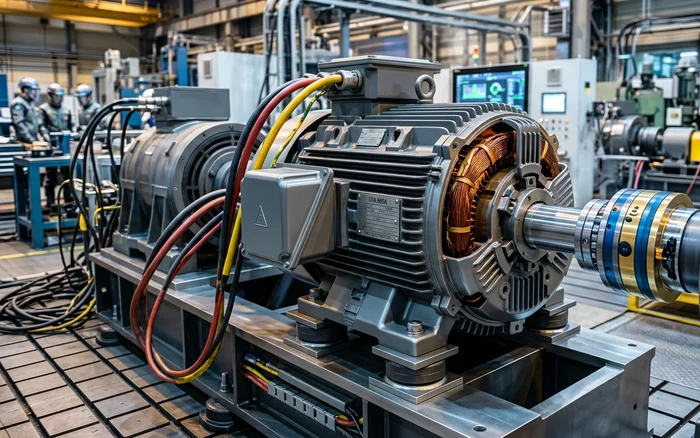
- 1.**Russia's 517 horsepower engine is bringing a breakthrough solution to the Aries transport industry.** Russia's largest manufacturer of rolling stock and railway equipment - Transmashholding Group (TMH) - has completed manufacturing the first 10 test models of the DTA-380A traction electric motor series with a capacity of 380 kW, equivalent to 517 horsepower.
- 2.This is a specialized engine line designed for Russia's first hydrogen-powered train, number 62-4584, this country's media reported on October 30.
- 3.The research and production of these electric machines is carried out by the factory "TMH-Electrotech" (a unit under the structure of "TMH-Energy Solutions").
Russia's 517 horsepower engine is bringing a breakthrough solution to the Aries transport industry.
Russia's largest manufacturer of rolling stock and railway equipment - Transmashholding Group (TMH) - has completed manufacturing the first 10 test models of the DTA-380A traction electric motor series with a capacity of 380 kW, equivalent to 517 horsepower.
This is a specialized engine line designed for Russia's first hydrogen-powered train, number 62-4584, this country's media reported on October 30.
The research and production of these electric machines is carried out by the factory "TMH-Electrotech" (a unit under the structure of "TMH-Energy Solutions").
The entire batch of tested engines has passed the initial technical inspection steps, officially achieved "O" level design certification and has been transferred to the quality certification testing stage.
Advanced transmission technology: Does not emit 1 gram of CO2
Technically, the DTA-380A is an asynchronous motor designed with a 4-pole structure with a squirrel cage rotor. The core task of this transmission is to convert the energy generated from the chemical reaction in hydrogen fuel cells into mechanical energy that pulls the train's wheel axles, through an inverter system that controls the frequency of the electric current.
The move to hydrogen traction technology on non-electrified railways promises to bring a huge turning point to the transport industry ecosystem.
The only by-product that arises during the operation of this engine system is pure water vapor. This completely eliminates carbon dioxide (CO2) emissions as well as toxins from fuel combustion - which are inherent bottlenecks of traditional diesel-powered trains.
Ready for complete assembly
To prepare for the mass production plan, the factory has implemented an intensive technological preparation process and completed a test production batch of 10 engine units.
Among them, 8 DTA-380A engines were transported directly to the Tver Rolling Stock Factory (TVZ) to complete the assembly of the first hydrogen-powered train in Russia. TVZ is one of Russia's oldest and largest railway vehicle manufacturing facilities, owned by Transmashholding group (TMH).
The successful testing and transfer of the DTA-380A traction electric motor to the Tver Wagon Manufacturing plant is not simply a technical step forward, but also marks a turning point in the comprehensive modernization and greening of the Russian transport industry.
The application of hydrogen technology on train line 62-4584 has demonstrated the high-tech autonomy of the domestic industry, creating a solid foundation for the goal of completely eliminating fossil fuels on non-electrified railway lines, which account for a large proportion of the railway network spread across the country.
The environmental implications of this breakthrough go beyond theoretical numbers. When replacing traditional diesel locomotives with hydrogen engines, emissions of greenhouse gases, dust and toxic compounds will be reduced to zero.
The only product released into the environment is pure steam, which helps protect ecosystems along transcontinental routes, especially in naturally sensitive areas such as Siberia or the Far East. This shift plays a pivotal role in the national strategy towards carbon neutrality and air pollution reduction.
At the same time, the success of the DTA-380A project opens up the prospect of commercializing and replicating the hydrogen vehicle model on a large scale.
This is the foundation for Russia to assert its leading position in the trend of developing new generation railway infrastructure, building a modern public transport system that operates smoothly, optimizes long-term fuel costs and is completely emission-free for long-distance journeys in the future.
Reference: FT

