Sail: the fabric that creates lift that carried people across oceans and opened up sea trade
Executive Briefing
Synthesized and verified with gemini-2.0-flash-thinking-exp
“Before the advent of steam engines, almost all long-distance sea shipments relied on a canvas stretc”
Key Takeaways
- 1.Before the advent of steam engines, almost all long-distance sea shipments relied on a canvas stretched on a wooden pole.
- 2.Sail allows people to use the power of wind, a free and never-ending energy, to carry people and goods over distances that oars cannot handle.
- 3.The history of sail is therefore closely linked to the history of trade and migration.
Before the advent of steam engines, almost all long-distance sea shipments relied on a canvas stretched on a wooden pole. Sail allows people to use the power of wind, a free and never-ending energy, to carry people and goods over distances that oars cannot handle. The history of sail is therefore closely linked to the history of trade and migration.
From the Nile to the Pacific Islands
According to Britannica, the earliest historical evidence of boats was found in Egypt during the 4th millennium BC. Wikipedia says Egyptian sails were drawn around 3200 BC, on reed boats traveling up the Nile River. Conditions here are very favorable: the river flows to the north, and the wind often blows from the north, so the boat floats to go downstream and sets sail to go back. Most early Nile boats had a square sail and a row of oarsmen. Excavations from the Ubaid period in Mesopotamia, about 6000 to 4300 BC, also show that sailboats may have appeared even earlier.
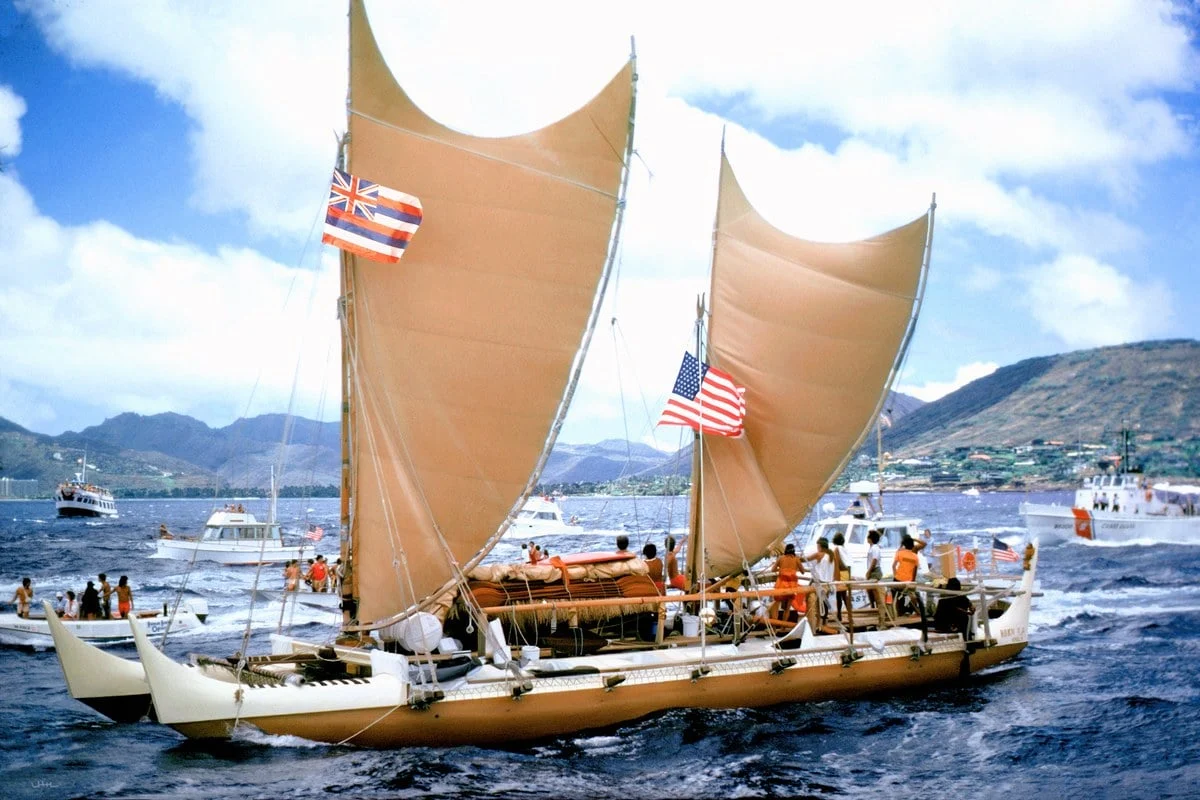
At the other end of Asia, the Austronesians, ancestors of many peoples of island Southeast Asia and the Pacific, developed their own set of technologies: catamarans, boats with balanced pontoons, and crab-shaped sails with two wooden slats supporting both the top and bottom edges. The sail is woven from pandan leaves and can withstand salt water. Thanks to these ships, they spread from Taiwan around 3000 BC, to Hawaii around 900 and New Zealand even later, covering a sea area spanning nearly half the globe, from Madagascar to Easter Island.
The catamaran Hōkūleʻa with two crab-shaped sails arrived in Honolulu from Tahiti in 1976. The trip to Tahiti was guided entirely by traditional techniques
In 1976, the traditionally built catamaran Hōkūleʻa sailed from Hawaii to Tahiti without the use of a compass or measuring instrument. Navigator Mau Piailug, from the island of Satawal in Micronesia, navigates without tools. The trip aimed to test the hypothesis that ancient Polynesians actively crossed the sea rather than drifting.
Sails act like airplane wings
The wind blowing from behind pushes the boat only when going downwind. In other directions, the curved sail faces act like an airplane wing: the passing wind creates a pressure difference between the two faces, generating lift. The keel or balance buoy prevents the boat from sliding sideways, so the remaining force pulls the boat.......... According to Wikipedia, when the wind blows across the body, the lifting force is stronger than the thrust force, and this is when the sailboat usually reaches its highest speed.
Diagram illustrating the sailing directions of a sailboat relative to the wind direction and how the curved sail surface creates lift like an airplane wing
Sailboats still cannot sail directly into the wind. For many boats, about 45 degrees on each side of the wind is the no-go zone, where the sails produce no lift. To reach a point on the windward side, the driver must go at an angle, then change sides in a zigzag pattern.
Monsoons, trade winds and maritime routes
Once they understood the wind, people began to schedule their trips according to the seasons. From the late 2nd century BC, Greek traders in Egypt took advantage of the monsoon to go straight from the Red Sea across the Indian Ocean to the Indian coast, instead of following the shore. In the Mediterranean, lateen triangular sails appeared around the 2nd century and were popular from the 5th century. According to Wikipedia, it does not sail better than square sails as many people think, but is cheaper to make and maintain.
From the mid-15th century, multi-masted sailing ships combining square and triangular sails took Europeans across the Atlantic, opening up what historians call the Age of Sail, which lasted until the mid-19th century. It was a period when sailing ships dominated both global trade and naval warfare, with maritime routes following trade winds that blew steadily all year round.
Advertisement
The clipper ship Cutty Sark (built 1869) sailed on the sea, one of the fastest tea ships of the late sailing period. Photo by George Schutze, State Library of Victoria (Australia)
The last clippers
The pinnacle of speed was the clipper ships of the mid-19th century. The Cutty Sark, built in 1869 at Dumbarton, Scotland, was one of the last and fastest tea ships. But in the same year, the Suez Canal was inaugurated, opening for steamships a shorter route of about 6,100 km from the Far East to Europe that was difficult for sailing ships to travel. Cutty Sark switched to carrying wool from Australia, with a trip in 1883 that took only 83 days from Newcastle to London, but eventually lost to steamships and was sold in 1895. Today it lies in dry dock in Greenwich, London.
Recently, the shipping industry has returned to interest in designs that utilize wind power to reduce fuel consumption, an idea that took humanity forward more than five thousand years ago.
Source:
Britannica: History of ships
,
Wikipedia: Sail
,
Wikipedia: Sailing ship
,
Wikipedia: Point of sail
,
Wikipedia: Hōkūleʻa
,
Wikipedia: Indian Ocean trade
,
Wikipedia: Cutty Sark