Science and technology leaders come to Vietnam to discuss AI development
Executive Briefing
Synthesized and verified with gemini-2.0-flash-thinking-exp
“# Lãnh đạo khoa học công nghệ đến Việt Nam bàn về phát triển AI Representatives of the US, China, J”
Key Takeaways
- 1.# Lãnh đạo khoa học công nghệ đến Việt Nam bàn về phát triển AI Representatives of the US, China, Japan, Korea, and many other countries and regions came to Vietnam to discuss the development of artificial intelligence (AI).
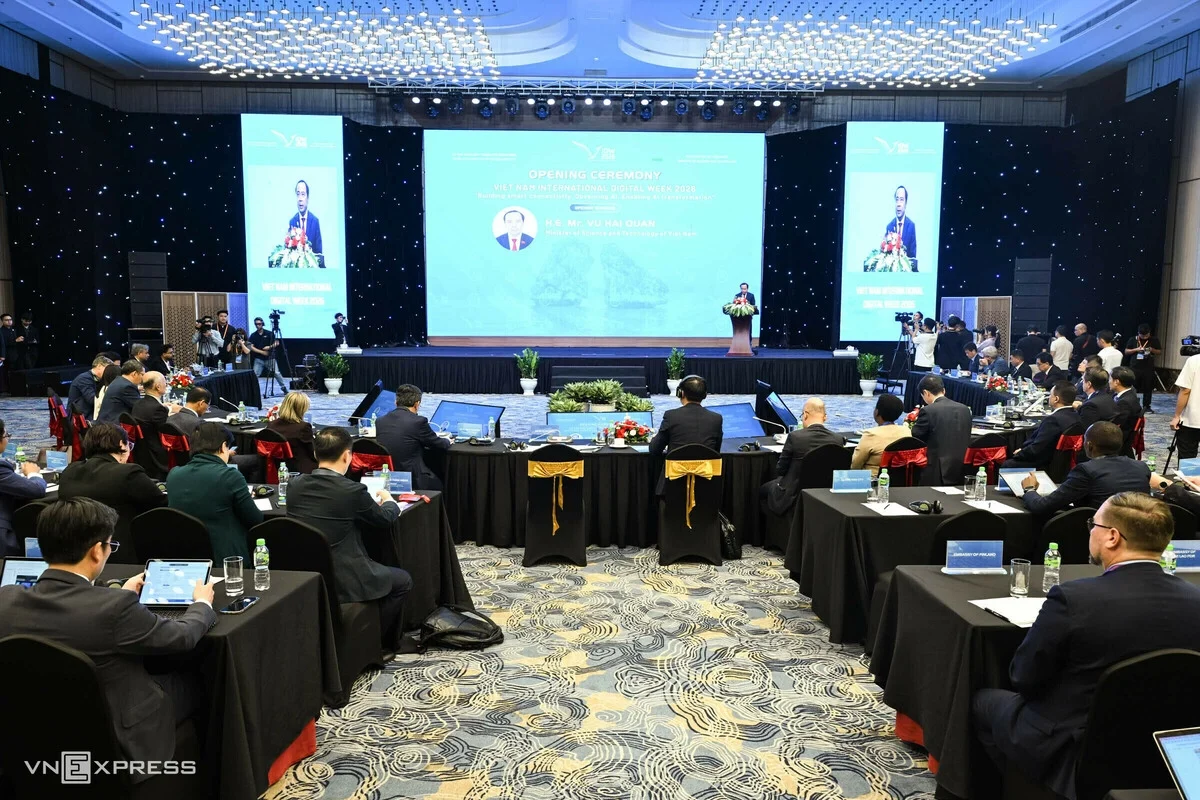
- 2.The round table "The Government's leadership role in AI transformation" took place within the framework of Vietnam International Digital Week 2026, held on October 28 in Quang Ninh.
- 3.The conference had the participation of government representatives and international organizations, focusing on exchanging policies, infrastructure, governance and international cooperation to promote the application of artificial intelligence.
Representatives of the US, China, Japan, Korea, and many other countries and regions came to Vietnam to discuss the development of artificial intelligence (AI).
The round table "The Government's leadership role in AI transformation" took place within the framework of Vietnam International Digital Week 2026, held on October 28 in Quang Ninh. The conference had the participation of government representatives and international organizations, focusing on exchanging policies, infrastructure, governance and international cooperation to promote the application of artificial intelligence. The discussion session was chaired by Vietnam's Minister of Science and Technology Vu Hai Quan.
China: AI development must go hand in hand with safety
Speaking at the session, Chinese Ambassador to Vietnam He Wei said that the scale of China's core AI industry has exceeded 1,200 billion yuan, while the country's large open source language models recorded more than 10 billion downloads globally.
Commenting that AI is creating a leap in productivity but also posing challenges in social operations and core values, he believes that countries need to coordinate to both unleash technological benefits and maintain safety red lines. China's perspective is to persevere in developing human-centered AI, ensuring that technology both makes rapid breakthroughs and operates sustainably. To promote benefit sharing, Mr. Ha Wei said that in the next 5 years, China will provide 5,000 AI training opportunities for developing countries, and support the construction of international AI computing centers for ASEAN, the African Union and the BRICS group.
Previously in June, China proposed to establish the World AI Cooperation Organization (WAICO) with nearly 40 founding countries, including Vietnam. The Ambassador affirmed that China is ready to cooperate with Vietnam to improve technological capacity and join hands to lead global AI governance in a fair, inclusive and mutually beneficial direction.
USA: Should develop safe 'super intelligence' but not limit innovation
"Super intelligence" (SI) is the name given by US President Donald Trump, instead of artificial intelligence. US Ambassador to Vietnam Jennifer Wicks said that Vietnam needs to have clear, transparent and predictable regulations to attract investment, support businesses to innovate and improve competitiveness in the digital economy. She recommended that Vietnam continue to coordinate closely with the private sector when developing regulations on digital technology, ensuring that necessary safety measures do not unintentionally limit innovation, competition and cross-border cooperation.
At the discussion session, Ms. Wicks emphasized that SI transformation and advanced computing systems need to be accompanied by stable, reliable energy infrastructure. As data centers and computing capacity increase electricity demand, energy supply will become critical to sustaining digital growth and attracting long-term investment.
The US Ambassador also noted that decisions on digital infrastructure in the next one to three years, from 5G, undersea fiber optic cables to data center equipment, could shape the national digital platform for decades. She mentioned the potential of low-orbit satellites such as Starlink and Amazon Leo to supplement the ground network, bringing high-speed Internet to remote areas.
The US affirmed its readiness to cooperate with Vietnam on advanced technology, semiconductors, cloud computing, telecommunications and SI training, towards an open, safe and innovative digital economy.
Korea supports businesses in developing AI with GPUs, data and human resources
Mr. DJ Kim, representative of the Korean National Information Technology Industry Promotion Agency (NIPA), shared five solutions applied by this country. Since 2019, South Korea has provided access to public computing capacity to more than 5,200 organizations, including small and medium-sized enterprises, startups, public agencies and universities. The government buys or leases GPUs, domestic cloud providers operate them, and users access the resources largely for free.
Another program uses vouchers to connect a needy party with a solution provider. The number of businesses providing AI in Korea increased from 150 in 2019 to more than 2,800 in 2025. The country also built a data warehouse for AI training, deployed an autonomous platform AI model development program and expanded human resource training from university to postgraduate, businesses and regional centers.
According to Mr. Kim, Korea's experience is that it is necessary to simultaneously invest in public computing capacity, provide first-class customer support for AI solutions, and train human resources at many levels. NIPA is ready to become a cooperative partner with interested parties.
Burundi calls for cooperation to expand digital infrastructure and human resource training
Ms. Francine Inarukundo, representative of Burundi, said digital transformation is one of the pillars of national development, aiming to become an emerging country by 2040 and a developed country by 2060.
According to estimates by the International Telecommunications Union (ITU) in 2024 cited by her, the Internet usage rate in Burundi has not reached 10% of the population, while 3G and 4G coverage still has many gaps. The country calls on partners to support the expansion of fiber optic networks, mobile broadband, secure data infrastructure and new generation telecommunications technology, including 5G when technically and economically appropriate. She cited the example of Viettel operating in Burundi under the Lumitel brand, contributing to the development of the local telecommunications ecosystem. Burundi also encourages cooperation in technical training, technology transfer, research and connections between universities, public agencies and businesses.
In addition to infrastructure, the country is promoting digital payments through the BurundiPay system, launched in April 2026, to support instant money transfers and electronic payments. The representative of Burundi emphasized that digital transformation requires coordination between the government, businesses and international partners so that technology creates more opportunities instead of increasing the access gap.
Australia puts public trust underpinning AI in Government
Speaking at Vietnam International Digital Week 2026, Ms. Lucy Poole, Strategy Director of the Australian Digital Transformation Agency (DTA), emphasized that the success of AI in the public sector is not measured by the amount of technology deployed, but by the level of people's trust and actual service effectiveness.
Citing the result of ranking second globally in the OECD's 2025 Digital Government Index, she said Australia is shifting from behind-the-scenes AI to direct contact services, typically using AI to speed up application processing for veterans but still keeping humans at the center of decisions.
The country's AI strategy focuses on three pillars: trust (publicly transparent how to use AI to ensure accountability), people (mandatory AI training for civil servants), and tools (standardize procurement, establish control barriers when AI proactively acts). DTA representatives recommended that countries promote the "triple helix" model between government, businesses and researchers to perfect technology governance.
Cambodia promotes digital transformation with infrastructure, AI and human resources
Mr. Chun Vat, Secretary of State at the Ministry of Posts and Telecommunications of Cambodia, said the country is transitioning from a traditional economy to a digital nation, in which technology is identified as the driving force for growth and enhancing competitiveness. Cambodia currently has 4G coverage over 96% of the population, and will deploy 5G from early 2026 to support smart urban development, logistics, precision agriculture and high-tech manufacturing.
According to him, in addition to infrastructure, Cambodia focuses on responsible, human-centered governance and application of AI. The National AI Strategy for the period 2025-2030 aims to develop solutions to serve domestic needs, such as smart document processing tools in Khmer and a public identity verification system using AI.
Cambodia also aims to train and improve the skills of more than 100,000 digital experts in the next decade, while promoting the technology startup ecosystem. According to the representative of Cambodia, digital transformation can only develop sustainably when combining modern infrastructure, clear AI management, skilled human resources and businesses that create solutions suitable to actual needs.
Japan: Building a safe and trustworthy AI ecosystem
Mr. Hideshikazu Koizumi, Director of International Cooperation at the Japanese Ministry of Internal Affairs and Communications, emphasized three cross-cutting requirements in AI development: safety, security and reliability. According to him, Japan is implementing domestic AI policy in parallel with promoting international cooperation, to encourage innovation while still minimizing risks.
One of the directions is to promote global AI governance through the Hiroshima AI Process, an initiative launched at the 2023 G7 Summit to develop international principles and codes of conduct for advanced AI systems. Japan also promotes the FOIP Digital Corridor Initiative, aiming to develop reliable communications infrastructure, from mobile networks and data centers to undersea fiber optic cables and satellite information networks.
According to Mr. Koizumi, no country can alone solve the challenges of AI. Expanding dialogue, sharing governance principles and developing an international community of experts will help countries jointly build a safe AI ecosystem, while creating conditions for people in many countries to access technology benefits.
Myanmar prioritizes expanding 5G, data centers and public digital infrastructure
Myanmar Deputy Minister of Digital Development and Communications Min Zeyar Hlaing said the country is aiming to connect data, computing infrastructure, public services and businesses on a secure, seamless platform. Priorities also include a national electronic identity code, interconnected digital payments and a centralized data exchange platform.
Regarding AI governance, Myanmar is finalizing the draft Law on Digital Development, at the same time strengthening the specialized apparatus, establishing the Department of AI Technology and the Department of Digital Development. At the regional level, the country supports ASEAN cooperation on AI governance, secure cross-border data flows and mutual recognition of digital services.
Mr. Min Zeyar Hlaing emphasized that digital transformation needs to be evaluated by real improvements in life, from public services, labor productivity to education and economic opportunities. Myanmar is ready to cooperate with ASEAN and international partners to build an inclusive, secure and responsible digital future.
EU wants to build a reliable semiconductor and AI supply chain with Vietnam
Speaking online from Brussels at Vietnam International Digital Week 2026, Ms. Renate Nikolay, Deputy Director General of DG CONNECT of the European Commission, commented that countries that master AI will firmly strengthen their competitiveness and strategic autonomy.
Referring to the legal framework, Ms. Nikolay said that the EU's Artificial Intelligence Act officially took effect this year. The Act applies a risk-based approach, similar to Vietnam's direction, to ensure that AI systems circulating on the market are safe, transparent and respect basic human rights. Along with that, the EU is promoting the Continental AI Action Plan and the goal of covering high-capacity connectivity networks across the bloc before 2030.
Appreciating Vietnam's speed of digital transformation, the European Commission representative said European businesses are ready to accompany Vietnam's strategic autonomy goal. Regarding the direction of cooperation, Ms. Renate Nikolay proposed that the two sides promote sharing of AI management experiences, controlled testing mechanisms (sandbox), digital skills training and together build a reliable technology supply chain, especially in the semiconductor field.
Laos calls on Vietnamese businesses to invest in AI and green data centers
Mr. Keovisouk Solaphom, Deputy Minister of Technology and Communications of Laos, said that the country has determined digital transformation to be a national priority to promote inclusive socio-economic development. The Lao government is deploying AI across three pillars: digital government, digital economy and digital society. Small and medium-sized enterprises are encouraged to apply technology to improve operational capacity.
Regarding infrastructure, Laos aims to provide 4G coverage to all 670 villages without Internet by 2030, of which it is expected to expand connection to 140 villages in the period 2026-2027. To promote regional cooperation, Mr. Keovisouk proposed three priorities: strengthening digital skills and training AI human resources according to international standards; expand public-private cooperation; Coordinate the development of legal frameworks, safety standards and AI ethics. He also called on Vietnamese and international technology businesses to participate in AI development and invest in data centers using clean energy in Laos, on the basis of respecting each country's sovereignty in the field of AI and cyberspace.
Vietnam targets AI to contribute 6% of GDP by 2030
Speaking at Vietnam International Digital Week 2026, Mr. Nguyen Khac Lich, Director of the Department of Digital Technology and Artificial Intelligence, Ministry of Science and Technology, said that Vietnam's number one priority is to bring AI into daily life to improve business productivity and optimize the public bureaucracy. By 2030, Vietnam strives to be in the top 3 of ASEAN in AI research and development, and this field will directly contribute 6% to GDP.
To realize the above goal, heads of ministries and localities must be directly responsible for implementation effectiveness, with progress specifically measured on the actual operating system. As of October 26, more than 700,000 AI assistant accounts have been allocated to civil servants, recording 95% positive feedback.
Regarding infrastructure and autonomous technology, Vietnam is preparing a power source of up to 500 megawatts to serve AI computing centers, in parallel with standardizing open data and developing Vietnamese language models that deeply understand the local cultural context. Regarding human resources, the national plan aims to train specialized teams, application engineers and popularize basic AI application skills for 10 million workers.
Regarding governance issues, Mr. Nguyen Khac Lich emphasized an approach based on risk control: AI systems with high risks affecting people's rights are required to have algorithm transparency, clearly define human accountability and have a clear review process to build social trust.
Minister Vu Hai Quan proposed three directions for AI cooperation after the conference
Speaking at the closing of the Digital and Artificial Intelligence Ministerial Roundtable on October 28 in Quang Ninh, Minister of Science and Technology Vu Hai Quan emphasized three priorities: developing smart connectivity, building AI governance to create trust, and promoting human-centered AI transformation.
According to the Minister, the connection network, data and computing capacity are the foundation of AI, which needs to be widely invested so that no one is left behind, and at the same time strong enough to promote innovation. He also believes that mechanisms such as controlled testing, standards, accreditation and interoperability frameworks between countries will help bring AI to life more safely.
The Minister proposed maintaining regular policy exchanges between management agencies, strengthening links between the government, businesses, researchers, universities and international organizations, especially in human resource training and joint research. Collaborative projects need to stem from real needs and be able to deploy and expand in scale.
The Ministry of Science and Technology will synthesize opinions and proposals at the conference and work with each partner to transform into specific cooperative activities, in the spirit of equality, trust, substance and mutual benefit.
Liu Quy

