SpaceX will recover all Starship rockets using pick-up chopsticks
Executive Briefing
Synthesized and verified with gemini-2.0-flash-thinking-exp
“# SpaceX will recover all Starship rockets with pick-up chopsticks AmericaSpaceX will use the mecha”
Key Takeaways
- 1.# SpaceX will recover all Starship rockets with pick-up chopsticks AmericaSpaceX will use the mechanical arm of the launch tower to capture the entire Starship rocket during test flight 15, scheduled to take place in November.
- 2.According to *Space*, the information was announced by Elon Musk, founder and CEO of SpaceX, during the third quarter revenue report meeting on October 20.
- 3.If SpaceX is successful, this will be the first time an orbital launch vehicle has been completely recovered.
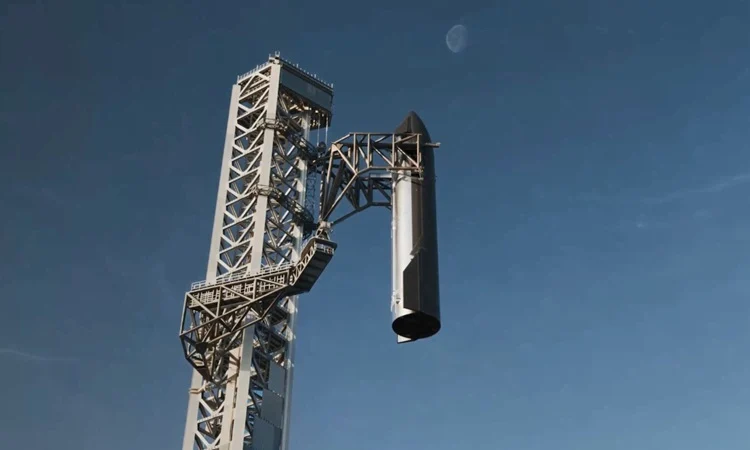
AmericaSpaceX will use the mechanical arm of the launch tower to capture the entire Starship rocket during test flight 15, scheduled to take place in November.
According to Space, the information was announced by Elon Musk, founder and CEO of SpaceX, during the third quarter revenue report meeting on October 20. If SpaceX is successful, this will be the first time an orbital launch vehicle has been completely recovered.
The Starship rocket is a two-stage system, including the Super Heavy booster stage and the Starship spacecraft (often referred to as Ship) above, equipped with a Raptor engine using a fuel mixture of liquid methane and liquid oxygen. First launched in 2018, this is the largest and most powerful rocket ever built, with a diameter of 9 m, a height of more than 122 m in its complete configuration and providing a thrust of about 7,500-8,200 tons depending on the Raptor engine version.
According to The Verge, both the Super Heavy booster stage and the rocket's Ship are designed for complete and rapid reuse. This breakthrough makes settlement on Mars economically viable.
Starship's recovery strategy differs from SpaceX's partially reusable Falcon 9 and Falcon Heavy rockets, which have a non-recoverable upper stage. The booster stages of these two rockets often return to Earth on landing pads near the launch area or ships offshore. However, Super Heavy and Ship will return to the launch tower on their own so that the mechanical arm nicknamed "chopsticks" can capture the vehicle in mid-air. The above approach allows SpaceX to test, refurbish and return Starship to flight faster, aiming for more than 10,000 launches per year by 2030.
To date, Starship has performed 14 test flights and SpaceX has successfully recovered the Super Heavy booster stage with a pick-up chopstick in three flights. However, the company has not repossessed Ship in the same way as this is much more difficult.
Tech Insider reports that after completing its mission, the Ship must pass through reentry, in which friction with the air creates extremely high temperatures on the vehicle's heat shield. Next, it must enter a horizontal landing phase before flipping over in the final seconds and landing on the launch tower. Each of these stages has destroyed prototypes in previous test flights.
The successful recovery of the thrust stage did not provide much information for the engineering team to apply to the Ship, because the two vehicles faced different physical conditions on the return journey. The thruster separated early in flight, did not leave the atmosphere for too long, and returned in a short orbit. Meanwhile, the Ship completes a full orbit or nearly the entire orbit, reentering the atmosphere at a much higher speed, subject to extreme temperature and aerodynamic pressure.
The booster stage and the Ship do not return to the launch tower at the same time, so the mechanical arm must capture the first stage safely, then prepare to retrieve the Ship. Failure at any stage risks destroying the launch tower and delaying subsequent flights.
Musk is confident that SpaceX can capture the Ship the first time even though it did not reveal the specific launch date of test flight 15. If the upcoming test is successful, Starship flights will continuously complete major milestones. During test flight 14 on September 28, the Ship flew into Earth orbit for the first time and deployed 26 SpaceX Starlink V3 satellites, paving the way for a new generation broadband super constellation expected to include about 100,000 ships.
SpaceX recorded revenue of $14.6 billion in the third quarter, up 161% compared to $5.6 billion in the same period last year. Only $1.8 billion in third-quarter revenue came from SpaceX's launch division, the rest came from two other segments: Internet connectivity via Starlink and artificial intelligence. SpaceX believes that these two segments will continue to boom. That's why the company is building the infrastructure to support thousands of Starship launches each year to put more Starlink satellites and AI data centers into Earth orbit.
An Khang summary

