Strange confrontation at the Chinese box office: AI movie costing more than 36 billion VND lost miserably to the worst criticized cartoon in history
Executive Briefing
Synthesized and verified with gemini-2.0-flash-thinking-exp
“**Investing 10 million yuan (about 36 billion VND), nearly 100 people worked for two years, "San Tin”
Key Takeaways
- 1.**Investing 10 million yuan (about 36 billion VND), nearly 100 people worked for two years, "San Tinh Dui: The Future" was introduced as China's first movie made with AI to be licensed for theatrical release.
- 2.After 4 days of release, the film earned less than 1/8 of its capital.** On Friday, October 23, 2026, *Sanxingdui: Future Past* (Sanxingdui: Future Past) by Uncle Na (Bona Film Group) premiered across China with more than 11,000 shows on the first day.
- 3.According to The Paper, as of the evening of October 26, after 4 days, the film had earned 1,229 million yuan (about 4.5 billion VND).
Investing 10 million yuan (about 36 billion VND), nearly 100 people worked for two years, "San Tinh Dui: The Future" was introduced as China's first movie made with AI to be licensed for theatrical release. After 4 days of release, the film earned less than 1/8 of its capital.
On Friday, October 23, 2026, Sanxingdui: Future Past (Sanxingdui: Future Past) by Uncle Na (Bona Film Group) premiered across China with more than 11,000 shows on the first day. According to The Paper, as of the evening of October 26, after 4 days, the film had earned 1,229 million yuan (about 4.5 billion VND). The show schedule has been reduced to 8,331 shows, accounting for 2.3% of the total number of shows. The theater occupancy rate is only 0.2%, with an average of 0.3 spectators per show. In other words, for every three screenings, only one person sits to watch.
Box office data platform Dang Thap predicts the film's final total revenue to be about 2,169 million yuan (about 7.9 billion VND). According to The Paper's estimates, after sharing with the theater, the producer only received about 800,000 yuan (about 2.9 billion VND). This amount is less than 1/10 of the cost of making a film.
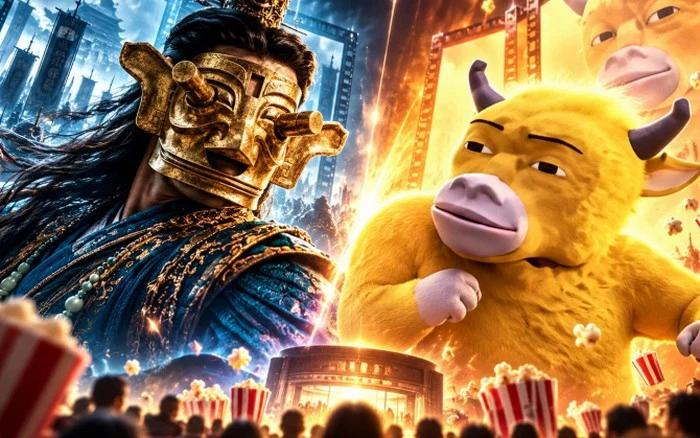
That same week, someone online mentioned the name of another movie: Nu Lai, an animated film made by a mother and son in Dalian for about 5 years. The film was once criticized as "the ugliest in history", but it earned more than 64 million yuan (about 235 billion VND), or about 50 times more than Tam Tinh Doi.
AI movies are cheaper than real movies, but the losses are no less
Technically, Tam Tinh Doi is not a make-believe project. According to Gioi Dien, the 100-minute film was made by Uncle Nap's AIGMS production center, using Sinh So company's Vidu model as the main technology partner. The film crew still shares roles like a traditional film crew, from screenwriter, director, art director to cinematography, lighting and editing.
They have created more than 1.2 million original photos. AI takes care of the images, actors and voices. Humans keep the script, lens language and historical verification. The film's setting stretches from the ancient kingdom of Shu, ancient Egypt to the years 2045 and 2095.
Producer Khuc Tieu Giang told the press that if a real movie of the same scale was filmed, the cost could reach 800 to 900 million yuan (about 2,900 to 3,300 billion VND). Thus, AI has helped reduce costs nearly a hundred times. This efficiency problem is the promise that the entire Chinese entertainment industry is betting on AI.
But the box office shows that calculation is missing a variable. AI can reduce production costs, but cannot reduce costs for audiences to pay for tickets. The day before the premiere, the total pre-sale ticket revenue on the platforms was only about 144,000 yuan (about 525 million VND). On Mieu Nhan, the number of people who clicked "want to see" was less than 6,000.
According to AFP, Iris Yang, an audience member who saw the free test screening, said frankly that with such quality she would not spend money to buy tickets. She is only willing to pay when AI creates an Avatar-level theatrical experience. Independent AI film director Truong Quan also commented that audiences will not automatically buy tickets just because a movie is made with AI.
The audience has reason to think so. According to AFP, in September 2026 alone, short films made with AI on Douyin reached more than 200 billion views. When viewers are provided with free and unlimited majestic images created by AI right on their phones, the word "AI" is no longer something that makes them curious enough to go to the theater, spend 20 to 90 yuan (about 73,000 to 330,000 VND) and sit still for 100 minutes. Those who have seen it praised the scene of the bronze magic tree, the bulging-eyed mask and the ancient Shu capital, but criticized the character who had just gone through an avalanche but his clothes and hair remained the same, his speech did not match his dialogue, and his emotions suddenly changed. An audience member told Khoa Bright Japan Daily that the movie "still smells of AI, the plot is quite incoherent".
The stock market bets first, the box office answers later
The most notable detail is probably not in the theater but on the stock exchange. On September 28, when Uncle Na announced that the film was licensed and set the premiere date, the company's stock price increased to 6.36 yuan. On October 9, the stock increased to the ceiling to 6.97 yuan, then continued to increase to the ceiling on October 12. The company twice had to issue notices reminding investors that box office revenue was still uncertain and advising them to "look at the topic of AI movies rationally".
After that, poor advance ticket sales data caused the stock to drop 9.92% in just the October 22 session. On October 26, after 4 days of the movie's release, the stock fell to the floor, losing 10.06% to 5.54 yuan. Uncle Nap's capitalization at that time was about 7.6 billion yuan (about 27,800 billion VND).
The difference between expectations and reality is also clearly seen in the financial statements. In the first half of 2026, Bo Nap had revenue of 458 million yuan, down 31.9% over the same period, and a loss of 169 million yuan. The AI film and television series only brought in 1.93 million yuan (about 7 billion VND), accounting for 0.42% of total revenue, although gross profit margin was up to 96.83%. Investors have valued the company's AI story much larger than the money this segment actually brings in.
Uncle Nap is not the only company placing bets. ByteDance has the brand Tuc Mong Phien Truong targeting long-form films, iQiyi runs the Lieu Nguyen program to incubate AI films, and Quang Tuyen Truyen Thuong develops its own AI tools for pre-production. Uncle Nap still has three AI film projects in the works. CEO Tuong Duc Phu still maintains the spirit of a pioneer: "We are the first to try, the first to be licensed for theatrical release, and also the first to be tested by the audience."
What audiences spend money on is human fingerprints
The Ox hits theaters on August 5, 2026 and also had a disastrous start. According to data compiled by Dang Tan, from August 5 to August 14, the film only earned about 11,300 yuan (about 41 million VND) with 417 audiences, and some days only sold a few tickets. The film is about a shy calf who dreams of growing up with his family. The 3D graphics were rudimentary, the characters were criticized as "ugly" and "scary", the film had no official poster, and according to some international newspapers, the budget was only about 200 USD (about 5 million VND).
The turning point came from the criticism itself. According to AP, mocking comments on Douban spread quickly, young people invited friends to watch it to "prank", and the movie's name even became a meme in the stock market because "Nuu Lai" can be understood as "coming bull", which means hoping the market will increase in price. On August 15, the film grossed 716,000 yuan, and just two days later it reached a peak of 8.2 million yuan (about 30 billion VND) in one day. By mid-September, total revenue exceeded 63 million yuan, with more than 2.2 million viewers. The film's release date has been extended until October 4.
In addition to the meme factor, Nu Lai is also appreciated by the audience for another reason. As AI increasingly floods social networks, the film's clumsiness becomes evidence that it was made by real people. On Letterboxd, someone called the film "a pioneer of the anti-AI movement". Teacher Chung Gia Minh in Guangzhou told AP that this is "a film for those who still retain a childlike soul", as simple as a bedtime story, in the midst of glossy but unattractive films.
Putting the two films side by side is to see a paradox of the content economy right now. One side has hundreds of people, two years and tens of billions of dong, the technical results are not bad but no one needs to go to the theater to see it. On the one hand, there is a mother and daughter and five years of filming, the technique is much worse, but everyone knows that there is a real person behind the scenes who put in the effort. When beautiful images can be produced en masse, perfection is no longer scarce. What is scarce is the story of the people behind the work.
Of course, one should not rush to conclude that AI movies have failed. Tai Lai also went through a period of obscurity, and its success was largely due to luck with memes. Uncle Nap himself has also proven that he can make a long film using AI, going through the entire process from production, censorship to theatrical release. But the first 4 days of release showed the industry that AI can replace humans in many stages of production, but cannot replace the answer to the question of why audiences should spend money to watch movies.
Perhaps producer Khuc Tieu Giang was right before the movie came out: "Tasks can be assigned to AI, but judgment and responsibility cannot be outsourced."