The Earth's core is leaking
Executive Briefing
Synthesized and verified with gemini-2.0-flash-thinking-exp
“# The Earth's core is leaking Chinese scientists discovered that material from the Earth's core is”
Key Takeaways
- 1.# The Earth's core is leaking Chinese scientists discovered that material from the Earth's core is still spraying onto the surface in a process that has lasted billions of years.
- 2.*NDTV* reported that a research team at the University of Science and Technology of China found evidence that the Earth's core may still be releasing hydrogen, helium and tungsten into the upper layers.
- 3.The research breaks the long-standing notion that the planet's deepest regions have been almost completely isolated since its formation.
Chinese scientists discovered that material from the Earth's core is still spraying onto the surface in a process that has lasted billions of years.
NDTV reported that a research team at the University of Science and Technology of China found evidence that the Earth's core may still be releasing hydrogen, helium and tungsten into the upper layers. The research breaks the long-standing notion that the planet's deepest regions have been almost completely isolated since its formation. In a paper published October 9 in the journal Science Advances, they concluded that Earth's core and mantle have exchanged material throughout the planet's 4.5 billion-year history.
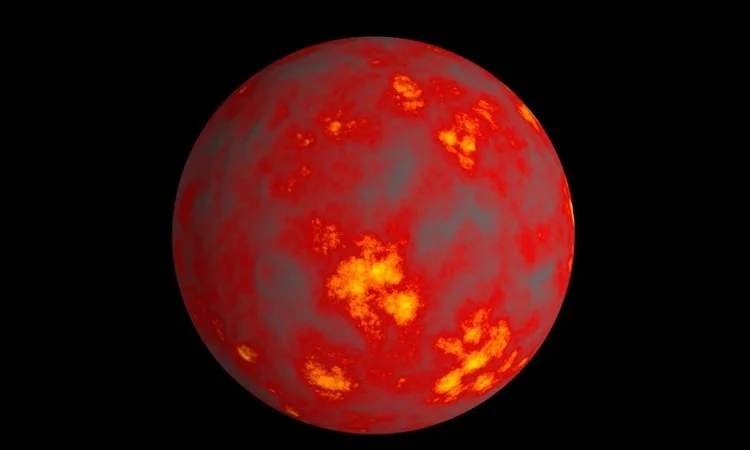
When it first formed, the Earth was extremely hot, containing mainly lava. As the planet cools, heavier material sinks to form the core while lighter material forms the mantle and crust. Some elements from Earth's infancy are trapped deep inside the planet.
In new research, geoscientist Yu Zhang and colleagues found that ancient materials may still be moving toward the ground. To understand the process, they used computer simulations aided by machine learning to study how hydrogen behaves in extreme conditions inside the Earth. The team examined hydrogen isotopes, specifically the ratio between hydrogen and the heavier form deuterium, to see how the element moves between the core and the mantle.
"Overall, the analysis results show that as the magma ocean cooled and solidified, it formed a primordial mantle with a uniform hydrogen isotopic composition, regardless of large changes in pressure, temperature or model assumptions," Science Alert quoted the research team.
According to Yu and his colleagues, the isotope distribution deep inside the Earth does not remain the same from the planet's early stages but can change due to the exchange of material between the core and the mantle.
Volcanic rocks also provide important clues. Basalt in oceanic islands such as Iceland and Baffin Island in Canada occurs when hot material emerges from the ground, containing unusual chemical and isotopic signatures. Some volcanic rocks have an unusually low ratio of deuterium to hydrogen, suggesting they may preserve early sources of hydrogen released from the Earth's core.
Another clue comes from helium. Helium-3 is a primordial isotope that has existed since the formation of the solar system, while helium-4 is continuously produced through radioactive decay. The unusual ratio of two helium isotopes in volcanic rocks indicates ancient helium spewed into the mantle from deep within the Earth.
Tungsten also strengthens the evidence for material exchange. In the early Earth, most of this heavy metal was concentrated in the core. Traces of tungsten isotopes in volcanic rocks help scientists trace the journey of material moving from the core toward the planet's surface.
Instead of separating, Earth's core and mantle may have continued to exchange chemical elements over billions of years. The next step, the team said, is to determine the amount of material escaping from the core and the impact of the process on the long-term evolution of the Earth.
An Khang summary